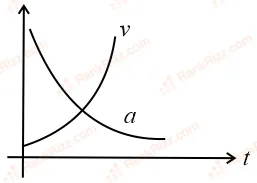
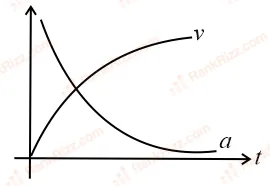
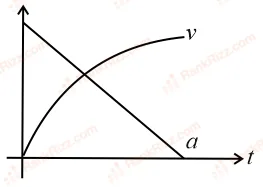
The velocity of a small ball of mass and density , when dropped in a container filled with glycerine, becomes constant after some time. If the density of glycerine is , then the viscous force acting on the ball will be
- A
- B
- C
- D
Every JEE Main question on Stokes' law and terminal velocity, one of the ideas inside Mechanical Properties of Fluids: 34 questions from 2004–2026, 24 of them in the last five years. Newest first, answer key on every one. Free to read.
Questions
34
Years asked
14
Since
2004
Of the chapter
18%
21–34 OF 34 · NEWEST FIRST
The velocity of a small ball of mass and density , when dropped in a container filled with glycerine, becomes constant after some time. If the density of glycerine is , then the viscous force acting on the ball will be
A small spherical ball of radius 0.1 mm and density kg m falls freely under gravity through a distance before entering a tank of water. If, after entering the water the velocity of ball does not change and it continue to fall with same constant velocity inside water, then the value of will be ______ m. (Given m s, viscosity of water N-s m).
The velocity of a small ball of mass 0.3 g and density 8 g cc when dropped in a container filled with glycerine becomes constant after some time. If the density of glycerine is 1.3 g cc, then the value of viscous force acting on the ball will be N, the value of x is _____ [use m s]
The diameter of an air bubble which was initially 2 mm, rises steadily through a solution of density 1750 kg/m at the rate of 0.35 cm/s. Coefficient of viscosity of the solution is _____ Poise. (Assume mass of the bubble to be negligible) (Answer in Poise to the nearest integer)
In Millikan's oil drop experiment, what is viscous force acting on an uncharged drop of radius m and density kg m? Take viscosity of liquid = N s m. (Neglect buoyancy due to air).
N
N
N
N
A raindrop with radius R = 0.2 mm falls from a cloud at a height h = 2000 m above the ground. Assume that the drop is spherical throughout its fall and the force of buoyancy may be neglected, then the terminal speed attained by the raindrop is: [Density of water kg m and Density of air kg m, g = 10 m/s, Coefficient of viscosity of air = N s m]
250.6 m s
43.56 m s
4.94 m s
14.4 m s
In an experiment to verify Stokes law, a small spherical ball of radius and density falls under gravity through a distance in air before entering a tank of water. If the terminal velocity of the ball inside water is same as its velocity just before entering the water surface, then the value of is proportional to: (ignore viscosity of air)
A solid sphere, of radius R acquires a terminal velocity when falling (due to gravity) through a viscous fluid having a coefficient of viscosity . The sphere is broken into 27 identical solid spheres. If each of these spheres acquires a terminal velocity, , when falling through the same fluid, the ratio equals:
27
9
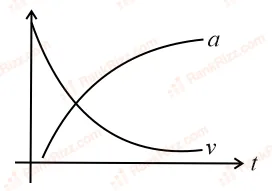
Which of the following option correctly describes the variation of the speed v and acceleration 'a' of a point mass falling vertically in a viscous medium that applies a force , where 'k' is a constant, on the body? (Graphs are schematic and not drawn to scale)


In an experiment, a small steel ball falls through a liquid at a constant speed of 10 cm/s. If the steel ball is pulled upward with a force equal to twice its effective weight, how fast will it move upward?
5 cm/s
Zero
10 cm/s
20 cm/s
The terminal velocity of a small sphere of radius in a viscous liquid is proportional to
A spherical solid ball of volume is made of a material of density . It is falling through a liquid of density . Assume that the liquid applies a viscous force on the ball that is proportional to the square of its speed v, i.e., . The terminal speed of the ball is
If the terminal speed of a sphere of gold (density ) is in a viscous liquid (density ) of the same size in the same liquid.
0.2 m/s
0.4 m/s
0.133 m/s
0.1 m/s
Spherical balls of radius are falling in a viscous fluid of viscosity with a velocity . The retarding viscous force acting on the spherical ball is
directly proportional to but inversely proportional to .
directly proportional to both radius and velocity .
inversely proportional to both radius and velocity .
inversely proportional to but directly proportional to velocity .
RELATED MECHANICAL PROPERTIES OF FLUIDS TOPICS