Newton's laws, free-body diagrams and equilibrium of a particle — JEE Main Previous Year Questions
Every JEE Main question on Newton's laws, free-body diagrams and equilibrium of a particle, one of the ideas inside Laws of Motion & Friction: 53 questions from 2007–2026, 33 of them in the last five years. Newest first, answer key on every one. Free to read.
JEE MAIN 2023 · 30 JAN S2Newton's laws, free-body diagrams and equilibrium of a particleTRANSCRIBED
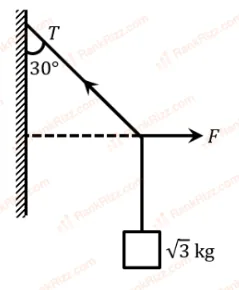
A block of 3 kg is attached to a string whose other end is attached to the wall. An unknown force F is applied so that the string makes an angle of 30° with the wall. The tension T is: (Given g=10 m s−2)
JEE MAIN 2023 · 11 APR S2Newton's laws, free-body diagrams and equilibrium of a particleTRANSCRIBED
A body of mass 500 g moves along x-axis such that it's velocity varies with displacement x according to the relation v=10x m s−1. The force acting on the body is:
JEE MAIN 2023 · 08 APR S1Newton's laws, free-body diagrams and equilibrium of a particleTRANSCRIBED
At any instant the velocity of a particle of mass 500 g is (2ti^+3t2j^) m s−1. If the force acting on the particle at t=1 s is (i^+xj^) N. Then the value of x will be:
JEE MAIN 2022 · 24 JUN S2Newton's laws, free-body diagrams and equilibrium of a particleTRANSCRIBED
An object of mass 5 kg is thrown vertically upwards from the ground. The air resistance produces a constant retarding force of 10 N throughout the motion. The ratio of time of ascent to the time of descent will be equal to : [Use g=10 m s−2]
JEE MAIN 2022 · 25 JUL S2Newton's laws, free-body diagrams and equilibrium of a particleTRANSCRIBED
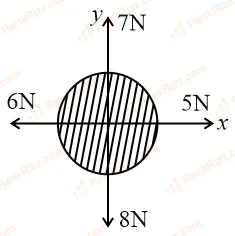
For a free body diagram shown in the figure, the four forces are applied in the 'x' and 'y' directions. What additional force must be applied and at what angle with positive x-axis so that the net acceleration of body is zero?
JEE MAIN 2022 · 26 JUL S1Newton's laws, free-body diagrams and equilibrium of a particleTRANSCRIBED
A monkey of mass 50 kg climbs on a rope which can withstand the tension (T) of 350 N. If monkey initially climbs down with an acceleration of 4 m s−2 and then climbs up with an acceleration of 5 m s−2. Choose the correct option (g=10 m s−2)
JEE MAIN 2022 · 28 JUL S1Newton's laws, free-body diagrams and equilibrium of a particleTRANSCRIBED
A balloon has mass of 10 g in air. The air escapes from the balloon at a uniform rate with velocity 4.5 cm s−1. If the balloon shrinks in 5 s completely. Then, the average force acting on that balloon will be (in dyne).
JEE MAIN 2022 · 29 JUN S1Newton's laws, free-body diagrams and equilibrium of a particleTRANSCRIBED
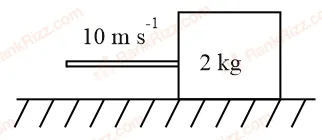
A block of metal weighing 2 kg is resting on a frictionless plane (as shown in figure). It is struck by a jet releasing water at a rate of 1 kg s−1 and at a speed of 10 m s−1. Then, the initial acceleration of the block, in m s−2, will be
JEE MAIN 2022 · 27 JUN S2Newton's laws, free-body diagrams and equilibrium of a particleTRANSCRIBED
A mass of 10 kg is suspended vertically by a rope of length 5 m from the roof. A force of 30 N is applied at the middle point of rope in horizontal direction. The angle made by upper half of the rope with vertical is α=tan−1(x×10−1). The value of x is ______. (Given, g=10 m s−2)
JEE MAIN 2022 · 25 JUN S1Newton's laws, free-body diagrams and equilibrium of a particleTRANSCRIBED
A force on an object of mass 100 g is (10i^+5j^) N. The position of that object at t=2 s is ai^+bj^ m after starting from rest. The value of ba will be ______.
JEE MAIN 2022 · 25 JUN S2Newton's laws, free-body diagrams and equilibrium of a particleTRANSCRIBED
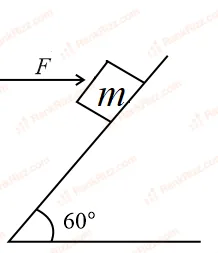
A block of mass 200 g is kept stationary on a smooth inclined plane by applying a minimum horizontal force F=x N as shown in figure. The value of x = ______.
JEE MAIN 2021 · 31 AUG S2Newton's laws, free-body diagrams and equilibrium of a particleTRANSCRIBED
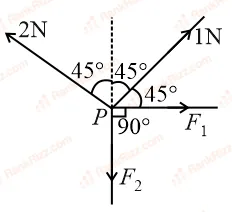
Statement I: If three forces F1, F2 and F3 are represented by three sides of a triangle and F1+F2=−F3, then these three forces are concurrent forces and satisfy the condition for equilibrium. Statement II: A triangle made up of three forces F1, F2 and F3 as its sides were taken in the same order, satisfies the condition for translatory equilibrium. In the light of the above statements, choose the most appropriate answer from the options given below:
JEE MAIN 2021 · 24 FEB S2Newton's laws, free-body diagrams and equilibrium of a particleTRANSCRIBED
A particle is projected with velocity v0 along x-axis. A damping force is acting on the particle which is proportional to the square of the distance from the origin i.e. ma=−αx2. The distance at which the particle stops:
JEE MAIN 2021 · 27 JUL S2Newton's laws, free-body diagrams and equilibrium of a particleTRANSCRIBED
A particle of mass M originally at rest is subjected to a force whose direction is constant but magnitude varies with time according to the relation F=F0[1−(Tt−T)2] where F0 and T are constants. The force acts only for the time interval 2T. The velocity v of the particle after time 2T is:
JEE MAIN 2021 · 16 MAR S2Newton's laws, free-body diagrams and equilibrium of a particleTRANSCRIBED
A body of mass 2 kg moves under a force of (2i^+3j^+5k^) N. It starts from rest and was at the origin initially. After 4 s, its new coordinates are (8,b,20). The value of b is ________. (Round off to the Nearest Integer)
JEE MAIN 2020 · 06 SEP S2Newton's laws, free-body diagrams and equilibrium of a particleTRANSCRIBED
A particle moving in the xy-plane experiences a velocity dependent force F=k(vyi^+vxj^), where vx and vy are the x and y components of its velocity v. If a is the acceleration of the particle, then which of the following statements is true for the particle?
JEE MAIN 2020 · 07 JAN S2Newton's laws, free-body diagrams and equilibrium of a particleTRANSCRIBED
A mass of 10 kg is suspended by a rope of length 4 m, from the ceiling. A force F is applied horizontally at the mid-point of the rope such that the top half of the rope makes an angle of 45∘ with the vertical. Then F equals: (Take g = 10 m s−2 and the rope to be massless)