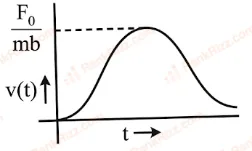
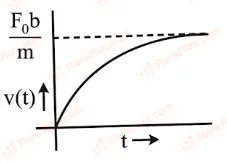
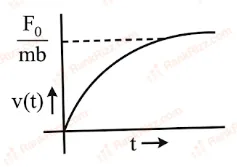
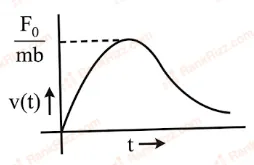
A small ball of mass is thrown upward with velocity from the ground. The ball experiences a resistive force where is its speed. The maximum height attained by the ball is:
- A
- B
- C
- D
Every JEE Main question on Newton's laws, free-body diagrams and equilibrium of a particle, one of the ideas inside Laws of Motion & Friction: 53 questions from 2007–2026, 33 of them in the last five years. Newest first, answer key on every one. Free to read.
Questions
53
Years asked
14
Since
2007
Of the chapter
35%
41–53 OF 53 · NEWEST FIRST
A small ball of mass is thrown upward with velocity from the ground. The ball experiences a resistive force where is its speed. The maximum height attained by the ball is:
A ball is thrown upward with an initial velocity from the surface of the earth. The motion of the ball is affected by a drag force equal to (where m is the mass of the ball, is its instantaneous velocity and is a constant). Time taken by the ball to rise to its zenith is:
A bullet of mass 20 g has an initial speed of 1 m s, just before it starts penetrating a mud wall of thickness 20 cm. If the wall offers a mean resistance of N, the speed of the bullet after emerging from the other side of the wall is close to:
0.7 m s
0.3 m s
0.1 m s
0.4 m s
A mass of 10 kg is suspended vertically by a rope from the roof. When a horizontal force is applied on the rope at some point, the rope deviated at an angle of 45 at the roof point. If the suspended mass is at equilibrium, the magnitude of the force applied is ( m s)
100 N
200 N
140 N
70 N
A body of mass kg is moving in a medium and experiences a frictional force . Its initial speed is m s. After 10 s its kinetic energy is , then the value of will be:
kg m s
kg m
kg m s
kg m
A particle of mass is acted upon by a force given by the empirical law . If this law is to be tested experimentally by observing the motion starting from rest, the best way is to plot
against
against
against
against
Water is flowing at a speed of 1.5 m s through a horizontal tube of cross-sectional area m and you are trying to stop the flow by your palm. Assuming that the water stops immediately after hitting the palm, the minimum force that you must exert should be (density of water = kg m)
33.7 N
45 N
15 N
22.5 N
A body of mass 5 kg under the action of constant force has velocity at t = 0 s as m/s and at t = 10 s as m/s. The force is:
N
N
N
N
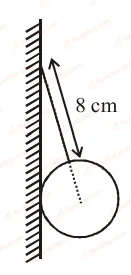
A uniform sphere of weight W and radius 5 cm is being held by a string as shown in the figure. The tension in the string will be :

A particle of mass is at rest at the origin at time . It is subjected to a force in the direction. Its speed is depicted by which of the following curves?


A car of mass 1000 kg is moving at a speed of . Brakes are applied to bring the car to rest. If the net retarding force is , the car comes to stop after travelling m in s. Then
This question has Statement 1 and Statement 2. Of the four choices given after the Statements, choose the one that best describes the two Statements.
Statement 1: If you push on a cart being pulled by a horse so that it does not move, the cart pushes you back with an equal and opposite force.
Statement 2: The cart does not move because the force described in statement 1 cancel each other.
Statement 1 is true, Statement 2 is true, Statement 2 is the correct explanation of Statement 1.
Statement 1 is false, Statement 2 is true.
Statement 1 is true, Statement 2 is false.
Statement 1 is true, Statement 2 is true, Statement 2 is not the correct explanation of Statement 1.
A body weighing 13 kg is suspended by two strings 5 m and 12 m long, their other ends being fastened to the extremities of a rod 13 m long. If the rod be so held that the body hangs immediately below the middle point. The tensions in the strings are
12 kg and 13 kg
5 kg and 5 kg
5 kg and 12 kg
5 kg and 13 kg