RankRizz

Motion on inclined planes and wedges — JEE Main Previous Year Questions

Every JEE Main question on Motion on inclined planes and wedges, one of the ideas inside Laws of Motion & Friction: 14 questions from 2005–2026, 10 of them in the last five years. Newest first, answer key on every one. Free to read.

Questions

14

Years asked

7

Since

2005

Of the chapter

9%

When JEE Main asked it

Questions on Motion on inclined planes and wedges in each year it was asked.

20264
20251
20242
20223
20212
20101
20051

Every Motion on inclined planes and wedges question

1–14 OF 14 · NEWEST FIRST

JEE MAIN 2026 · 28 JAN S2Motion on inclined planes and wedgesTRANSCRIBED

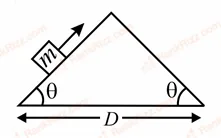
A small block of mass m slides down from the top of a frictionless inclined surface, while the inclined plane is moving towards left with constant acceleration a0a_{0}. The angle between the inclined plane and ground is θ and its base length is L. Assuming that initially the small block is at the top of the inclined plane, the time it takes to reach the lowest point of the inclined plane is ___ .
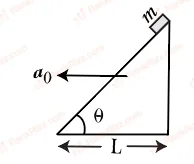
Figure for JEE Main 2026 Physics question on Motion on inclined planes and wedges
  1. A

    4Lgsin⁡2θ−a∘(1+cos⁡2θ)\sqrt{\dfrac{4L}{g \sin 2\theta -a_{\circ}(1+\cos 2\theta)}}

  2. B

    2Lgsin⁡θ−a∘cos⁡θ\sqrt{\dfrac{2L}{g \sin \theta -a_{\circ}\cos \theta}}

  3. C

    2Lgsin⁡2θ+a∘(1+cos⁡2θ)\sqrt{\dfrac{2L}{g \sin 2\theta +a_{\circ}(1+\cos 2\theta)}}

  4. D

    4Lgcos⁡2θ+a∘sin⁡θcos⁡θ\sqrt{\dfrac{4L}{g \cos^{2}\theta +a_{\circ}\sin \theta \cos \theta}}

JEE MAIN 2026 · 05 APR S1Motion on inclined planes and wedgesTRANSCRIBED

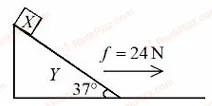
A wedge Y with mass of 10 kg and all frictionless surfaces and the inclined surface making 37° with horizontal. A block X with mass 2 kg is placed at the highest point of the wedge as shown in figure is at rest. At t=0t = 0 wedge (Y) is pulled toward right with constant force (ff) of 24 N. Taking the block X at rest at t=0t = 0, the time taken by it to slide down 8.8 m on the slope, while Y is on the move, is _______ s. (take tan⁡(37°)=3/4\tan(37°) = 3/4 and g=10g = 10 m/s2^2)

Figure for JEE Main 2026 Physics question on Motion on inclined planes and wedges
  1. A

    22 

  2. B

    44 

  3. C

    2\sqrt{2} 

  4. D

    222\sqrt{2} 

JEE MAIN 2026 · 23 JAN S2Motion on inclined planes and wedgesTRANSCRIBED

A block is sliding down on an inclined plane of slope θ\theta and at an instant t = 0 this block is given an upward momentum so that it starts moving up on the inclined surface with velocity u. The distance (S) travelled by the block before its velocity become zero, is ______.
(g = gravitational acceleration)

  1. A

    u22gcos⁡θ\frac{u^{2}}{\sqrt{2}g \cos \theta}

  2. B

    2u2gcos⁡θ\frac{2u^{2}}{g \cos \theta}

  3. C

    u22gcos⁡θ\frac{u^{2}}{2g \cos \theta}

  4. D

    u24gsin⁡θ\frac{u^{2}}{4g \sin \theta}

JEE MAIN 2026 · 28 JAN S1Motion on inclined planes and wedgesTRANSCRIBED

A block of mass 5 kg is moving on an inclined plane which makes an angle of 30° with the horizontal. Friction coefficient between the block and inclined plane surface is 32\frac{\sqrt{3}}{2}. The force to be applied on the block so that the block will move down without acceleration is _______N
(g=10m/s2)(g=10m/s^{2})

  1. A

    15

  2. B

    12.5

  3. C

    25

  4. D

    7.5

JEE MAIN 2025 · 07 APR S1Motion on inclined planes and wedgesTRANSCRIBED

A cubic block of mass m is sliding down on an inclined plane at 60∘60^{\circ} with an acceleration of g2\frac{g}{2}, the value of coefficient of kinetic friction is

  1. A

    3−1\sqrt{3} - 1

  2. B

    32\frac{\sqrt{3}}{2}

  3. C

    23\frac{\sqrt{2}}{3}

  4. D

    1−321 - \frac{\sqrt{3}}{2}

JEE MAIN 2024 · 04 APR S2Motion on inclined planes and wedgesTRANSCRIBED

A 22 kg brick begins to slide over a surface which is inclined at an angle of 45°45° with respect to horizontal axis. The co-efficient of static friction between their surfaces is:

  1. A

    1.71.7

  2. B

    13\frac{1}{\sqrt{3}}

  3. C

    0.50.5

  4. D

    11

JEE MAIN 2024 · 31 JAN S2Motion on inclined planes and wedgesTRANSCRIBED

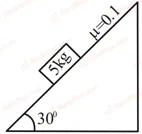
A block of mass 5 kg is placed on a rough inclined surface as shown in the figure. If F1⃗\vec{F_1} is the force required to just move the block up the inclined plane and F2⃗\vec{F_2} is the force required to just prevent the block from sliding down, then the value of ∣F1⃗∣−∣F2⃗∣|\vec{F_1}| - |\vec{F_2}| is: [Use g=10g = 10 m s−2^{-2}]

Figure for JEE Main 2024 Physics question on Motion on inclined planes and wedges
  1. A

    25325\sqrt{3} N

  2. B

    535\sqrt{3} N

  3. C

    532\frac{5\sqrt{3}}{2} N

  4. D

    10 N

JEE MAIN 2022 · 27 JUL S2Motion on inclined planes and wedgesTRANSCRIBED

A block of mass MM slides down on a rough inclined plane with constant velocity. The angle made by the incline plane with horizontal is θ\theta. The magnitude of the contact force will be :

  1. A

    MgMg

  2. B

    Mgcos⁡θMg \cos\theta

  3. C

    Mgsin⁡θ+Mgcos⁡θ\sqrt{Mg \sin\theta + Mg \cos\theta}

  4. D

    Mgsin⁡θ1+μMg \sin\theta \sqrt{1 + \mu}

JEE MAIN 2022 · 27 JUL S2Motion on inclined planes and wedgesTRANSCRIBED

A block AA takes 2 s to slide down a frictionless incline of 30∘30^\circ and length ll, kept inside a lift going up with uniform velocity vv. If the incline is changed to 45∘45^\circ, the time taken by the block, to slide down the incline, will be approximately:

  1. A

    2.66 s

  2. B

    0.83 s

  3. C

    1.68 s

  4. D

    0.70 s

JEE MAIN 2022 · 27 JUL S2Motion on inclined planes and wedgesTRANSCRIBED

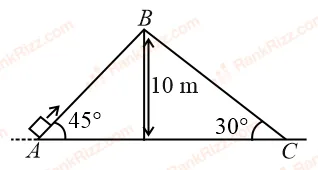
Two inclined planes are placed as shown in figure.
A block is projected from the Point A of inclined plane AB along its surface with a velocity just sufficient to carry it to the top Point B at a height 10 m. After reaching the Point B the block slides down on inclined plane BC. Time it takes to reach to the point C from point A is t(2+1)t(\sqrt{2} + 1) s. The value of t is _____ (use g=10 ms−2g = 10 \ m s^{-2})

Figure for JEE Main 2022 Physics question on Motion on inclined planes and wedges
JEE MAIN 2021 · 01 SEP S2Motion on inclined planes and wedgesTRANSCRIBED

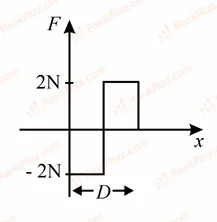
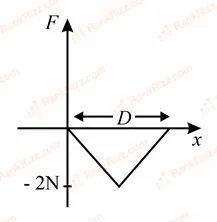
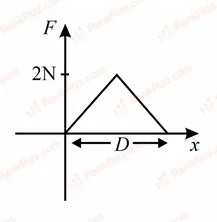
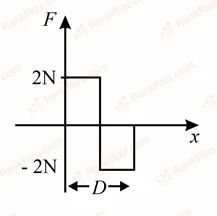
An object of mass mm is being moved with a constant velocity under the action of an applied force of 2 N along a frictionless surface with following surface profile.

Figure for JEE Main 2021 Physics question on Motion on inclined planes and wedges


The correct applied force vs distance graph will be:

  1. A
    Figure for JEE Main 2021 Physics question on Motion on inclined planes and wedges
  2. B
    Figure for JEE Main 2021 Physics question on Motion on inclined planes and wedges
  3. C
    Figure for JEE Main 2021 Physics question on Motion on inclined planes and wedges
  4. D
    Figure for JEE Main 2021 Physics question on Motion on inclined planes and wedges
JEE MAIN 2021 · 01 SEP S2Motion on inclined planes and wedgesTRANSCRIBED

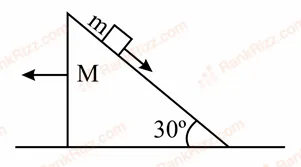
A block of mass mm slides on the wooden wedge, which in turn slides backward on the horizontal surface. The acceleration of the block with respect to the wedge is:
Given m=8m = 8 kg, M=16M = 16 kg
Assume all the surfaces shown in the figure to be frictionless.

Figure for JEE Main 2021 Physics question on Motion on inclined planes and wedges
  1. A

    35\frac{3}{5} g

  2. B

    45\frac{4}{5} g

  3. C

    65\frac{6}{5} g

  4. D

    23\frac{2}{3} g

JEE MAIN 2010Motion on inclined planes and wedgesTRANSCRIBED

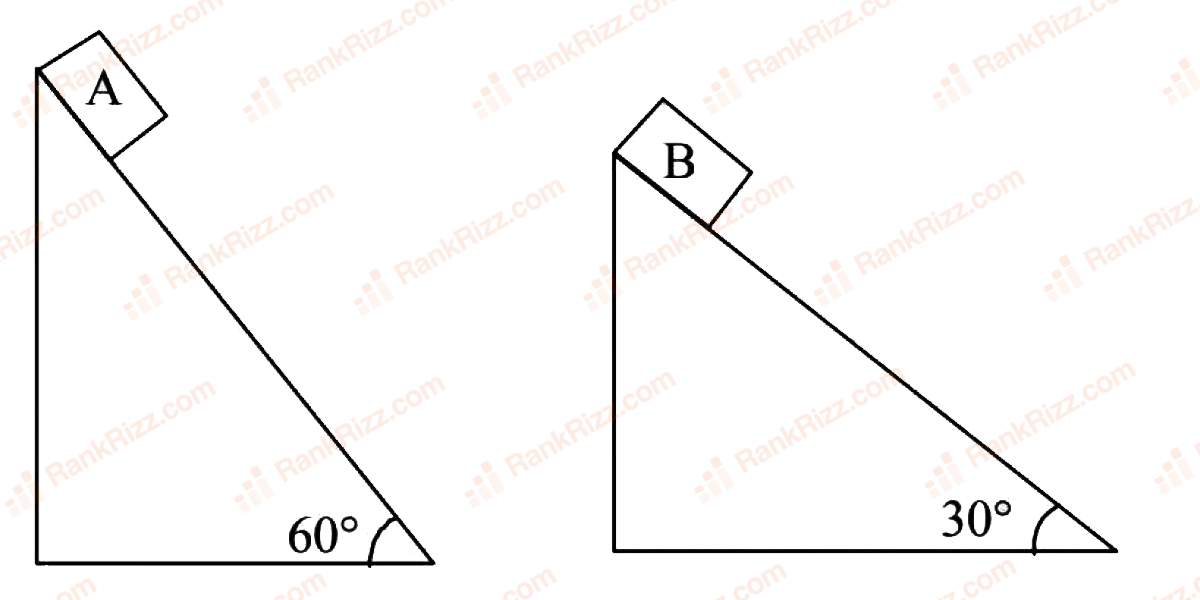
Two fixed frictionless inclined plane making an angle 30∘30^\circ and 60∘60^\circ with the vertical are shown in the figure. Two block AA and BB are placed on the two planes. What is the relative vertical acceleration of AA with respect to BB?

JMA_LOM_C03_075_Q01
  1. A

    4.94.9 ms−2^{-2} in horizontal direction

  2. B

    9.89.8 ms−2^{-2} in vertical direction

  3. C

    zero

  4. D

    4.94.9 ms−2^{-2} in vertical direction

JEE MAIN 2005Motion on inclined planes and wedgesTRANSCRIBED

A block is kept on a frictionless inclined surface with angle of inclination α\alpha. The incline is given an acceleration aa to keep the block stationary. Then aa is equal to?

  1. A

    g/tan⁡αg/\tan \alpha

  2. B

    g cosec αg \, \text{cosec} \, \alpha

  3. C

    gg

  4. D

    gtan⁡αg \tan \alpha