JEE MAIN 2026 · 04 APR S2Newton's laws, free-body diagrams and equilibrium of a particleTRANSCRIBED
At , a body of mass g starts moving under the influence of a force N. After s, its position is m. The ratio is ______.
- A
- B
- C
- D
Every JEE Main question on Newton's laws, free-body diagrams and equilibrium of a particle, one of the ideas inside Laws of Motion & Friction: 53 questions from 2007–2026, 33 of them in the last five years. Newest first, answer key on every one. Free to read.
Questions
53
Years asked
14
Since
2007
Of the chapter
35%
Questions on Newton's laws, free-body diagrams and equilibrium of a particle in each year it was asked, the latest 12 of 14.
1–20 OF 53 · NEWEST FIRST
At , a body of mass g starts moving under the influence of a force N. After s, its position is m. The ratio is ______.
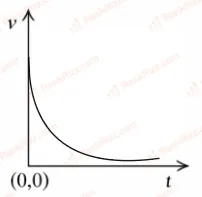
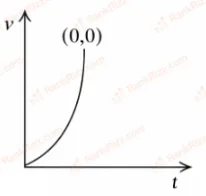
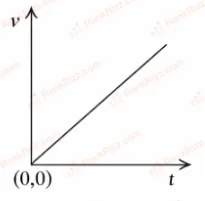
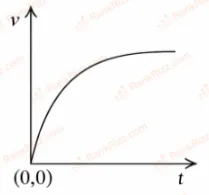
A particle of mass m falls from rest through a resistive medium having resistive force, F = -kv, where v is the velocity of the particle and k is a constant. Which of the following graphs represents velocity (v) versus time (t)?
A 4 kg mass moves under the influence of a force where t is the time in second. If mass starts from origin at t= 0, the velocity and position after t= 2 s will be:
A flexible chain of mass m hangs between two fixed points at the same level. The inclination of the chain with the horizontal at the two points of support is . Considering the equilibrium of each half of the chain, the tension of the chain at the lowest point is __________.
mg
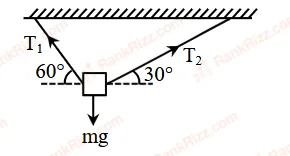
A body of mass m is suspended by two strings making angles and with the horizontal ceiling with tensions and simultaneously. and are related by . The angles and are
, with
, with
, with
, with
A body of mass 2 kg moving with velocity of ms enters into a constant force field of 6N directed along positive z-axis. If the body remains in the field for a period of seconds, then velocity of the body when it emerges from force field is
A balloon and its content having mass is moving up with an acceleration 'a'. The mass that must be released from the content so that the balloon starts moving up with an acceleration '3a' will be (Take ' g ' as acceleration due to gravity)
A body of mass 1 kg is suspended with the help of two strings making angles as shown in figure. Magnitude of tensions and , respectively, are (in N) :
An object with mass 500 g moves along x-axis with speed m/s. The force acting on the object is :
8 N
5 N
6 N
4 N
A particle moves in plane under the influence of a force such that its linear momentum is . If is constant, the angle between and will be :
A cricket player catches a ball of mass 120 g moving with speed. If the catching process is completed in 0.1 s then the magnitude of force exerted by the ball on the hand of player will be (in SI unit):
24
12
25
30
A body of weight is suspended from a tree branch through a chain of mass . The branch pulls the chain by a force equal to (if ) :
A mass is suspended from the ceiling by a rope of length . A horizontal force '' is applied at the mid point of the rope so that the rope makes an angle of with respect to the vertical axis as shown in figure.
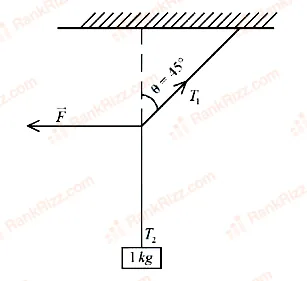
The magnitude of is : (Assume that the system is in equilibrium and )
A body of mass 4 kg experiences two forces and . The acceleration acting on the body is:
A wooden block of mass rests on a soft horizontal floor. When an iron cylinder of mass is placed on the top of the block, the floor yields and the block and the cylinder together go down with an acceleration of . The action force of the system on the floor is equal to:
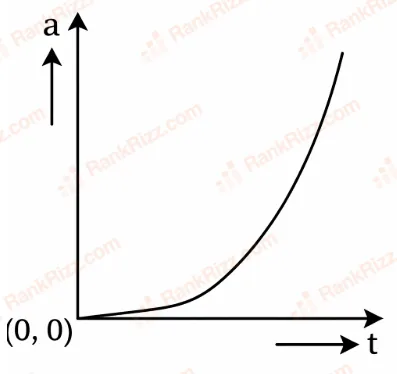
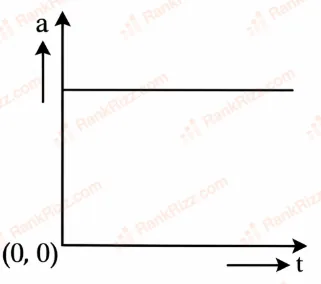
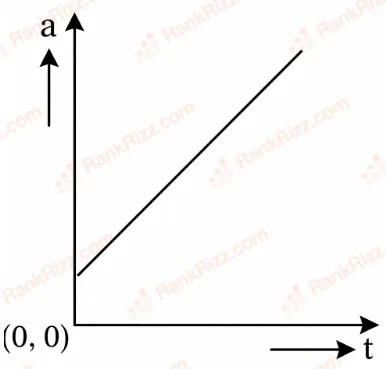
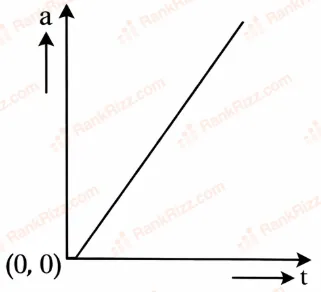
A wooden block, initially at rest on the ground, is pushed by a force which increases linearly with time t. Which of the following curve best describes acceleration of the block with time:
A player caught a cricket ball of mass moving at a speed of . If the catching process is completed in , the magnitude of force exerted by the ball on the hand of the player is:
Three forces N, N, N are acting on a particle of mass 5 kg. The forces and are applied perpendicularly so that particle remains at rest. If the force is removed, then the acceleration of the particle is
m s
m s
m s
m s
As shown in figure, a 70 kg garden roller is pushed with a force of N at an angle of 30° with horizontal. The normal reaction on the roller is (Given m s)
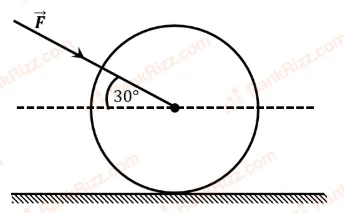
N
600 N
800 N
N
Force acts for s on a body of mass kg, starting from rest, after which the force ceases and then body describes m in the next s. The value of force will be:
N
N
N
N