RankRizz

Ideal gas equation and gas laws — JEE Main Previous Year Questions

Every JEE Main question on Ideal gas equation and gas laws, one of the ideas inside Kinetic Theory of Gases: 38 questions from 2004–2026, 19 of them in the last five years. Newest first, answer key on every one. Free to read.

Questions

38

Years asked

15

Since

2004

Of the chapter

20%

Every Ideal gas equation and gas laws question

21–38 OF 38 · NEWEST FIRST

JEE MAIN 2021 · 16 MAR S1Ideal gas equation and gas lawsTRANSCRIBED

The volume VV of an enclosure contains a mixture of three gases, 16 g of oxygen, 28 g of nitrogen and 44 g of carbon dioxide at absolute temperature TT. Consider RR as universal gas constant. The pressure of the mixture of gases is:

  1. A

    88RTV\frac{88RT}{V}

  2. B

    3RTV\frac{3RT}{V}

  3. C

    52RTV\frac{5}{2}\frac{RT}{V}

  4. D

    4RTV\frac{4RT}{V}

JEE MAIN 2021 · 27 AUG S1Ideal gas equation and gas lawsTRANSCRIBED

A balloon carries a total load of 185 kg at normal pressure and temperature of 27°C. What load will the balloon carry on rising to a height at which the barometric pressure is 45 cm of Hg and the temperature is -7°C. Assuming the volume constant?

  1. A

    214.15 kg

  2. B

    123.54 kg

  3. C

    219.07 kg

  4. D

    181.46 kg

JEE MAIN 2021 · 31 AUG S2Ideal gas equation and gas lawsTRANSCRIBED

A mixture of hydrogen and oxygen has volume 500 cm3^3, temperature 300 K, pressure 400 kPa and mass 0.76 g. The ratio of masses of oxygen to hydrogen will be:

  1. A

    16 : 3

  2. B

    3 : 8

  3. C

    8 : 3

  4. D

    3 : 16

JEE MAIN 2021 · 26 AUG S2Ideal gas equation and gas lawsTRANSCRIBED

A cylindrical container of volume 4.0×10−34.0 \times 10^{-3} m3^3 contains one mole of hydrogen and two moles of carbon dioxide. Assume the temperature of the mixture is 400 K. The pressure of the mixture of gases is:
[Take gas constant as 8.3 J mol−1^{-1} K−1^{-1}]

  1. A

    24.9×10324.9 \times 10^3 Pa

  2. B

    249×101249 \times 10^1 Pa

  3. C

    24.9×10524.9 \times 10^5 Pa

  4. D

    24.9 Pa

JEE MAIN 2021 · 20 JUL S2Ideal gas equation and gas lawsTRANSCRIBED

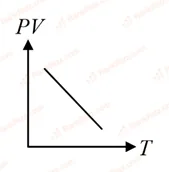
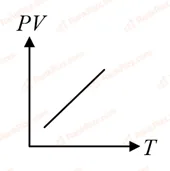
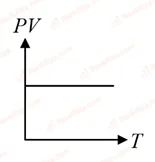
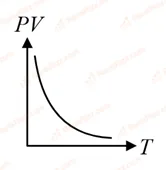
Which of the following graphs represent the behaviour of an ideal gas? Symbols have their usual meaning.

  1. A
    Figure for JEE Main 2021 Physics question on Ideal gas equation and gas laws
  2. B
    Figure for JEE Main 2021 Physics question on Ideal gas equation and gas laws
  3. C
    Figure for JEE Main 2021 Physics question on Ideal gas equation and gas laws
  4. D
    Figure for JEE Main 2021 Physics question on Ideal gas equation and gas laws
JEE MAIN 2020 · 04 SEP S2Ideal gas equation and gas lawsTRANSCRIBED

The change in the magnitude of the volume of an ideal gas when a small additional pressure ΔP\Delta P is applied at a constant temperature, is the same as the change when the temperature is reduced by a small quantity ΔT\Delta T at constant pressure. The initial temperature and pressure of the gas were 300 K and 2 atm respectively. If ∣ΔT∣=C∣ΔP∣|\Delta T| = C|\Delta P| then value of C in (K/atm) is __________

JEE MAIN 2020 · 06 SEP S1Ideal gas equation and gas lawsTRANSCRIBED

Initially a gas of diatomic molecules is contained in a cylinder of volume V1V_1 at a pressure P1P_1 and temperature 250 K250\,\text{K}. Assuming that 25%25\% of the molecules get dissociated causing a change in number of moles. The pressure of the resulting gas at temperature 2000 K2000\,\text{K}, when contained in a volume 2V12V_1 is given by P2P_2. The ratio P2/P1P_2/P_1 is ___

JEE MAIN 2020 · 04 SEP S1Ideal gas equation and gas lawsTRANSCRIBED

A closed vessel contains 0.1 mole of a monoatomic ideal gas at 200 K. If 0.05 mole of the same gas at 400 K is added to it, the final equilibrium temperature (in K) of the gas in the vessel will be close to __________

JEE MAIN 2019 · 12 JAN S2Ideal gas equation and gas lawsTRANSCRIBED

A vertical closed cylinder is separated into two parts by a frictionless piston of mass m and of negligible thickness. The piston is free to move along the length of the cylinder. The length of the cylinder above piston is l1l_1, and that below the piston is l2l_2, such that l1>l2l_1 > l_2. Each part of the cylinder contains n moles of an ideal gas at equal temperature T. If the piston is stationary, its mass m will be given by: (R is universal gas constant and g is the acceleration due to gravity)

  1. A

    RTng[l1−3l2l1l2]\frac{RT}{ng}\left[\frac{l_1 - 3l_2}{l_1 l_2}\right]

  2. B

    nRTg[l1−l2l1l2]\frac{nRT}{g}\left[\frac{l_1 - l_2}{l_1 l_2}\right]

  3. C

    RTg[2l1+l2l1l2]\frac{RT}{g}\left[\frac{2l_1 + l_2}{l_1 l_2}\right]

  4. D

    RTgl[2l1+l2l1l2]\frac{RT}{gl}\left[\frac{2l_1 + l_2}{l_1 l_2}\right]

JEE MAIN 2019 · 12 APR S2Ideal gas equation and gas lawsTRANSCRIBED

The number density of molecules of a gas depends on their distance r from the origin as, n(r)=n0e−αr4n(r) = n_0 e^{-\alpha r^4}. Then the numer of molecules is proportional to:

  1. A

    n0α−3n_0 \alpha^{-3}

  2. B

    n0α12\sqrt{n_0} \alpha^{\frac{1}{2}}

  3. C

    n0α−34n_0 \alpha^{\frac{-3}{4}}

  4. D

    n0α14n_0 \alpha^{\frac{1}{4}}

JEE MAIN 2017 · 02 APR OFFLINEIdeal gas equation and gas lawsTRANSCRIBED

The temperature of an open room of volume 30 m3^{3} increases from 17°C to 27°C due to the sunshine. The atmospheric pressure in the room remains 1×1051 \times 10^{5} Pa. If nin_{i} and nfn_{f} are the number of molecules in the room before and after heating, then nf−nin_{f} - n_{i} will be:

  1. A

    −2.5×1025-2.5 \times 10^{25}

  2. B

    −1.61×10²³-1.61 \times 10^{23}

  3. C

    1.38×10231.38 \times 10^{23}

  4. D

    2.5×10252.5 \times 10^{25}

JEE MAIN 2016 · 10 APR ONLINEIdeal gas equation and gas lawsTRANSCRIBED

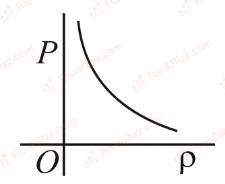
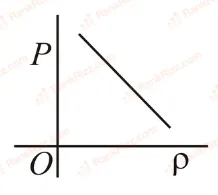
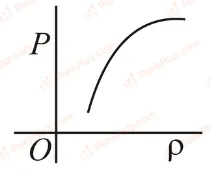
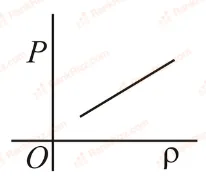
Which of the following shows the correct relationship between the pressure PP and density ρ\rho of an ideal gas at constant temperature?

  1. A
    Figure for JEE Main 2016 Physics question on Ideal gas equation and gas laws
  2. B
    Figure for JEE Main 2016 Physics question on Ideal gas equation and gas laws
  3. C
    Figure for JEE Main 2016 Physics question on Ideal gas equation and gas laws
  4. D
    Figure for JEE Main 2016 Physics question on Ideal gas equation and gas laws
JEE MAIN 2014 · 09 APR ONLINEIdeal gas equation and gas lawsTRANSCRIBED

Modern vacuum pumps can evacuate a vessel down to a pressure of 4.0×10−154.0 \times 10^{-15} atm. at room temperature (300 K). Taking R = 8.3 JK−1^{-1} mole−1^{-1}, 1 atm = 10510^5 Pa and NAvogadro=6×10²³N_{Avogadro} = 6 \times 10^{23} mole−1^{-1}, the mean distance between molecules of gas in an evacuated vessel will be of the order of:

  1. A

    0.2 μ\mum

  2. B

    0.2 mm

  3. C

    0.2 cm

  4. D

    0.2 nm

JEE MAIN 2014 · 11 APR ONLINEIdeal gas equation and gas lawsTRANSCRIBED

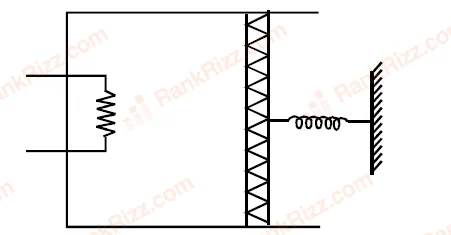
An ideal monoatomic gas is confined in a cylinder by a spring loaded piston of cross section 8.0×10−38.0 \times 10^{-3} m2^2. Initially the gas is at 300 K and occupies a volume of 2.4×10−32.4 \times 10^{-3} m3^3 and the spring is in its relaxed state as shown in figure. The gas is heated by a small heater until the piston moves out slowly by 0.1 m. The force constant of the spring is 8000 N/m and the atmospheric pressure is 1.0×1051.0 \times 10^5 N/m2^2. The cylinder and the piston are thermally insulated. The piston and the spring are massless and there is no friction between the piston and the cylinder. The final temperature of the gas will be: (Neglect the heat loss through the lead wires of the heater. The heat capacity of the heater coil is also negligible).

Figure for JEE Main 2014 Physics question on Ideal gas equation and gas laws
  1. A

    300 K

  2. B

    800 K

  3. C

    500 K

  4. D

    1000 K

JEE MAIN 2013 · 23 APR ONLINEIdeal gas equation and gas lawsTRANSCRIBED

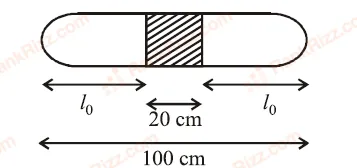
A thin tube sealed at both ends is 100 cm long. It lies horizontally, the middle 20 cm containing mercury and two equal ends containing air at standard atmospheric pressure. If the tube is now turned to a vertical position, by what amount will the mercury be displaced?
(Given : cross-section of the tube can be assumed to be uniform)

Figure for JEE Main 2013 Physics question on Ideal gas equation and gas laws
  1. A

    2.95 cm

  2. B

    5.18 cm

  3. C

    8.65 cm

  4. D

    0.0 cm

JEE MAIN 2012Ideal gas equation and gas lawsTRANSCRIBED

A perfect gas at 27∘27^\circC is heated at constant pressure so as to double its volume. The final temperature of the gas will be, close to

  1. A

    327∘327^\circC

  2. B

    200∘200^\circC

  3. C

    54∘54^\circC

  4. D

    300∘300^\circC

JEE MAIN 2008Ideal gas equation and gas lawsTRANSCRIBED

An insulated container of gas has two chambers separated by an insulating partition. One of the chambers has volume V1V_1 and contains ideal gas at pressure P1P_1 and temperature T1T_1. The other chamber has volume V2V_2 and contains ideal gas at pressure P2P_2 and temperature T2T_2. If the partition is removed without doing any work on the gas, the final equilibrium temperature of the gas in the container will be

  1. A

    T1T2(P1V1+P2V2)P1V1T2+P2V2T1\frac{T_1 T_2 (P_1 V_1 + P_2 V_2)}{P_1 V_1 T_2 + P_2 V_2 T_1}

  2. B

    P1V1T1+P2V2T2P1V1+P2V2\frac{P_1 V_1 T_1 + P_2 V_2 T_2}{P_1 V_1 + P_2 V_2}

  3. C

    P1V1T2+P2V2T1P1V1+P2V2\frac{P_1 V_1 T_2 + P_2 V_2 T_1}{P_1 V_1 + P_2 V_2}

  4. D

    T1T2(P1V1+P2V2)P1V1T1+P2V2T2\frac{T_1 T_2 (P_1 V_1 + P_2 V_2)}{P_1 V_1 T_1 + P_2 V_2 T_2}

JEE MAIN 2004Ideal gas equation and gas lawsTRANSCRIBED

Two thermally insulated vessels 1 and 2 are filled with air at temperatures (T1,T2)(T_1, T_2), volume (V1,V2)(V_1, V_2) and pressure (P1,P2)(P_1, P_2) respectively. If the valve joining two vessels is opened, the temperature inside the vessel at equilibrium will be

  1. A

    T1+T2T_1 + T_2

  2. B

    (T1+T2)/2(T_1 + T_2)/2

  3. C

    T1T2(P1V1+P2V2)P1V1T2+P2V2T1\frac{T_1 T_2 (P_1 V_1 + P_2 V_2)}{P_1 V_1 T_2 + P_2 V_2 T_1}

  4. D

    T1T2(P1V1+P2V2)P1V1T1+P2V2T2\frac{T_1 T_2 (P_1 V_1 + P_2 V_2)}{P_1 V_1 T_1 + P_2 V_2 T_2}