RankRizz
JEE MAIN 2013 · 23 APR ONLINE+4 / −1HARDTRANSCRIBED

JEE Main 2013 Physics question — Ideal gas equation and gas laws

A thin tube sealed at both ends is 100 cm long. It lies horizontally, the middle 20 cm containing mercury and two equal ends containing air at standard atmospheric pressure. If the tube is now turned to a vertical position, by what amount will the mercury be displaced?
(Given : cross-section of the tube can be assumed to be uniform)
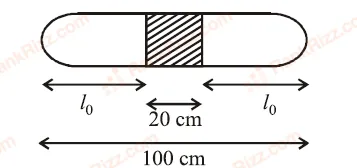
Figure for JEE Main 2013 Physics question on Ideal gas equation and gas laws
SOLUTION

When the tube is turned vertical, let the mercury be displaced by a distance xx. The new lengths of the air columns will be (40−x)(40 - x) for the lower section and (40+x)(40 + x) for the upper section.

Applying Boyle's Law (P1V1=P2V2P_1V_1 = P_2V_2) for both air columns:

Upper air column: P1(40+x)=P0(40)  ⟹  P1=76×4040+xP_1(40 + x) = P_0(40) \implies P_1 = \frac{76 \times 40}{40 + x}

Lower air column: P2(40−x)=P0(40)  ⟹  P2=76×4040−xP_2(40 - x) = P_0(40) \implies P_2 = \frac{76 \times 40}{40 - x}

P2=P1+20P_2 = P_1 + 20

76×4040−x=76×4040+x+20\frac{76 \times 40}{40 - x} = \frac{76 \times 40}{40 + x} + 20

15240−x=15240+x+1\frac{152}{40 - x} = \frac{152}{40 + x} + 1

152[140−x−140+x]=1152 \left[ \frac{1}{40 - x} - \frac{1}{40 + x} \right] = 1

152[(40+x)−(40−x)1600−x2]=1152 \left[ \frac{(40 + x) - (40 - x)}{1600 - x^2} \right] = 1

152(2x1600−x2)=1  ⟹  304x=1600−x2152 \left( \frac{2x}{1600 - x^2} \right) = 1 \implies 304x = 1600 - x^2

x2+304x−1600=0x^2 + 304x - 1600 = 0

x≈−304+314.352=10.352≈5.18 cmx \approx \frac{-304 + 314.35}{2} = \frac{10.35}{2} \approx 5.18\text{ cm}

    Tagged Ideal gas equation and gas laws. Machine-assigned, so read it as a strong shortlist rather than a verdict.

    SubjectPhysics
    TopicIdeal gas equation and gas laws
    TypeMultiple choice