JEE MAIN 2022 · 28 JUL S1Ohm's law, resistance, resistivity and colour codeTRANSCRIBED
A wire of resistance R1 is drawn out so that its length is increased by twice of its original length. The ratio of new resistance to original resistance is:
- A
- B
- C
- D
JEE MAIN 2022 · 29 JUL S2Ohm's law, resistance, resistivity and colour codeTRANSCRIBED
Given below are two statements: one is labelled as Assertion A and the other is labelled as Reason R.
Assertion A: Alloys such as constantan and manganin are used in making standard resistance coils.
Reason R: Constantan and manganin have very small value of temperature coefficient of resistance.
In the light of the above statements, choose the correct answer from the options given below.
- A
Both A and R are true and R is the correct explanation of A
- B
Both A and R are true but R is NOT the correct explanation of A
- C
- D
JEE MAIN 2022 · 29 JUL S2Ohm's law, resistance, resistivity and colour codeTRANSCRIBED
A 1 m long wire is broken into two unequal parts X and Y. The X part of the wire is stretched into another wire W. Length of W is twice the length of X and the resistance of W is twice that of Y. Find the ratio of length of X and Y.
- A
- B
- C
- D
JEE MAIN 2022 · 29 JUN S1Ohm's law, resistance, resistivity and colour codeTRANSCRIBED
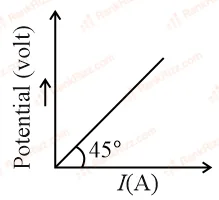
The variation of applied potential and current flowing through a given wire is shown in figure. The length of wire is 31.4 cm. The diameter of wire is measured as 2.4 cm. The resistivity of the given wire is measured as x×10−3 Ω cm. The value of x is ______. [Take π=3.14]
JEE MAIN 2022 · 25 JUN S2Ohm's law, resistance, resistivity and colour codeTRANSCRIBED
The length of a given cylindrical wire is increased to double of its original length. The percentage increase in the resistance of the wire will be ______ %.
JEE MAIN 2021 · 26 FEB S2Ohm's law, resistance, resistivity and colour codeTRANSCRIBED
A wire of 1 Ω has a length of 1 m. It is stretched till its length increases by 25%. The percentage change in resistance to the nearest integer is:
- A
- B
- C
- D
JEE MAIN 2021 · 16 MAR S1Ohm's law, resistance, resistivity and colour codeTRANSCRIBED
A conducting wire of length l, area of cross-section A and electric resistivity ρ is connected between the terminals of a battery. A potential difference V is developed between its ends, causing an electric current. If the length of the wire of the same material is doubled and the area of cross-section is halved, the resultant current would be:
- A
41ρlVA
- B
43ρlVA
- C
41VAρl
- D
4ρlVA
JEE MAIN 2021 · 27 AUG S2Ohm's law, resistance, resistivity and colour codeTRANSCRIBED
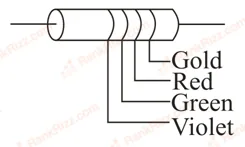
The colour coding on a carbon resistor is shown in the given figure. The resistance value of the given resistor is:
- A
(7500±375)Ω
- B
(5700±285)Ω
- C
(7500±755)Ω
- D
(5700±375)Ω
JEE MAIN 2020 · 02 SEP S1Ohm's law, resistance, resistivity and colour codeTRANSCRIBED
Consider four conducting materials copper, tungsten, mercury and aluminium with resistivity ρC, ρT, ρM and ρA respectively. Then:
- A
ρC>ρA>ρT
- B
ρM>ρA>ρC
- C
ρA>ρT>ρC
- D
ρA>ρM>ρC
JEE MAIN 2019 · 09 JAN S1Ohm's law, resistance, resistivity and colour codeTRANSCRIBED
A copper wire is stretched to make it 0.5% longer. The percentage change in its electrical resistance if its volume remains unchanged is:
- A
- B
- C
- D
JEE MAIN 2019 · 09 JAN S2Ohm's law, resistance, resistivity and colour codeTRANSCRIBED
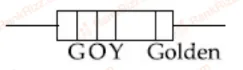
A carbon resistance has a following colour code. What is the value of the resistance?
GOY Golden
- A
- B
- C
- D
JEE MAIN 2019 · 09 APR S2Ohm's law, resistance, resistivity and colour codeTRANSCRIBED
A metal wire of resistance 3 Ω is elongated to make a uniform wire of double its previous length. This new wire is now bent and the ends joined to make a circle. If two points on this circle make an angle 60° at the center, the equivalent resistance between these two points will be:
- A
35 Ω
- B
512 Ω
- C
27 Ω
- D
25 Ω
JEE MAIN 2019 · 08 APR S1Ohm's law, resistance, resistivity and colour codeTRANSCRIBED
A 200 Ω resistor has certain colour code. If one replaced the red colour by green in the code, the new resistance will be:
- A
- B
- C
- D
JEE MAIN 2019 · 10 APR S1Ohm's law, resistance, resistivity and colour codeTRANSCRIBED
In an experiment, the resistance of a material is plotted as a function of temperature (in some range). As shown in the figure, it is a straight line.
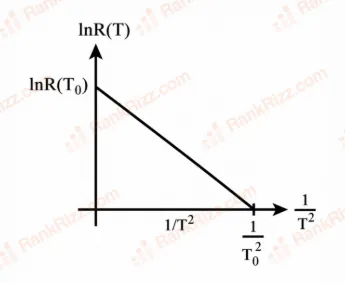
One may conclude that
- A
R(T)=R0eT2/T02
- B
R(T)=T2R0
- C
R(T)=R0e−T2/T02
- D
R(T)=R0e−T02/T2
JEE MAIN 2019 · 10 JAN S1Ohm's law, resistance, resistivity and colour codeTRANSCRIBED
A 2 W carbon resistor is color coded with green, black, red and silver respectively. The maximum current which can be passed through this resistor is:
- A
- B
- C
- D
JEE MAIN 2019 · 09 APR S2Ohm's law, resistance, resistivity and colour codeTRANSCRIBED
In a conductor, if the number of conduction electrons per unit volume is 8.5×1028 m−3 and mean free time is 25 fs (femto second), it's approximate resistivity is: (me=9.1×10⁻³¹ kg)
- A
10−7 Ω m
- B
10−6 Ω m
- C
10−5 Ω m
- D
10−8 Ω m
JEE MAIN 2019 · 09 JAN S1Ohm's law, resistance, resistivity and colour codeTRANSCRIBED
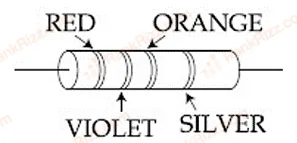
A resistance is shown in the figure. Its value and tolerance are given respectively by:
- A
- B
- C
- D
JEE MAIN 2019 · 10 APR S2Ohm's law, resistance, resistivity and colour codeTRANSCRIBED
Space between two concentric conducting spheres of radii a and b (b > a) is filled with a medium of resistivity ρ. The resistance between the two spheres will be:
- A
4πρ(a1+b1)
- B
2πρ(a1+b1)
- C
4πρ(a1−b1)
- D
2πρ(a1−b1)
JEE MAIN 2019 · 10 JAN S2Ohm's law, resistance, resistivity and colour codeTRANSCRIBED
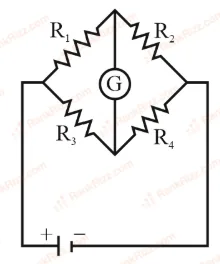
The Wheatstone bridge shown in the figure below, gets balanced when the carbon resistor used as R1 has the colour code (orange, red, brown). The resistors R2 and R4 are 80 Ω and 40 Ω, respectively. Assuming that the colour code for the carbon resistors gives their accurate values, the colour code for the carbon resistor, used as R3, would be:
- A
- B
- C
- D
JEE MAIN 2017 · 09 APR ONLINEOhm's law, resistance, resistivity and colour codeTRANSCRIBED
A uniform wire of length l and radius r has a resistance of 100 Ω. It is recast into a wire of radius 2r. The resistance of new wire will be-
- A
- B
- C
- D