JEE Main 2019 Physics question — Ohm's law, resistance, resistivity and colour code
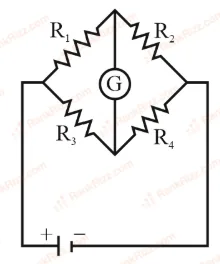
The Wheatstone bridge shown in the figure below, gets balanced when the carbon resistor used as has the colour code (orange, red, brown). The resistors and are 80 and 40 , respectively. Assuming that the colour code for the carbon resistors gives their accurate values, the colour code for the carbon resistor, used as , would be:
SOLUTION
For a Wheatstone bridge to be balanced, we apply the well-known balance condition
We are told that the carbon resistor used as has the colour code (orange, red, brown). Before proceeding, let us translate this colour code into an actual resistance value.
The standard 3-band colour code for a carbon resistor is:
• First band first significant digit
• Second band second significant digit
• Third band multiplier
Using the colour-digit table (black = 0, brown = 1, red = 2, orange = 3, yellow = 4, green = 5, blue = 6, violet = 7, grey = 8, white = 9), we have
So
The problem statement gives us
Now we substitute these values into the balance condition:
Rearranging to find the unknown , we get
Substituting the numerical values,
Simplify the fraction inside:
Hence
The next task is to convert into its colour code. Again using the 3-band scheme:
• First significant digit = 1 brown
• Second significant digit = 6 blue
• Multiplier required: (because ) brown
Therefore, the colour sequence for is
brown, blue, brown.
Looking at the given options, this corresponds to Option B (which is numbered 2 in the list).
Hence, the correct answer is Option 2.
Tagged Ohm's law, resistance, resistivity and colour code. Machine-assigned, so read it as a strong shortlist rather than a verdict.