JEE Main 2019 Physics question — Galvanometer conversion to ammeter and voltmeter
To verify Ohm's law, a student connects the voltmeter across the battery as shown in the figure. The measured voltage is plotted as a function of the current, and the following graph is obtained.
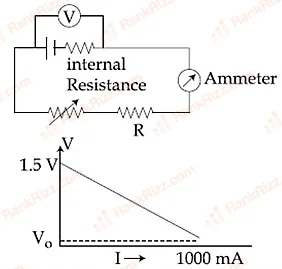
If V is almost zero, identify the correct statement:
SOLUTION
To find the electromotive force (, ) and the internal resistance () of the battery, we use the relationship between terminal potential difference (), current (), and internal resistance during discharging.
Here is the structured, step-by-step calculation based on the provided circuit and graph.
1. Governing Equation
The terminal voltage measured by the voltmeter across a battery supplying a current is given by the equation:
Rearranging this into the standard slope-intercept form of a straight line ():
- -intercept represents the electromotive force ().
- Slope of the line represents the negative internal resistance ().
- Correct Statement: The emf of the battery is and its internal resistance is .
- Correct Option: A
2. Finding the Electromotive Force ()
From the given graph, when the current in the circuit is zero ():
Substituting into our governing equation:
Thus, the emf of the battery is .
3. Finding the Internal Resistance ()
The graph shows that when the terminal potential difference falls to , the current reaches its maximum value:
Substituting , , and into the equation:
Thus, the internal resistance of the battery is .
Final Conclusion
Tagged Galvanometer conversion to ammeter and voltmeter. Machine-assigned, so read it as a strong shortlist rather than a verdict.