JEE MAIN 2020 · 09 JAN S1Head-on collisions and coefficient of restitutionTRANSCRIBED
Two particles of equal mass have respective initial velocities and . They collide completely inelastically. The energy lost in the process is:
- A
- B
- C
- D
Every JEE Main question on Head-on collisions and coefficient of restitution, one of the ideas inside Centre of Mass, Momentum & Collisions: 48 questions from 2008–2026, 12 of them in the last five years. Newest first, answer key on every one. Free to read.
Questions
48
Years asked
16
Since
2008
Of the chapter
36%
21–40 OF 48 · NEWEST FIRST
Two particles of equal mass have respective initial velocities and . They collide completely inelastically. The energy lost in the process is:
Particle A of mass moving with velocity collides with another particle B of mass which is at rest initially. Let and be the velocities of particles A and B after collision respectively. If and after collision , the angle between and is:
A block of mass 1.9 kg is at rest at the edge of a table, of height 1 m. A bullet of mass 0.1 kg collides with the block and sticks to it. If the velocity of the bullet is 20 m s in the horizontal direction just before the collision then the kinetic energy just before the combined system strikes the floor, is [Take g = 10 m s. Assume there is no rotational motion and loss of energy after the collision is negligible.]
21 J
20 J
19 J
23 J
Blocks of masses m, 2m, 4m and 8m are arranged in a line of a frictionless floor. Another block of mass m, moving with speed v along the same line (see figure) collides with mass m in perfectly inelastic manner. All the subsequent collisions are also perfectly inelastic. By the time the last block of mass 8m starts moving the total energy loss is p% of the original energy. Value of 'p' is close to:

77
94
37
87
A particle of mass is projected with a speed from the ground at an angle w.r.t. horizontal (x-axis). When it has reached its maximum height, it collides completely inelastically with another particle of the same mass and velocity . The horizontal distance covered by the combined mass before reaching the ground is:
A particle of mass m with an initial velocity collides perfectly elastically with a mass 3m at rest. It moves with a velocity after collision, then, v is given by:
A body A of mass kg has an initial velocity of m s. It collides elastically with another body B of the same mass which has an initial velocity of m s. After the collision, A moves with a velocity m s. The energy of B after the collision is written as J. The value of is
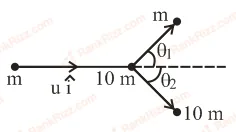
A particle of mass m is moving along the x-axis with initial velocity . It collides elastically with a particle of mass 10m at rest and then moves with half its initial kinetic energy (see figure). If , then value of n is ___________.
Two particles, of masses and , moving, as shown, with speeds of and , collide elastically at the origin. After the collision, they move along the indicated directions with speeds and , respectively. The values of and are nearly :
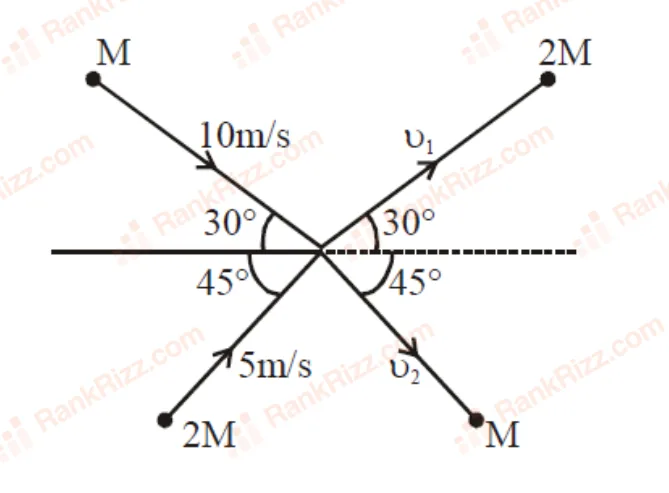
6.5 m s and 6.3 m s
3.2 m s and 12.6 m s
13.02 m s and 19.7 m s
3.2 m s and 6.3 m s
A simple pendulum, made of a string of length and a bob of mass , is released from a small angle . It strikes a block of mass , kept on horizontal surface at its lowest point of oscillations, elastically. It bounces back and goes up to an angle . Then M is given by:
A body of mass 1 kg falls freely from a height of 100 m, on a platform of mass 3 kg which is mounted on a spring having spring constant N/m. The body sticks to the platform and the spring's maximum compression is found to be . Given that , the value of will be close to:
40 cm
4 cm
80 cm
8 cm
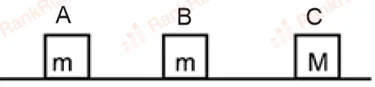
Three blocks A, B and C are lying on a smooth horizontal surface, as shown in the figure. A and B have equal masses, while C has mass . Block A is given an initial speed towards B due to which it collides with B perfectly inelastically. The combined mass collides with C, also perfectly inelastically. th of the initial kinetic energy is lost in the whole process. What is the value of ?
3
4
5
2
A piece of wood of mass 0.03 kg is dropped from the top of a 100 m height building. At the same time, a bullet of mass 0.02 kg is fired vertically upward, with a velocity 100 ms, from the ground. The bullet gets embedded in the wood. Then the maximum height to which the combined system reaches above the top of the building before falling below is: ( ms)
40 m
20 m
10 m
30 m
A body of mass 2 kg makes an elastic collision with a second body at rest and continues to move in the original direction but with one fourth of its original speed. What is the mass of the second body?
1.8 kg
1.2 kg
1.0 kg
1.5 kg
A particle of mass is moving with speed and collides with a mass moving with speed in the same direction. After the collision, the first mass is stopped completely while the second one splits into two particles each of mass , which move at an angle 45° with respect to the original direction. The speed of each of the moving particle will be:
A body of mass moving with an unknown velocity of , undergoes a collinear collision with a body of mass moving with a velocity . After the collision, and move with velocities of and , respectively. If and , then is:
An alpha-particle of mass m suffers 1-dimensional elastic collision with a nucleus at rest of unknown mass. It is scattered directly backwards losing 64% of its initial kinetic energy. The mass of the nucleus is
1.5m
4m
3.5m
5m
It is found that if a neutron suffers an elastic collinear collision with a deuterium at rest, the fractional loss of its energy is , while for its similar collision with a carbon nucleus at rest, the fractional loss of energy is . The values of and are respectively:
0, 1
0.89, 0.28
0.28, 0.89
0, 0
A proton of mass m collides elastically with a particle of unknown mass at rest. After the collision, the proton and the unknown particle are seen moving at an angle of 90 with respect to each other. The mass of unknown particle is:
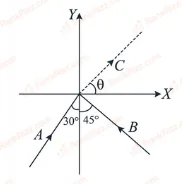
Two particles and of equal mass are moving with the same speed as shown in figure. They collide completely inelastic and move as a single particle . The angle that the path of makes with the X-axis is given by-
RELATED CENTRE OF MASS, MOMENTUM & COLLISIONS TOPICS