Radioactivity: decay law, half-life and decay modes — JEE Main Previous Year Questions
Every JEE Main question on Radioactivity: decay law, half-life and decay modes, one of the ideas inside Atoms & Nuclei: 104 questions from 2005–2026, 47 of them in the last five years. Newest first, answer key on every one. Free to read.
Every Radioactivity: decay law, half-life and decay modes question
41–60 OF 104 · NEWEST FIRST
JEE MAIN 2022 · 29 JUN S1Radioactivity: decay law, half-life and decay modesTRANSCRIBED
The activity of a radioactive material is 2.56×10⁻³ Ci. If the half life of the material is 5 days, after how many days the activity will become 2×10⁻⁵ Ci?
JEE MAIN 2022 · 29 JUN S2Radioactivity: decay law, half-life and decay modesTRANSCRIBED
In the following nuclear reaction, DαD1βD2αD3γD4 Mass number of D is 182 and atomic number is 74. Mass number and atomic number of D4 respectively will be
JEE MAIN 2022 · 29 JUL S2Radioactivity: decay law, half-life and decay modesTRANSCRIBED
Read the following statements: (A) Volume of the nucleus is directly proportional to the mass number. (B) Volume of the nucleus is independent of mass number. (C) Density of the nucleus is directly proportional to the mass number. (D) Density of the nucleus is directly proportional to the cube root of the mass number. (E) Density of the nucleus is independent of the mass number. Choose the correct option from the following options.
JEE MAIN 2022 · 24 JUN S2Radioactivity: decay law, half-life and decay modesTRANSCRIBED
A sample contains 10−2 kg each of two substances A and B with half lives 4 s and 8 s respectively. The ratio of their atomic weights is 1:2. The ratio of the amounts of A and B after 16 s is 100x. The value of x is ______.
JEE MAIN 2022 · 29 JUN S2Radioactivity: decay law, half-life and decay modesTRANSCRIBED
The half life of a radioactive substance is 5 years. After x years a given sample of the radioactive substance gets reduced to 6.25% of its initial value. The value of x is ______.
JEE MAIN 2022 · 29 JUL S2Radioactivity: decay law, half-life and decay modesTRANSCRIBED
Two radioactive materials A and B have decay constants 25λ and 16λ respectively. If initially they have the same number of nuclei, then the ratio of the number of nuclei of B to that of A will be 'e' after a time aλ1. The value of a is _____
JEE MAIN 2022 · 28 JUL S1Radioactivity: decay law, half-life and decay modesTRANSCRIBED
A freshly prepared radioactive source of half life 2 hours 30 minutes emits radiation which is 64 times the permissible safe level. The minimum time, after which it would be possible to work safely with source, will be _____ hours.
JEE MAIN 2021 · 25 FEB S1Radioactivity: decay law, half-life and decay modesTRANSCRIBED
Two radioactive substances X and Y originally have N1 and N2 nuclei respectively. Half life of X is half of the half life of Y. After three half lives of Y, number of nuclei of both are equal. The ratio N2N1 will be equal to:
JEE MAIN 2021 · 25 JUL S1Radioactivity: decay law, half-life and decay modesTRANSCRIBED
Some nuclei of a radioactive material are undergoing radioactive decay. The time gap between the instances when a quarter of the nuclei have decayed and when half of the nuclei have decayed is given as: (where λ is the decay constant)
JEE MAIN 2021 · 20 JUL S1Radioactivity: decay law, half-life and decay modesTRANSCRIBED
A radioactive material decays by simultaneous emissions of two particles with half lives of 1400 years and 700 years, respectively. What will be the time after the which one third of the material remains? (Take ln 3 = 1.1)
JEE MAIN 2021 · 31 AUG S1Radioactivity: decay law, half-life and decay modesTRANSCRIBED
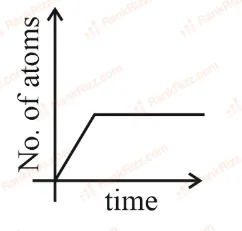
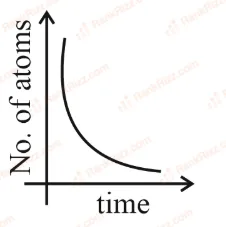
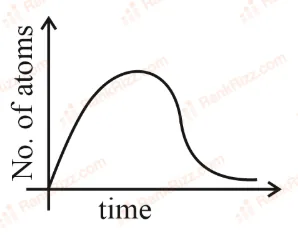
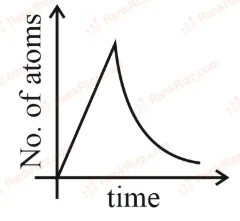
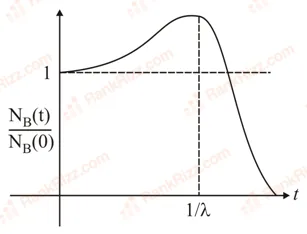
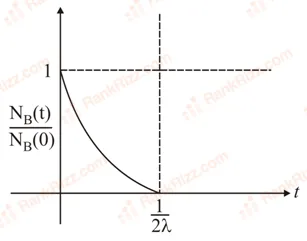
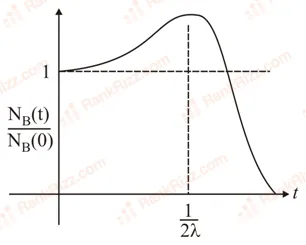
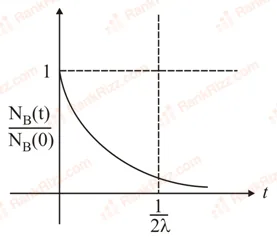
A sample of a radioactive nucleus A disintegrates to another radioactive nucleus B, which in turn disintegrates to some other stable nucleus C. Plot of a graph showing the variation of number of atoms of nucleus B versus time is: (Assume that at t=0, there are no B atoms in the sample)
JEE MAIN 2021 · 26 AUG S2Radioactivity: decay law, half-life and decay modesTRANSCRIBED
At time t=0, a material is composed of two radioactive atoms A and B, where NA(0)=2NB(0). The decay constant of both kind of radioactive atoms is λ. However, A disintegrates to B and B disintegrates to C. Which of the following figures represents the evolution of NB(0)NB(t) with respect to time t?
JEE MAIN 2021 · 27 JUL S1Radioactivity: decay law, half-life and decay modesTRANSCRIBED
If f denotes the ratio of the number of nuclei decayed (Nd) to the number of nuclei at t=0, (N0) then for a collection of radioactive nuclei, the rate of change of f with respect to time is given as: [λ is the radioactive decay constant]
JEE MAIN 2021 · 27 JUL S2Radioactivity: decay law, half-life and decay modesTRANSCRIBED
Consider the following statements: A. Atoms of each element emit characteristics spectrum. B. According to Bohr's Postulate, an electron in a hydrogen atom revolves in a certain stationary orbit. C. The density of nuclear matter depends on the size of the nucleus. D. A free neutron is stable but a free proton decay is possible. E. Radioactivity is an indication of the instability of nuclei. Choose the correct answer from the options given below.
JEE MAIN 2021 · 01 SEP S2Radioactivity: decay law, half-life and decay modesTRANSCRIBED
The half life period of a radioactive element x is same as the mean life time of another radioactive element y. Initially they have the same number of atoms. Then:
A
x and y decay at the same rate always.
B
x-will decay faster than y.
C
y-will decay faster than x.
D
x and y have same decay rate initially and later on different decay rate.