A radioactive sample is undergoing decay. At any time , its activity is and another time , the activity is . What is the average life time for the sample?
- A
- B
- C
- D
Every JEE Main question on Radioactivity: decay law, half-life and decay modes, one of the ideas inside Atoms & Nuclei: 104 questions from 2005–2026, 47 of them in the last five years. Newest first, answer key on every one. Free to read.
Questions
104
Years asked
20
Since
2005
Of the chapter
34%
61–80 OF 104 · NEWEST FIRST
A radioactive sample is undergoing decay. At any time , its activity is and another time , the activity is . What is the average life time for the sample?
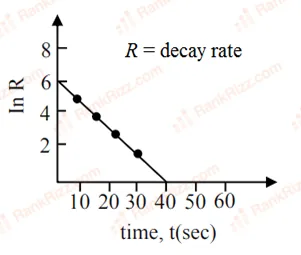
For a certain radioactive process, the graph between ln R and (sec) is obtained as shown in the figure. Then the value of half life for the unknown radioactive material is approximately:

9.15 sec
6.93 sec
2.62 sec
4.62 sec
The nuclear activity of a radioactive element becomes of its initial value in 30 years. The half-life of radioactive element is _________ years.
A radioactive sample has an average life of 30 ms and is decaying. A capacitor of capacitance 200 F is first charged and later connected with resistor . If the ratio of the charge on the capacitor to the activity of the radioactive sample is fixed with respect to time then the value of should be _________ .
A radioactive substance decays to of its initial activity in 80 days. The half life of the radioactive substance expressed in days is ___.
In a radioactive material, a fraction of active material remaining after the time is . The fraction that was remaining after the time is:
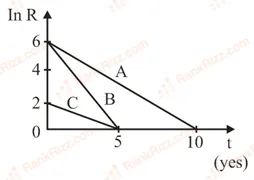
Activities of three radioactive substances , and are represented by the curves , and , in the figure. Then their half-lives are in the ratio:

A radioactive nucleus decays by two different processes. The half-life for the first process is and that for the second is . The effective half-life of the nucleus is close to:
9 s
6 s
55 s
12 s
The radius R of a nucleus of mass number A can be estimated by the formula m. It follows that the mass density of n nucleus is of the order of: kg)
kg m
kg m
kg m
kg m
Given the masses of various atomic particles , , , , , where p = proton, n = neutron, e = electron, = antineutrino and d = deuteron. Which of the following process is allowed by momentum and energy conservation:
deuterium atom (electron bound to the nucleus)
The activity of a radioactive sample falls from 700 s to 500 s in 30 minutes. Its half life is close to:
72 min
62 min
66 min
52 min
Two radioactive materials A and B have decay constants and , respectively. If initially they have the same number of nuclei, then the ratio of the number of nuclei of A to that of B will be 1/e after a time:
At a given instant, say , two radioactive substance A and B have equal activities. The ratio of their activities after time itself decays with time as . If the half-life of A is , the half-life of B is:
Using a nuclear counter the count rate of emitted particles from a radioactive source is measured. At it was 1600 counts per second and seconds it was 100 counts per second. The count rate observed, as counts per second, at seconds is close to:
400
200
150
360
In a radioactive decay chain, the initial nucleus is . At the end, there are 6 -particles and 4-particles which are emitted. If the end nucleus is , A and Z are given by:
A = 208; Z = 82
A = 208; Z = 80
A = 200; Z = 81
A = 202; Z = 80
Half lives of two radioactive nuclei A and B are 10 minutes and 20 minutes, respectively. If, initially a sample has equal number of nuclei, then after 60 minutes, the ratio of decayed numbers of nuclei A and B will be:
3 : 8
8 : 1
1 : 8
9 : 8
The ratio of mass densities of nuclei of Ca and O is close to:
1
0.1
2
5
Two radioactive substances A and B have decay constants and respectively. At t = 0, a sample has the same number of the two nuclei. The time taken for the ratio of the number of nuclei to become will be
A Sample of radioactive material A, that has an activity of 10 mCi (1 Ci decays s), has twice the number of nuclei as another sample of a different radioactive material B which has an activity of 20 mCi. The correct choices for half-lives of A and B would then be, respectively:
5 days and 10 days
10 days and 40 days
20 days and 10 days
20 days and 5 days
Both the nucleus and the atom of some element are in their respective first excited states. They get de-excited by emitting photons of wavelengths , respectively. The ratio is closest to:
10