RankRizz

Thermodynamic principles and Ellingham diagram — JEE Main Previous Year Questions

Every JEE Main question on Thermodynamic principles and Ellingham diagram, one of the ideas inside General Principles and Processes of Isolation of Metals: 20 questions from 2008–2023, 17 of them in the last five years. Newest first, answer key on every one. Free to read.

Questions

20

Years asked

8

Since

2008

Of the chapter

17%

When JEE Main asked it

Questions on Thermodynamic principles and Ellingham diagram in each year it was asked.

20234
20222
20216
20203
20192
20151
20121
20081

Every Thermodynamic principles and Ellingham diagram question

1–20 OF 20 · NEWEST FIRST

JEE MAIN 2023 · 10 APR S2Thermodynamic principles and Ellingham diagramTRANSCRIBED

Gibbs energy vs T plot for the formation of oxides is given below. For the given diagram, the correct statement is-
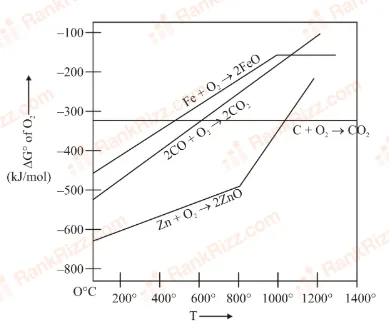
Figure for JEE Main 2023 Chemistry question on Thermodynamic principles and Ellingham diagram
  1. A

    At 600∘^\circC, CO cannot reduce FeO

  2. B

    At 600∘^\circC, CO can reduce ZnO

  3. C

    At 600∘^\circC, C can reduce ZnO

  4. D

    At 600∘^\circC, C can reduce FeO

JEE MAIN 2023 · 01 FEB S1Thermodynamic principles and Ellingham diagramTRANSCRIBED

Given below are two statements:
Assertion A: In an Ellingham diagram, the oxidation of carbon to carbon monoxide shows a negative slope with respect to temperature.
Reason R: CO tends to get decomposed at higher temperature.

  1. A

    Both A and R are correct and R is the correct explanation of A

  2. B

    A is not correct but R is correct

  3. C

    Both A and R are correct but R is NOT the correct explanation of A

  4. D

    A is correct but R is not correct

JEE MAIN 2023 · 13 APR S2Thermodynamic principles and Ellingham diagramTRANSCRIBED

Given below are two statements related to Ellingham diagram :
Statement I : Ellingham diagrams can be constructed for formation of oxides, sulphides and halides of metals.
Statement II : It consists of plots of ΔH°\Delta H° vs T for formation of oxides of elements.
In the light of the above statements, choose the most appropriate answer from the options given below :

  1. A

    Both Statement I and Statement II are correct

  2. B

    Both Statement I and Statement II are incorrect

  3. C

    Statement I is correct but Statement II is incorrect

  4. D

    Statement I is incorrect but Statement II is correct

JEE MAIN 2023 · 12 APR S1Thermodynamic principles and Ellingham diagramTRANSCRIBED

Given below are two statements: one is labelled as Assertion A and the other is labelled as Reason R
Assertion A: In the Ellingham diagram, a sharp change in slope of the line is observed from Mg →\to MgO at ~1120°C
Reason R: There is a large change of entropy associated with the change of state
In the light of the above statements, choose the correct answer from the options given below

  1. A

    Both A and R are true but R is NOT the correct explanation of A

  2. B

    A is false but R is true

  3. C

    Both A and R are true and R is the correct explanation of A

  4. D

    A is true but R is false

JEE MAIN 2022 · 28 JUN S1Thermodynamic principles and Ellingham diagramTRANSCRIBED

Given are two statements one is labelled as Assertion and other is labelled as Reason.
Assertion: Magnesium can reduce Al2O3Al_2O_3 at a temperature below 1350°1350°C, while above 1350°1350°C aluminium can reduce MgO.
Reason: The melting and boiling points of magnesium are lower than those of aluminium.

  1. A

    Both Assertion and Reason are correct, and Reason is correct explanation of Assertion.

  2. B

    Both Assertion and Reason are correct, but Reason is NOT the correct explanation of Assertion.

  3. C

    Assertion is correct Reason is not correct.

  4. D

    Assertion is not correct, Reason is correct.

JEE MAIN 2022 · 26 JUN S1Thermodynamic principles and Ellingham diagramTRANSCRIBED

Given below are two statements :
Statement I : According to the Ellingham diagram, any metal oxide with higher ΔG°\Delta G° is more stable than the one with lower ΔG°\Delta G°.
Statement II : The metal involved in the formation of oxide placed lower in the Ellingham diagram can reduce the oxide of a metal placed higher in the diagram.
In the light of the above statements, choose the most appropriate answer from the options given below

  1. A

    Both Statement I and Statement II are correct.

  2. B

    Both Statement I and Statement II are incorrect.

  3. C

    Statement I is correct but Statement II is incorrect.

  4. D

    Statement I is incorrect but Statement II is correct.

JEE MAIN 2021 · 16 MAR S2Thermodynamic principles and Ellingham diagramTRANSCRIBED

Which of the following reduction reaction CANNOT be carried out with coke?

  1. A

    Al2O3→AlAl_2O_3 \to Al

  2. B

    ZnO→ZnZnO \to Zn

  3. C

    Fe2O3→FeFe_2O_3 \to Fe

  4. D

    Cu2O→CuCu_2O \to Cu

JEE MAIN 2021 · 16 MAR S1Thermodynamic principles and Ellingham diagramTRANSCRIBED

The process that involves the removal of sulphur from the ores is:

  1. A

    Smelting

  2. B

    Roasting

  3. C

    Leaching

  4. D

    Refining

JEE MAIN 2021 · 27 JUL S1Thermodynamic principles and Ellingham diagramTRANSCRIBED

The statement that is INCORRECT about Ellingham diagram is

  1. A

    provides idea about the reaction rate.

  2. B

    provides idea about free energy change.

  3. C

    provides idea about changes in the phases during the reaction.

  4. D

    provides idea about reduction of metal oxide.

JEE MAIN 2021 · 17 MAR S1Thermodynamic principles and Ellingham diagramTRANSCRIBED

The point of intersection and sudden increase in the slope, in the diagram given below, respectively, indicates:

Figure for JEE Main 2021 Chemistry question on Thermodynamic principles and Ellingham diagram
  1. A

    ΔG=0\Delta G = 0 and melting or boiling point of the metal oxide

  2. B

    ΔG>0\Delta G > 0 and decomposition of the metal oxide

  3. C

    ΔG<0\Delta G < 0 and decomposition of the metal oxide

  4. D

    ΔG=0\Delta G = 0 and reduction of the metal oxide

JEE MAIN 2021 · 26 AUG S1Thermodynamic principles and Ellingham diagramTRANSCRIBED

Given below are two statements.
Statement I: The choice of reducing agents for metals extraction can be made by using the Ellingham diagram, a plot of ΔG\Delta G vs temperature.
Statement II: The value of ΔS\Delta S increases from left to right in the Ellingham diagram.
In the light of the above statements, choose the most appropriate answer from the options given below:

  1. A

    Statement I is false but Statement II is true

  2. B

    Both Statement I and Statement II are true

  3. C

    Statement I is true but Statement II is false

  4. D

    Both Statement I and Statement II are false

JEE MAIN 2021 · 25 FEB S1Thermodynamic principles and Ellingham diagramTRANSCRIBED

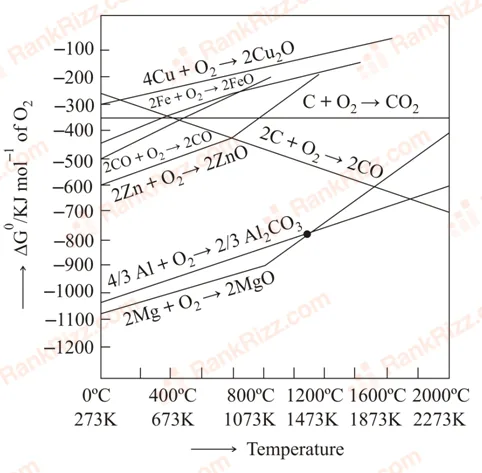
Ellingham diagram is a graphical representation of:

  1. A

    ΔG\Delta G vs P

  2. B

    (ΔG−TΔS)(\Delta G - T\Delta S) vs T

  3. C

    ΔH\Delta H vs T

  4. D

    ΔG\Delta G vs T

JEE MAIN 2020 · 06 SEP S2Thermodynamic principles and Ellingham diagramTRANSCRIBED

For a reaction 4M(s)+nO2(g)→2M2On(s)4M(s) + nO_2(g) \to 2M_2O_n(s). The free energy change is plotted as a function of temperature. The temperature below which the oxide is stable could be inferred from the plot as the point at which:

  1. A

    the slope change from negative to positive

  2. B

    the free energy change show a change from negative to positive value

  3. C

    the slope changes from positive to negative

  4. D

    the slope changes from positive to zero

JEE MAIN 2020 · 05 SEP S1Thermodynamic principles and Ellingham diagramTRANSCRIBED

An Ellingham diagram provides information about:

  1. A

    the conditions of pH and potential under which a species is thermodynamically stable

  2. B

    the temperature dependence of the standard Gibbs energies of formation of some metal oxides

  3. C

    the pressure dependence of the standard electrode potentials of reduction reactions involved in the extraction of metals

  4. D

    the kinetics of the reduction process

JEE MAIN 2020 · 09 JAN S1Thermodynamic principles and Ellingham diagramTRANSCRIBED

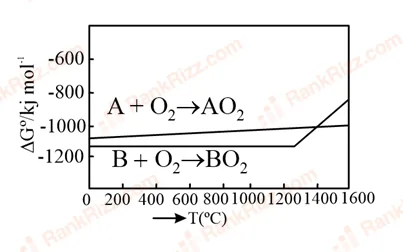
According to the following diagram, A reduces BO2BO_2 when the temperature is:

Figure for JEE Main 2020 Chemistry question on Thermodynamic principles and Ellingham diagram
  1. A

    <1400°C< 1400°C

  2. B

    >1400°C> 1400°C

  3. C

    >1200°C> 1200°C but <1400°C< 1400°C

  4. D

    <1200°C< 1200°C

JEE MAIN 2019 · 09 JAN S2Thermodynamic principles and Ellingham diagramTRANSCRIBED

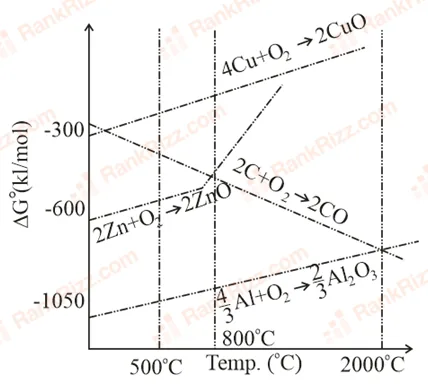
The correct statement regarding the given Ellingham diagram is:

Figure for JEE Main 2019 Chemistry question on Thermodynamic principles and Ellingham diagram
  1. A

    At 1400∘^{\circ}C, Al can be used for the extraction of Zn from ZnO

  2. B

    At 500∘^{\circ}C, coke can be used for the extraction of Zn from ZnO

  3. C

    At 800∘^{\circ}C, Cu can be used for the extraction of Zn from ZnO

  4. D

    Coke cannot be used for the extraction of Cu from Cu2_2O

JEE MAIN 2019 · 08 APR S1Thermodynamic principles and Ellingham diagramTRANSCRIBED

Which respect to an ore, Ellingham diagram helps to predict the feasibility of its:

  1. A

    Electrolysis

  2. B

    Zone refining

  3. C

    Vapour phase refining

  4. D

    Thermal reduction

JEE MAIN 2015 · 10 APR ONLINEThermodynamic principles and Ellingham diagramTRANSCRIBED

In the isolation of metals, calcination process usually results in:

  1. A

    Metal oxide

  2. B

    Metal carbonate

  3. C

    Metal sulphide

  4. D

    Metal hydroxide

JEE MAIN 2012Thermodynamic principles and Ellingham diagramTRANSCRIBED

Which of the oxide groups among the following cannot be reduced by carbon?

  1. A

    Cu2O,SnO2\text{Cu}_2\text{O}, \text{SnO}_2

  2. B

    CaO, K2O\text{K}_2\text{O}

  3. C

    PbO, Fe2O4\text{Fe}_2\text{O}_4

  4. D

    Fe2O3\text{Fe}_2\text{O}_3, ZnO

JEE MAIN 2008Thermodynamic principles and Ellingham diagramTRANSCRIBED

Which of the following factors is of no significance for roasting sulphide ores to the oxides and not subjecting the sulphide ores to carbon reduction directly?

  1. A

    Metal sulphides are thermodynamically more stable than CS2CS_2

  2. B

    CO2CO_2 is thermodynamically more stable than CS2CS_2

  3. C

    Metal sulphides are less stable than the corresponding oxides

  4. D

    CO2CO_2 is more volatile than CS2CS_2