JEE Main 2020 Chemistry question — Thermodynamic principles and Ellingham diagram
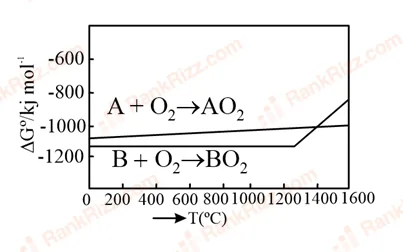
According to the following diagram, A reduces when the temperature is:
SOLUTION
Ellingham Diagram:
-
Stability of Oxides:
On an Ellingham diagram, a lower position (more negative value) indicates a more stable oxide. The metal corresponding to the lower curve has a higher affinity for oxygen.
-
Criteria for Reduction:
For a metal to reduce another metal's oxide, the free energy of formation of its own oxide must be more negative than that of the oxide being reduced. In graphical terms, a metal can reduce the oxide of any metal whose line lies above its own line on the diagram.
Step-by-Step Analysis of the Graph:
-
Below :
The curve for the formation of () lies below the curve for (). This means that below , is more stable than , and B can reduce , but A cannot reduce .
-
At the Intersection Point ():
The two curves intersect. At this specific temperature, the standard Gibbs free energy change () for both oxidation reactions is equal, meaning the system is in a state of dynamic equilibrium.
-
Above :
The curve for the formation of cross over and now lies below the curve of . As a result, becomes thermodynamically more stable than . Therefore, element A can spontaneously reduce to element B according to the net reaction:
Conclusion:
Element A reduces only in the temperature region where the line for is below the line for , which occurs when the temperature is greater than .
Answer: Option B —
Tagged Thermodynamic principles and Ellingham diagram. Machine-assigned, so read it as a strong shortlist rather than a verdict.