JEE Main 2021 Chemistry question — Thermodynamic principles and Ellingham diagram
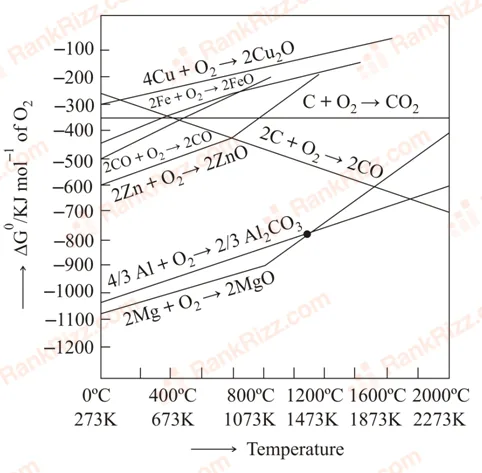
The point of intersection and sudden increase in the slope, in the diagram given below, respectively, indicates:
SOLUTION
In an Ellingham diagram, the vertical axis represents for oxide formation, while temperature is plotted on the horizontal axis.
Point of intersection of two lines indicates the temperature at which the standard Gibbs free energies of formation of both oxides become equal.
At this temperature:
for the corresponding reduction reaction, and the system is at equilibrium.
For example, at the intersection of the Mg and lines, neither metal can reduce the oxide of the other.
Below this temperature, the metal represented by the lower line can reduce the oxide represented by the upper line.
The slope of an Ellingham line is equal to:
A sudden increase in slope indicates that has become more negative.
This occurs when the metal undergoes a phase transition such as:
or
Thus:
1. Point of intersection indicates for the reduction reaction.
2. Sudden increase in slope indicates phase change of the metal.
Tagged Thermodynamic principles and Ellingham diagram. Machine-assigned, so read it as a strong shortlist rather than a verdict.