JEE MAIN 2026 · 21 JAN S2Electrode potentials, electrochemical series and cell EMFTRANSCRIBED
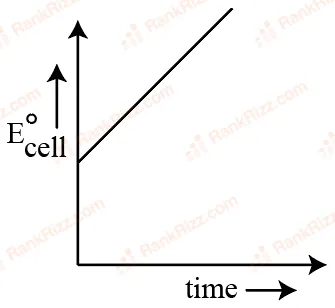
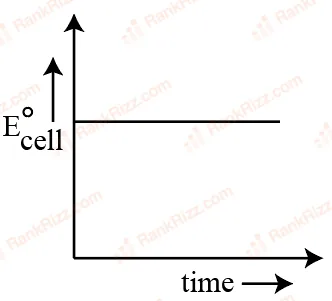
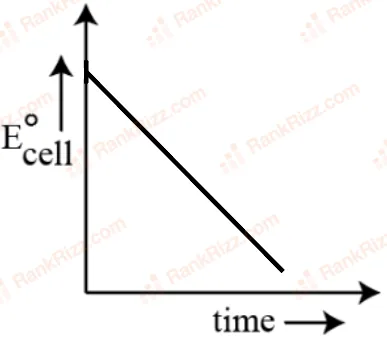
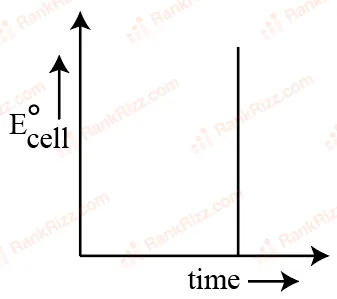
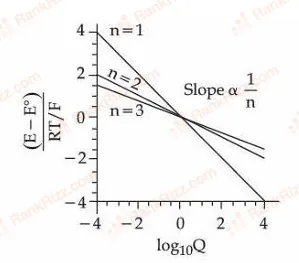
For a closed circuit Daniell cell, which of the following plots is the accurate one at a given temperature?
- A
- B
- C
- D
Every JEE Main question on Electrode potentials, electrochemical series and cell EMF, one of the ideas inside Electrochemistry: 106 questions from 2004–2026, 62 of them in the last five years. Newest first, answer key on every one. Free to read.
Questions
106
Years asked
15
Since
2004
Of the chapter
47%
Questions on Electrode potentials, electrochemical series and cell EMF in each year it was asked, the latest 12 of 15.
1–20 OF 106 · NEWEST FIRST
For a closed circuit Daniell cell, which of the following plots is the accurate one at a given temperature?
Given at 298 K :
Volt
Volt
The in Volt at 298 K is given by :
An electrochemical cell is constructed using half cells in the direction of spontaneous change
Fe(OH)(s) + 2e Fe(s) + 2OH(aq) E = −0.88 V
and AgBr(s) + e Ag(s) + Br(aq) E = +0.07 V
Which of the following option is correct?
Overall reaction Fe(s)+2OH(aq)+2AgBr(s) Fe(OH)(s)+2Ag(s)+2Br(aq)
V
Fe is reduced in the electrochemical cell
is an extensive property
One half cell in a voltaic cell is constructed by dipping silver rod in solution of unknown concentration, other half cell is Zn rod dipped in 1 molar solution of . A voltage of is measured at for this cell. What is the concentration of ions used in terms of ?
For a general redox reaction
Anode:
Cathode:
Which of the following statement is **incorrect** ?
The overall reaction can be written as
The electrons do not appear in the overall reaction because electrons produced at the anode are consumed at the cathode.
Here n is the number of electrons transferred in redox reaction.
If the reaction is carried out reversibly, the electrical work done is equal to the ratio of charge and potential difference through which charge is moved.
Consider the following reduction processes :
The tendency to act as reducing agent decreases in the order :
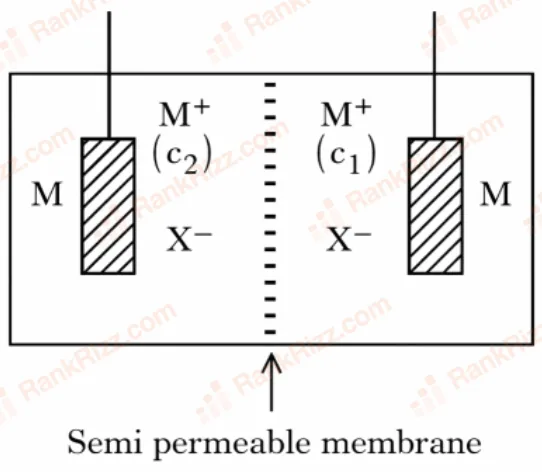
Consider the above electrochemical cell where a metal electrode (M) is undergoing redox reaction by forming . The cation is present in two different concentrations and as shown above. which of the following statement is correct for generating a positive cell potential?
If is present at anode, then .
If is present at cathode, then .
If is present at cathode, then .
If is present at anode then .
In the given electrochemical cell, , at298 K, theceU potential will increase when:
A. Concentration of is increased.
B. Concentration of is decreased.
C. Concentration of is decreased.
D. Concentration of is increased.
E. Concentration of is increased.
Choose the correct answer from the options given below :
B Only
A and B Only
C, D and E Only
A and E Only
Consider the following electrochemical cell : ,
The pH above which , oxygen gas would start to evolve at anode is ____ (nearest integer).
[Given: , are standard reduction potential and at the given condition]
A volume of x mL of 5 M solution was mixed with 10 mL of 2 M solution to make an electrolytic buffer. If the same buffer was used in the following electrochemical cell to record a cell potential of 235.3 mV, then the value of x=_______ mL (nearest integer).
Consider upto one place of decimal for intermediate calculations
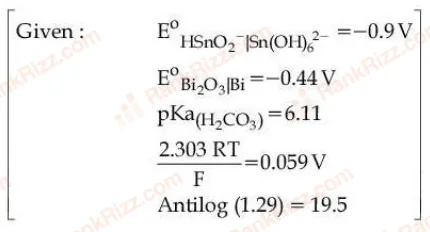
Consider the following electrochemical cell at 298K
.
If the reaction quotient at a given time is , then the cell is _____ (Nearest integer).
Given the standard half-cell reduction potential as
An electrochemical cell, consist of the following two redox couples, M(aq)/M(s) [ V] and Fe(aq)/Fe(s) [ V]. The cell EMF (E) is recorded to be 0.2057 V. If the reaction quotient of the electrochemical reaction is found to be , then the value of is __________. (Nearest integer)
[Given: M is a p-block metal and V]
MX is a sparingly soluble salt that follows the given solubility equilibrium at 298 K.
If the standard reduction potential for and , then the value of the standard reduction potential for the metal/metal insoluble salt electrode is __________mV.(nearest integer)
[Given : ]
Consider the following redox reaction taking place in acidic medium
If the Nerst equation for the above balanced reaction is , then the value of n is______.(Nearest integer)
In the above diagram, the standard electrode potentials are given in volts (over the arrow). The value of is
2.1 V
1.7 V
1.4 V
1.2 V
Based on the data given below: the strongest reducing agent is:
Standard electrode potentials for a few half cells are mentioned below :
Which one of the following cells gives the most negative value of ?
The standard reduction potential values of some of the p-block ions are given below. Predict the one with the strongest oxidising capacity.
For the given cell the standard cell potential of the above reaction is Given:
For a the correct Nernst Equation is :