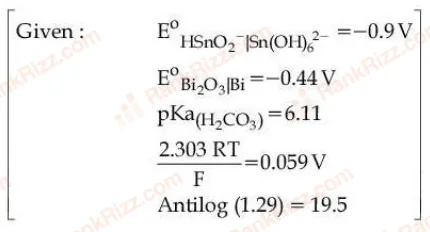
We need to determine the volume x mL of 5 M NaHCO3 required to form an electrolytic buffer used in the given electrochemical cell.
1. Determine Standard Cell Potential (Ecell∘):
- The overall cell reaction consists of:
- Anode (Oxidation): 3HSnO2−+3OH−+6H2O→3[Sn(OH)6]2−+6e−(Eox∘=+0.9 V)
- Cathode (Reduction): Bi2O3+3H2O+6e−→2Bi+6OH−(Ered∘=−0.44 V)
- Net Cell Reaction:
3HSnO2−(aq)+Bi2O3(s)+9H2O(l)→3[Sn(OH)6]2−(aq)+2Bi(s)+3OH−(aq)
- Standard Cell Potential:
Ecell∘=Eox∘+Ered∘=0.9 V−0.44 V=0.46 V
2. Apply Nernst Equation to Calculate pOH and pH:
Using the Nernst equation at 298 K for n=6 electrons transferred:
Ecell=Ecell∘−60.059log([HSnO2−]3[Sn(OH)62−]3⋅[OH−]3)
Substitute the given concentrations ([Sn(OH)62−]=0.5 M, [HSnO2−]=0.05 M) and the observed cell potential (Ecell=0.2353 V):
0.2353=0.46−60.059log((0.050.5)3⋅[OH−]3)
0.2353=0.46−60.059⋅3log([OH−]10)
0.2353=0.46−20.059log([OH−]10)
20.059log([OH−]10)=0.46−0.2353=0.2247
log([OH−]10)=0.0592×0.2247=7.6
log(10)−log[OH−]=7.6⟹1+pOH=7.6⟹pOH=6.6
pH=14−pOH=14−6.6=7.4
3. Apply Henderson-Hasselbalch Equation for the Buffer:
The electrolytic buffer is formed by weak acid H2CO3 and its conjugate base NaHCO3:
pH=pKa+log([H2CO3][HCO3−])
7.4=6.11+log(Millimoles of H2CO3Millimoles of NaHCO3)
1.29=log(10×25x)
205x=101.29
Using the given value Antilog(1.29)=19.5:
4x=19.5⟹x=19.5×4=78 mL
Answer: 78