Consider the following data.
| Electrolyte | (S cm mol) |
|---|---|
| BaCl | |
| HSO | |
| HCl |
BaSO is sparingly soluble in water. If the conductivity of the saturated BaSO solution is S cm then the solubility product of BaSO can be given as
(Here )
- A
- B
- C
- D
Every JEE Main question on Conductance, conductivity and molar conductivity, one of the ideas inside Electrochemistry: 70 questions from 2005–2026, 42 of them in the last five years. Newest first, answer key on every one. Free to read.
Questions
70
Years asked
14
Since
2005
Of the chapter
31%
Questions on Conductance, conductivity and molar conductivity in each year it was asked, the latest 12 of 14.
1–20 OF 70 · NEWEST FIRST
Consider the following data.
| Electrolyte | (S cm mol) |
|---|---|
| BaCl | |
| HSO | |
| HCl |
BaSO is sparingly soluble in water. If the conductivity of the saturated BaSO solution is S cm then the solubility product of BaSO can be given as
(Here )
Molar conductivity of a weak acid HQ of concentration 0.18 M was found to be 1/30 of the molar conductivity of another weak acid HZ with concentration of 0.02M. If happened to be equal with , then the difference of the values of the two weak acids is ___ (Nearest integer).
[Given: degree of dissociation () << 1 for both weak acids, : limiting molar conductivity of ions]
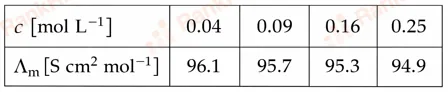
For strong electrolyte increases slowly with dilution and can be represented by the equation
Molar conductivity values of the solutions of strong electrolyte AB at 18°C are given below:
The value of constant A based on the above data [in S ]unit is_______.
Electricity is passed through an acidic solution of till all the Cu2+ was exhausted, leading to the deposition of 300 mg of Cu metal. However, a current of 600 mA was continued to pass through the same solution for another 28 minutes by keeping the total volume of the solution fixed at 200 mL. The total volume of oxygen evolved at STP during the entire process is __ mL. (Nearest integer)
[Given:
Molar mass of Cu= 63.54 g
Molar mass of = 32 g
Farnday Constant = 96500 C
Molar volume at STP = 22.4 L]
At 298 K, the molar conductivity of an (w/w) MX solution is 123.5 S cm. The conductance of same solution is . The value of x is ______ .
(Given: Cell constant = 1.3 cm, molar mass of MX = 75 , density of aqueous solution of at 298 K is 1.0 )
The pH and conductance of a weak acid (HX) was found to be 5 and . respectively. The conductance was measured under standard condition using a cell where the electrode plates having a surface area of 1 were at a distance of 15 cm apart. The value of the limiting molar conductivity is ______ S (nearest integer)
(Given : degree of dissociation of the weak acid () < < 1)
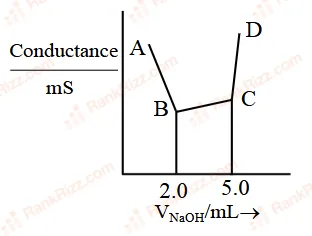
40 mL of a mixture of and HCl (aqueous solution) is titrated against 0.1 M NaOH conductometrically. Which of the following statement is correct?

The concentration of in the original mixture is 0.005 M
The concentration of HCl in the original mixture is 0.005 M
is neutralised first followed by neutralisation of HCl
Point 'C' indicates the complete neutralisation of HCl
gas will be evolved as a product of electrolysis of : (A) an aqueous solution of using silver electrodes. (B) an aqueous solution of using platinum electrodes. (C) a dilute solution of using platinum electrodes. (D) a high concentration solution of using platinum electrodes. Choose the correct answer from the options given below :
(A) and (C) only
(B) and (C) only
(A) and (D) only
(B) and (D) only
Which of the following electrolyte can be used to obtain by the process of electrolysis?
Dilute solution of sodium sulphate.
Acidified dilute solution of sodium sulphate.
Dilute solution of sulphuric acid
Concentrated solution of sulphuric acid
The molar conductivity of a weak electrolyte when plotted against the square root of its concentration, which of the following is expected to be observed ?
A small decrease in molar conductivity is observed at infinite dilution.
Molar conductivity decreases sharply with increase in concentration.
A small increase in molar conductivity is observed at infinite dilution.
Molar conductivity increases sharply with increase in concentration.
Correct order of limiting molar conductivity for cations in water at 298 K is :
Given below are two statements :
1 M aqueous solution of each of , , ; are electrolysed using inert electrodes.
Given :
and
Statement (I) : With increasing voltage, the sequence of deposition of metals on the cathode will be Ag, Hg and Cu
Statement (II) : Magnesium will not be deposited at cathode instead oxygen gas will be evolved at the cathode.
In the light of the above statement, choose the most appropriate answer from the options given below :
Both statement I and statement II are incorrect
Statement I is correct but Statement II is incorrect
Both statement I and statement II are correct
Statement I is incorrect but Statement II is correct
Electrolysis of 600 mL aqueous solution of NaCl for 5 min changes the pH of the solution to 12 . The current in Amperes used for the given electrolysis is ____. (Nearest integer).
0.2 % (w/v) solution of NaOH is measured to have resistivity 870.0 m m. The molar conductivity of the solution will be _________ mS dm mol.
(Nearest integer)
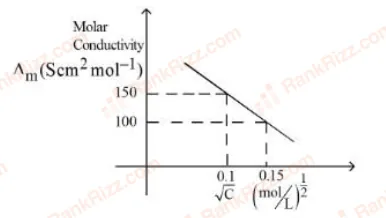
Given below is the plot of the molar conductivity vs for KCl in aqueous solution.

If, for the higher concentration of KCl solution, the resistance of the conductivity cell is 100Ω, then the resistance of the same cell with the dilute solution is Ω The value of is __________ (Nearest integer)
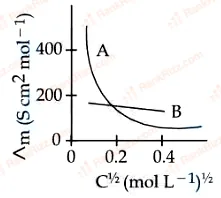
The molar conductivity for electrolytes A and B are plotted against as shown below. Electrolytes A and B respectively are

A: strong electrolyte ; B: weak electrolyte
A: weak electrolyte ; B: weak electrolyte
A: weak electrolyte ; B: strong electrolyte
A: strong electrolyte ; B: strong electrolyte
Which out of the following is a correct equation to show change in molar conductivity with respect to concentration for a weak electrolyte, if the symbols carry their usual meaning :
Identify the factor from the following that does not affect electrolytic conductance of a solution.
The nature of the electrolyte added.
The nature of the electrode used.
Concentration of the electrolyte.
The nature of solvent used.
For a strong electrolyte, a plot of molar conductivity against (concentration) is a straight line, with a negative slope, the correct unit for the slope is:
S cm mol L
S cm mol L
S cm mol L
S cm mol L
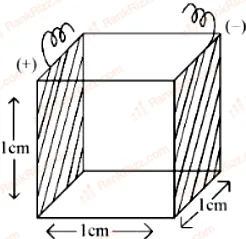
A conductivity cell with two electrodes (dark side) are half filled with infinitely dilute aqueous solution of a weak electrolyte. If volume is doubled by adding more water at constant temperature, the molar conductivity of the cell will -

decrease sharply
increase sharply
remain same or can not be measured accurately
depend upon type of electrolyte