RankRizz

Electrode potentials, electrochemical series and cell EMF — JEE Main Previous Year Questions

Every JEE Main question on Electrode potentials, electrochemical series and cell EMF, one of the ideas inside Electrochemistry: 106 questions from 2004–2026, 62 of them in the last five years. Newest first, answer key on every one. Free to read.

Questions

106

Years asked

15

Since

2004

Of the chapter

47%

Every Electrode potentials, electrochemical series and cell EMF question

21–40 OF 106 · NEWEST FIRST

JEE MAIN 2025 · 02 APR S1Electrode potentials, electrochemical series and cell EMFTRANSCRIBED

Consider the following electrochemical cell at standard condition.

Au(s)∣QH2,Q∣NH4X(0.01M)∣∣Ag+(1M)∣Ag(s)Au(s)|QH_2,Q|NH_4X(0.01M)||Ag^+(1M)|Ag(s)

Ecell=+0.4VE_{cell} = +0.4V

The couple QH2/QQH_2/Q represents quinhydrone electrode, the half cell reaction is given below:
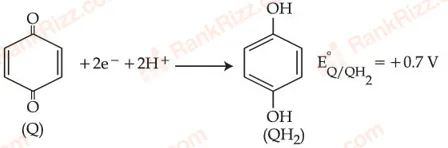
Figure for JEE Main 2025 Chemistry question on Electrode potentials, electrochemical series and cell EMF

[Given: EAg+/Ago=+0.8VE^o_{Ag^+/Ag} = +0.8V and 2.303RTF=0.06V\frac{2.303RT}{F} = 0.06V]

The pKbpK_b value of the ammonium halide salt (NH4XNH_4X) used here is ______. (nearest integer)
JEE MAIN 2025 · 07 APR S1Electrode potentials, electrochemical series and cell EMFTRANSCRIBED

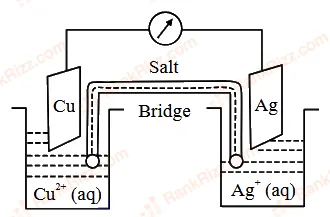
1 Faraday electricity was passed through Cu2+Cu^{2+} (1.5 M, 1 L)/Cu and 0.1 Faraday was passed through Ag+Ag^+ (0.2 M, 1 L)/Ag electrolytic cells. After this the two cells were connected as shown below to make an electrochemical cell. The emf of the cell thus formed at 298 K is ______. (Given: ECu2+/Cu0=0.34E^0_{Cu^{2+}/Cu} = 0.34 V, EAg+/Ag0=0.8E^0_{Ag^+/Ag} = 0.8 V, 2.303RTF=0.06\frac{2.303RT}{F} = 0.06 V)

Figure for JEE Main 2025 Chemistry question on Electrode potentials, electrochemical series and cell EMF
JEE MAIN 2025 · 08 APR S2Electrode potentials, electrochemical series and cell EMFTRANSCRIBED

Consider the following half cell reaction: Cr2O72−(aq)+6e−+14H+(aq)→2Cr3+(aq)+7H2O(l)Cr_2O_7^{2-}(aq) + 6e^- + 14H^+(aq) \to 2Cr^{3+}(aq) + 7H_2O(l). The reaction was conducted with the ratio of [Cr3+]2[Cr2O72−]=10−6\frac{[Cr^{3+}]^2}{[Cr_2O_7^{2-}]} = 10^{-6}. The pH value at which the EMF of the half cell will become zero is _____ . (nearest integer value)  [Given : standard half cell reduction potential ECr2O72−,H+/Cr3+0=1.33E^0_{Cr_{2}O^{2-}_{7},H^{+}/Cr^{3+}} = 1.33 V, 2.303RTF=0.059\frac{2.303RT}{F} = 0.059 V]

JEE MAIN 2024 · 06 APR S2Electrode potentials, electrochemical series and cell EMFTRANSCRIBED

How can an electrochemical cell be converted into an electrolytic cell?

  1. A

    Applying an external opposite potential lower than E0E^0 cell.

  2. B

    Reversing the flow of ions in salt bridge.

  3. C

    Applying an external opposite potential greater than E0E^0 cell.

  4. D

    Exchanging the electrodes at anode and cathode.

JEE MAIN 2024 · 04 APR S1Electrode potentials, electrochemical series and cell EMFTRANSCRIBED

What pressure (bar) of H₂ would be required to make emf of hydrogen electrode zero in pure water at 25°C?

  1. A

    10−710^{-7}

  2. B

    0.50.5

  3. C

    11

  4. D

    10−1410^{-14}

JEE MAIN 2024 · 30 JAN S2Electrode potentials, electrochemical series and cell EMFTRANSCRIBED

Reduction potential of ions are given below:
ClO4−ClO_4^-: E°=1.19E° = 1.19 V; IO4−IO_4^-: E°=1.65E° = 1.65 V; BrO4−BrO_4^-: E°=1.74E° = 1.74 V
The correct order of their oxidising power is:

  1. A

    ClO4−>IO4−>BrO4−ClO_4^- > IO_4^- > BrO_4^-

  2. B

    BrO4−>IO4−>ClO4−BrO_4^- > IO_4^- > ClO_4^-

  3. C

    BrO4−>ClO4−>IO4−BrO_4^- > ClO_4^- > IO_4^-

  4. D

    IO4−>BrO4−>ClO4−IO_4^- > BrO_4^- > ClO_4^-

JEE MAIN 2024 · 08 APR S2Electrode potentials, electrochemical series and cell EMFTRANSCRIBED

The emf of cell 

Figure for JEE Main 2024 Chemistry question on Electrode potentials, electrochemical series and cell EMF

It could be increased by :

  1. A

    decreasing concentration of both Tl+Tl^+ and Cu2+Cu^{2+} ions

  2. C

    increasing concentration of Tl+Tl^+ ions

  3. D

    increasing concentration of both Tl+Tl^+ and Cu2+Cu^{2+} ions

JEE MAIN 2024 · 04 APR S1Electrode potentials, electrochemical series and cell EMFTRANSCRIBED

One of the commonly used electrode is calomel electrode. Under which of the following categories, calomel electrode comes?

  1. A

    Oxidation-Reduction electrodes

  2. B

    Metal ion-Metal electrodes

  3. C

    Gas-Ion electrodes

  4. D

    Metal-Insoluble Salt-Anion electrodes

JEE MAIN 2024 · 08 APR S2Electrode potentials, electrochemical series and cell EMFTRANSCRIBED

The reaction; 12H2(g)+AgCl(s)→H(aq)++Cl(aq)−+Ag(s)\frac{1}{2}H_{2(g)} + AgCl_{(s)} \rightarrow H^+_{(aq)} + Cl^-_{(aq)} + Ag_{(s)} occurs in which of the following galvanic cell :

  1. A

    Ag∣AgCl(s)∣KCl(soln.)∣AgNO3(aq.)∣AgAg \left| AgCl_{(s)} \right| KCl_{(soln.)} \left| AgNO_{3(aq.)} \right| Ag

  2. B

    Pt∣H2(g)∣HCl(soln.)∣AgCl(s)∣AgPt \left| H_{2(g)} \right| HCl_{(soln.)} \left| AgCl_{(s)} \right| Ag

  3. C

    Pt∣H2(g)∣KCl(soln.)∣AgCl(s)∣AgPt \left| H_{2(g)} \right| KCl_{(soln.)} \left| AgCl_{(s)} \right| Ag

  4. D

    Pt∣H2(g)∣HCl(soln.)∣AgNO3(aq)∣AgPt \left| H_{2(g)} \right| HCl_{(soln.)} \left| AgNO_{3(aq)} \right| Ag

JEE MAIN 2024 · 05 APR S2Electrode potentials, electrochemical series and cell EMFTRANSCRIBED

For the electrochemical cell, if E(M2+/M)0=0.46E^0_{(M^{2+}/M)} = 0.46 V and E(X/X2−)0=0.34E^0_{(X/X^{2-})} = 0.34 V. Which of the following is correct?

  1. A

    M+X→M2++X2−M + X \rightarrow M^{2+} + X^{2-} is a spontaneous reaction

  2. B

    Ecell=0.80E_{cell} = 0.80 V

  3. C

    Ecell=−0.80E_{cell} = -0.80 V

  4. D

    M2++X2−→M+XM^{2+} + X^{2-} \rightarrow M + X is a spontaneous reaction

JEE MAIN 2024 · 09 APR S1Electrode potentials, electrochemical series and cell EMFTRANSCRIBED

The standard reduction potentials at 298298 K for the following half cells are given below :
Cr2O72−+14H++6e−→2Cr3++7H2OCr_2O_7^{2-} + 14H^+ + 6e^- \rightarrow 2Cr^{3+} + 7H_2O, E°=1.33E° = 1.33 V
Fe3+(aq)+3e−→FeFe^{3+}(aq) + 3e^- \rightarrow Fe, E°=−0.04E° = -0.04 V
Ni2+(aq)+2e−→NiNi^{2+}(aq) + 2e^- \rightarrow Ni, E°=−0.25E° = -0.25 V
Ag+(aq)+e−→AgAg^+(aq) + e^- \rightarrow Ag, E°=0.80E° = 0.80 V
Au3+(aq)+3e−→AuAu^{3+}(aq) + 3e^- \rightarrow Au, E°=1.40E° = 1.40 V
Consider the given electrochemical reactions, The number of metal(s) which will be oxidized by Cr2O72−Cr_2O_7^{2-}, in aqueous solution is ______

JEE MAIN 2024 · 01 FEB S1Electrode potentials, electrochemical series and cell EMFTRANSCRIBED

The potential for the given half cell at 298K is −x×10−2- x \times 10^{-2} V.
2H(aq)++2e−→H2(g)2H^+_{(aq)} + 2e^- \rightarrow H_2(g), [H+]=1[H^+] = 1 M, PH2=2P_{H_2} = 2 atm.
(Given 2.303 RT/F=0.062.303\ RT/F = 0.06 V, log⁡2=0.3\log 2 = 0.3). The value of xx is:

JEE MAIN 2024 · 01 FEB S2Electrode potentials, electrochemical series and cell EMFTRANSCRIBED

Consider the following redox reaction: MnO4−+H++H2C2O4⇌Mn2++H2O+CO2MnO_4^- + H^+ + H_2C_2O_4 \rightleftharpoons Mn^{2+} + H_2O + CO_2
The standard reduction potentials are given as below:
EMnO4−/Mn2+0=+1.51E^0_{MnO_4^-/Mn^{2+}} = +1.51 V; ECO2/H2C2O40=−0.49E^0_{CO_2/H_2C_2O_4} = -0.49 V
If the equilibrium constant of the above reaction is given as Keq=10xK_{eq} = 10^x, then the value of xx = ______ (nearest integer)

JEE MAIN 2024 · 27 JAN S2Electrode potentials, electrochemical series and cell EMFTRANSCRIBED

The hydrogen electrode is dipped in a solution of pH = 3 at 25°C. The potential of the electrode will be −- _____ ×10−2\times 10^{-2} V.
2.303RTF=0.059\frac{2.303RT}{F} = 0.059 V. Round off the answer to the nearest integer.

JEE MAIN 2023 · 08 APR S2Electrode potentials, electrochemical series and cell EMFTRANSCRIBED

The incorrect statements from the following is:
A. The electrical work that a reaction can perform at constant pressure and temperature is equal to the reaction Gibbs energy.
B. Ecell∘E^\circ_{cell} is dependent on the pressure.
C. dEcelldT=ΔrSnF\frac{dE_{cell}}{dT} = \frac{\Delta_r S}{nF}
D. A cell is operating reversibly if the cell potential is exactly balanced by an opposing source of potential difference.

JEE MAIN 2023 · 08 APR S1Electrode potentials, electrochemical series and cell EMFTRANSCRIBED

The reaction occurs in which of the given galvanic cell?
12H2(g)+AgCl(s)⇌H+(aq)+Cl−(aq)+Ag(s)\dfrac{1}{2}H_2(g) + AgCl(s) \rightleftharpoons H^+(aq) + Cl^-(aq) + Ag(s)

  1. A

    Pt |H2_2(g)| HCl(soln^n) |AgCl(s)| Ag

  2. B

    Ag |AgCl(s)| KCl(soln^n) |AgNO3_3 |Ag

  3. C

    Pt |H2_2(g)| HCl(soln^n) |AgNO3_3(soln^n) |Ag

  4. D

    Pt |H2_2(g)| KCl(soln^n) |AgCl(s) |Ag

JEE MAIN 2023 · 06 APR S1Electrode potentials, electrochemical series and cell EMFTRANSCRIBED

The standard electrode potential of M+^+/M in aqueous solution does not depend on

  1. A

    Hydration of a gaseous metal ion

  2. B

    Sublimation of a solid metal

  3. C

    Ionisation of a solid metal atom

  4. D

    Ionisation of a gaseous metal atom

JEE MAIN 2023 · 29 JAN S1Electrode potentials, electrochemical series and cell EMFTRANSCRIBED

The standard electrode potential (M3+^{3+}/M2+^{2+}) for V, Cr, Mn & Co are −0.26-0.26 V, −0.41-0.41 V, +1.57+1.57 V and +1.97+1.97 V, respectively. The metal ions which can liberate H2_2 from a dilute acid are

  1. A

    V2+^{2+} and Mn2+^{2+}

  2. B

    Cr2+^{2+} and Co2+^{2+}

  3. C

    V2+^{2+} and Cr2+^{2+}

  4. D

    Mn2+^{2+} and Co2+^{2+}

JEE MAIN 2023 · 10 APR S1Electrode potentials, electrochemical series and cell EMFTRANSCRIBED

FeO42−→+2.2VFe3+→+0.70VFe2+→−0.45VFe0FeO_4^{2-} \xrightarrow{+2.2 V} Fe^{3+} \xrightarrow{+0.70 V} Fe^{2+} \xrightarrow{-0.45 V} Fe^0
EFeO42−/Fe2+0E^0_{FeO_4^{2-}/Fe^{2+}} is x×10−3x \times 10^{-3} V. The value of x is _______.

JEE MAIN 2023 · 25 JAN S2Electrode potentials, electrochemical series and cell EMFTRANSCRIBED

Pt(s)|H2_2(g)(1 bar)|H+^+(aq)(1M)||M3+^{3+}(aq), M+^+(aq)|Pt(s)
The Ecell_{cell} for the given cell is 0.1115 V at 298 K
When [M+(aq)][M3+(aq)]=10a\frac{[M^+(aq)]}{[M^{3+}(aq)]} = 10^a
The value of a is _____
Given: EM3+/M+0^0_{M^{3+}/M^+} = 0.2 V
2.303RTF\frac{2.303RT}{F} = 0.059 V
