JEE Main 2026 Chemistry question — Electrode potentials, electrochemical series and cell EMF
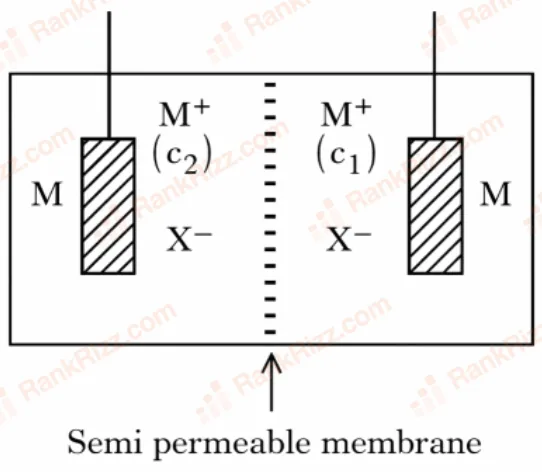
Consider the above electrochemical cell where a metal electrode (M) is undergoing redox reaction by forming . The cation is present in two different concentrations and as shown above. which of the following statement is correct for generating a positive cell potential?
SOLUTION
The given cell is a metal/metal-ion concentration cell: the same metal is present at both electrodes, but the molar concentration of the cation differs.
Overall cell reaction (at 298 K):
Anode (oxidation)
Cathode (reduction)
Using the Nernst equation for a concentration cell with transferred electron, the cell potential is
For the cell potential to be positive we must have
Now compare the four statements provided:
Case 1: Option A — “If is present at anode, then .”
If the two concentrations are equal, , so , not positive. Hence wrong.
Case 2: Option B — “If is present at cathode, then .”
Here and . The requirement for a positive potential is exactly , so this statement is correct.
Case 3: Option C — “If is present at cathode, then .”
This yields , giving a negative , so it is incorrect.
Case 4: Option D — “If is present at anode, then .”
That would imply , again producing a negative cell potential; therefore wrong.
Hence, the only correct statement that guarantees a positive cell potential is:
Option B which is: If is present at cathode, then .
Tagged Electrode potentials, electrochemical series and cell EMF. Machine-assigned, so read it as a strong shortlist rather than a verdict.