JEE Main 2025 Chemistry question — Colour and magnetic behaviour of complexes from CFT
Match the LIST-I with LIST-II
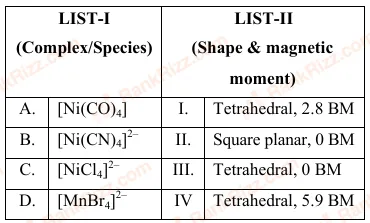
Choose the correct answer from the options given below :
SOLUTION
First write the ground-state electronic configurations of the central metal atoms.
Ni :
Mn :
Next, find the oxidation state of the metal in each complex.
: CO is neutral Ni is -oxidation.
: from gives .
: from gives .
: from gives .
Now list the -electron counts.
Ni(0) (after promotion-hybridisation will pair all 10).
Ni(II) .
Mn(II) .
Identify each ligand as strong- or weak-field.
CO and are strong-field (cause pairing).
and are weak-field (do not cause pairing).
Determine hybridisation, geometry and unpaired electrons one by one.
Case A:
CO is strong field; Ni is in state. The 3d orbitals are fully paired and do not participate in hybridisation. The complex uses hybridisation (4s + 3p) tetrahedral. With all electrons paired, unpaired . Hence: Tetrahedral, 0 BM (Choice III).
Case B:
Ni is . is strong field, so the electrons pair up giving configuration with no unpaired electrons. Square-planar geometry arises from hybridisation. . Hence: Square planar, 0 BM (Choice II).
Case C:
Ni is and is weak field, so no additional pairing occurs. The complex adopts hybridisation tetrahedral. For a tetrahedral high-spin ion there are unpaired electrons, so
. Hence: Tetrahedral, 2.8 BM (Choice I).
Case D:
Mn is , and the weak-field keeps it high-spin. With hybridisation the geometry is tetrahedral. All five electrons remain unpaired, , so
. Hence: Tetrahedral, 5.9 BM (Choice IV).
Collecting the results:
A III B II C I D IV
Comparing with the given options, this matches Option C.
Tagged Colour and magnetic behaviour of complexes from CFT. Machine-assigned, so read it as a strong shortlist rather than a verdict.