RankRizz

JEE Main 02 Apr 2025, Shift 1: Chemistry

The 25 Chemistry questions of JEE Main 02 Apr 2025, Shift 1, numbered across the whole paper. Pick an answer on any question to check it against the key. Free to read, nothing to download.

Chemistry

Q26AromaticityTRANSCRIBED

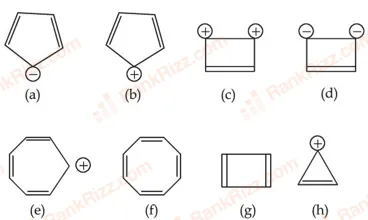
Designate whether each of the following compounds is aromatic or not aromatic.

Figure for JEE Main 2025 Chemistry question on Aromaticity
  1. A

    e, g aromatic and a, b, c, d, f, h not aromatic

  2. B

    b, e, f, g aromatic and a, c, d, h not aromatic

  3. C

    a, b, c, d aromatic and e, f, g, h not aromatic

  4. D

    a, c, d, e, h aromatic and b, f, g not aromatic

Q27Nucleophilic addition reactions of carbonyl compoundsTRANSCRIBED

An optically active alkyl halide C4H9BrC_4H_9Br [A] reacts with hot KOH dissolved in ethanol and forms alkene [B] as major product which reacts with bromine to give dibromide [C]. The compound [C] is converted into a gas [D] upon reacting with alcoholic NaNH2_2. During hydration 18 gram of water is added to 1 mole of gas [D] on warming with mercuric sulphate and dilute acid at 333 K to form compound [E]. The IUPAC name of compound [E] is:

  1. A

    But-2-yne

  2. B

    Butan-2-ol

  3. C

    Butan-2-one

  4. D

    Butan-1-al

Q28Atomic and ionic radiiTRANSCRIBED

The property/properties that show irregularity in first four elements of group-17 is/are:
(A) Covalent radius
(B) Electron affinity
(C) Ionic radius
(D) First ionization energy
Choose the correct answer from the options given below:
  1. A

    B and D only

  2. B

    A and C only

  3. C

    B only

  4. D

    A, B, C and D

Q29Solubility of gases and Henry's lawTRANSCRIBED

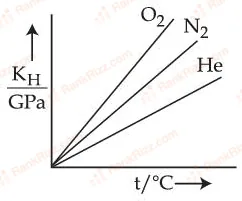
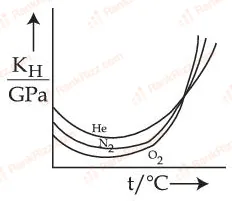
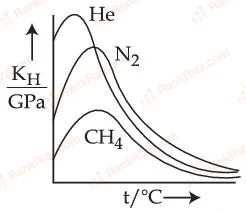
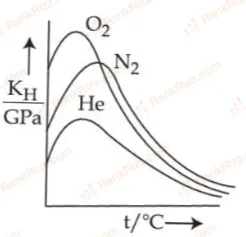
Which of the following graph correctly represents the plots of KHK_H at 1 bar gases in water versus temperature?

  1. A
    Figure for JEE Main 2025 Chemistry question on Solubility of gases and Henry's law
  2. B
    page28_img2
  3. C
    page28_img4
  4. D
    page28_img3
Q30Bohr model of hydrogen-like speciesTRANSCRIBED

According to Bohr's model of hydrogen atom, which of the following statement is incorrect?

  1. A

    Radius of 3rd orbit is nine times larger than that of 1st orbit.

  2. B

    Radius of 8th orbit is four times larger than that of 4th orbit.

  3. C

    Radius of 6th orbit is three time larger than that of 4th orbit.

  4. D

    Radius of 4th orbit is four times larger than that of 2nd orbit.

Q31First law: work, heat and internal energyTRANSCRIBED
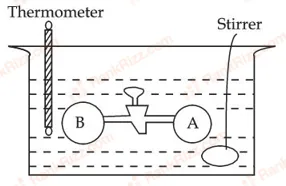
Figure for JEE Main 2025 Chemistry question on First law: work, heat and internal energy

Two vessels A and B are connected via stopcock. The vessel A is filled with a gas at a certain pressure. The entire assembly is immersed in water and is allowed to come to thermal equilibrium with water. After opening the stopcock the gas from vessel A expands into vessel B and no change in temperature is observed in the thermometer. Which of the following statement is true?

  1. A

    dw≠0dw \neq 0

  2. B

    dq≠0dq \neq 0

  3. C

    dU≠0dU \neq 0

  4. D

    The pressure in the vessel B before opening the stopcock is zero.

Q32Relative lowering of vapour pressureTRANSCRIBED

A solution is made by mixing one mole of volatile liquid A with 3 moles of volatile liquid B. The vapour pressure of pure A is 200 mm Hg and that of the solution is 500 mm Hg. The vapour pressure of pure B and the least volatile component of the solution, respectively, are:

  1. A

    1400 mm Hg, A

  2. B

    1400 mm Hg, B

  3. C

    600 mm Hg, B

  4. D

    600 mm Hg, A

Q33Mole concept, atomic and molar massTRANSCRIBED

CaCO3(s)+2HCl(aq)→CaCl2(aq)+CO2(g)+H2O(l)CaCO_3(s) + 2HCl(aq) \rightarrow CaCl_2(aq) + CO_2(g) + H_2O(l)

Consider the above reaction, what mass of CaCl2CaCl_2 will be formed if 250 mL of 0.76 M HCl reacts with 1000 g of CaCO3CaCO_3?

(Given: Molar mass of Ca, C, O, H and Cl are 40, 12, 16, 1 and 35.5 g mol−1^{-1}, respectively)

  1. A

    3.908 g

  2. B

    2.636 g

  3. C

    10.545 g

  4. D

    5.272 g

Q34Solubility product and common ion effectTRANSCRIBED

If equal volumes of AB2AB_2 and XY (both are salts) aqueous solutions are mixed, which of the following combination will give a precipitate of AY2AY_2 at 300 K?

(Given KspK_{sp} (at 300 K) for AY2=5.2×10⁻⁷AY_2 = 5.2 \times 10^{-7})

  1. A

    3.6×10−33.6 \times 10^{-3} M AB2AB_2, 5.0×10−45.0 \times 10^{-4} M XY

  2. B

    2.0×10−42.0 \times 10^{-4} M AB2AB_2, 0.8×10−30.8 \times 10^{-3} M XY

  3. C

    2.0×10−22.0 \times 10^{-2} M AB2AB_2, 2.0×10−22.0 \times 10^{-2} M XY

  4. D

    1.5×10−41.5 \times 10^{-4} M AB2AB_2, 1.5×10−31.5 \times 10^{-3} M XY

Q35VSEPR theory and shapes of molecules and ionsTRANSCRIBED

Among SO2SO_2, NF3NF_3, NH3NH_3, XeF2XeF_2, ClF3ClF_3 and SF4SF_4, the hybridization of the molecule with non-zero dipole moment and highest number of lone pairs of electrons on the central atom is:

  1. A

    sp3sp^3

  2. B

    dsp2dsp^2

  3. C

    sp3d2sp^3d^2

  4. D

    sp3dsp^3d

Q36Nucleophilic addition reactions of carbonyl compoundsTRANSCRIBED

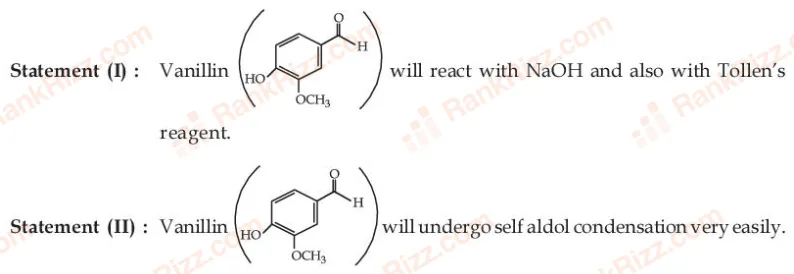
Given below are two statements:

Figure for JEE Main 2025 Chemistry question on Nucleophilic addition reactions of carbonyl compounds

In the light of the above statements, choose the most appropriate answer from the options given below:

  1. A

    Statement I is incorrect but Statement II is correct

  2. B

    Statement I is correct but Statement II is incorrect

  3. C

    Both Statement I and Statement II are incorrect

  4. D

    Both Statement I and Statement II are correct

Q37Proteins and enzymesTRANSCRIBED

Identify the correct statement among the following:

  1. A

    All naturally occurring amino acids except glycine contain one chiral centre.

  2. B

    All naturally occurring amino acids are optically active.

  3. C

    Glutamic acid is the only amino acid that contains a -COOH group at the side chain.

  4. D

    Amino acid, cysteine easily undergo dimerization due to the presence of free SH group.

Q38Reactions and tests of aminesTRANSCRIBED

The correct order of basic nature on aqueous solution for the bases NH3NH_3, H2N−NH2H_2N-NH_2, CH3CH2NH2CH_3CH_2NH_2, (CH3CH2)2NH(CH_3CH_2)_2NH and (CH3CH2)3N(CH_3CH_2)_3N is:

  1. A

    NH3<H2N−NH2<(CH3CH2)3N<CH3CH2NH2<(CH3CH2)2NHNH_3 \lt H_2N-NH_2 \lt (CH_3CH_2)_3N \lt CH_3CH_2NH_2 \lt (CH_3CH_2)_2NH

  2. B

    NH3<H2N−NH2<CH3CH2NH2<(CH3CH2)2NH<(CH3CH2)3NNH_3 \lt H_2N-NH_2 \lt CH_3CH_2NH_2 \lt (CH_3CH_2)_2NH \lt (CH_3CH_2)_3N

  3. C

    H2N−NH2<NH3<(CH3CH2)3N<CH3CH2NH2<(CH3CH2)2NHH_2N-NH_2 \lt NH_3 \lt (CH_3CH_2)_3N \lt CH_3CH_2NH_2 \lt (CH_3CH_2)_2NH

  4. D

    NH3<NH2−NH2<NH3<CH3CH2NH2<(CH3CH2)3N<(CH3CH2)2NHNH_3 \lt NH_2-NH_2 \lt NH_3 \lt CH_3CH_2NH_2 \lt (CH_3CH_2)_3N \lt (CH_3CH_2)_2NH

Q39Atomic and ionic radiiTRANSCRIBED

Given below are two statements:

Statement (I): The metallic radius of Al is less than that of Ga.

Statement (II): The ionic radius of Al3+^{3+} is less than that of Ga3+^{3+}.

In the light of the above statements, choose the most appropriate answer from the options given below:

  1. A

    Both Statement I and Statement II are incorrect

  2. B

    Statement I is incorrect but Statement II is correct

  3. C

    Statement I is correct but Statement II is incorrect

  4. D

    Both Statement I and Statement II are correct

Q40Colour and magnetic behaviour of complexes from CFTTRANSCRIBED

Given below are two statements:

Statement (I): In octahedral complexes, when Δo<P\Delta_o \lt P high spin complexes are formed. When Δo>P\Delta_o \gt P low spin complexes are formed.

Statement (II): In tetrahedral complexes because of Δt<P\Delta_t \lt P, low spin complexes are rarely formed.

In the light of the above statements, choose the most appropriate answer from the options given below:

  1. A

    Statement I is correct but Statement II is incorrect.

  2. B

    Both Statement I and Statement II are incorrect

  3. C

    Statement I is incorrect but Statement II is correct

  4. D

    Both Statement I and Statement II are correct

Q41Group analysis and confirmatory tests of cationsTRANSCRIBED

Choose the correct tests with respective observations.

(A) CuSO4CuSO_4 (acidified with acetic acid) + K4[Fe(CN)6]K_4[Fe(CN)_6] →\rightarrow Chocolate brown precipitate.

(B) FeCl3+K4[Fe(CN)6]FeCl_3 + K_4[Fe(CN)_6] →\rightarrow Prussian blue precipitate.

(C) ZnCl2+K4[Fe(CN)6]ZnCl_2 + K_4[Fe(CN)_6], neutralised with NH4OHNH_4OH →\rightarrow White or bluish white precipitate.

(D) MgCl2+K4[Fe(CN)6]MgCl_2 + K_4[Fe(CN)_6] →\rightarrow Blue precipitate.

(E) BaCl2+K4[Fe(CN)6]BaCl_2 + K_4[Fe(CN)_6], neutralised with NaOH →\rightarrow White precipitate.

Choose the correct answer from the options given below:
  1. A

    A, D and E only

  2. B

    B, D and E only

  3. C

    A, B and C only

  4. D

    C, D and E only

Q42Mole concept, atomic and molar massTRANSCRIBED

On complete combustion 1.0 g of an organic compound (X) gave 1.46 g of CO2CO_2 and 0.567 g of H2OH_2O. The empirical formula mass of compound (X) is ________ g.

(Given molar mass in g mol−1^{-1} C: 12, H: 1, O: 16)

  1. A

    30

  2. B

    45

  3. C

    60

  4. D

    15

Q43Reactive intermediates and rearrangementsTRANSCRIBED

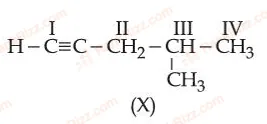
Consider the following compound (X):

Figure for JEE Main 2025 Chemistry question on Reactive intermediates and rearrangements


The most stable and least stable carbon radicals, respectively, produced by homolytic cleavage of corresponding C-H bond are:

  1. A

    II, IV

  2. B

    III, II

  3. C

    I, IV

  4. D

    II, I

Q44Reactions of carboxylic acidsTRANSCRIBED

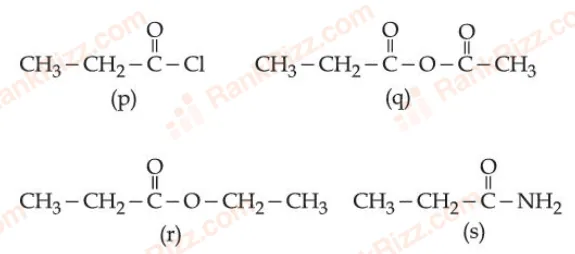
Consider the following molecules:

Figure for JEE Main 2025 Chemistry question on Reactions of carboxylic acids

The correct order of rate of hydrolysis is:

  1. A

    r>q>p>sr \gt q \gt p \gt s

  2. B

    q>p>r>sq \gt p \gt r \gt s

  3. C

    p>r>q>sp \gt r \gt q \gt s

  4. D

    p>q>r>sp \gt q \gt r \gt s

Q45VSEPR theory and shapes of molecules and ionsTRANSCRIBED

A molecule with the formula AX4YAX_4Y has all its elements from p-block. Element AA is rarest, monoatomic, non-radioactive from its group and has the lowest ionization enthalpy value amongA,XA, X and YY. Elements XX and YY have first and second highest electronegativity values respectively among all the known elements. The shape of the molecule is:

  1. A

    Square pyramidal

  2. B

    Octahedral

  3. C

    Pentagonal planar

  4. D

    Trigonal bipyramidal

Q46Colour and magnetic behaviour of complexes from CFTTRANSCRIBED

A transition metal (M)(M) among Mn,Cr,CoMn, Cr, Co and FeFe has the highest standard electrode potential (M3+/M2+M^{3+}/M^{2+}). It forms a metal complex of the type [M(CN)6]4−[M(CN)_6]^{4-}. The number of electrons present in the ege_g orbital of the complex is ______.

Q47Electrode potentials, electrochemical series and cell EMFTRANSCRIBED

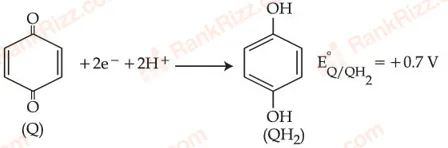
Consider the following electrochemical cell at standard condition.

Au(s)∣QH2,Q∣NH4X(0.01M)∣∣Ag+(1M)∣Ag(s)Au(s)|QH_2,Q|NH_4X(0.01M)||Ag^+(1M)|Ag(s)

Ecell=+0.4VE_{cell} = +0.4V

The couple QH2/QQH_2/Q represents quinhydrone electrode, the half cell reaction is given below:

Figure for JEE Main 2025 Chemistry question on Electrode potentials, electrochemical series and cell EMF

[Given: EAg+/Ago=+0.8VE^o_{Ag^+/Ag} = +0.8V and 2.303RTF=0.06V\frac{2.303RT}{F} = 0.06V]

The pKbpK_b value of the ammonium halide salt (NH4XNH_4X) used here is ______. (nearest integer)

Q48Mole concept, atomic and molar massTRANSCRIBED

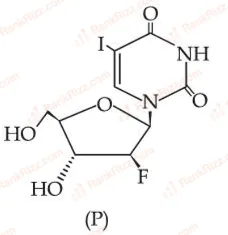
0.1 mol of the following given antiviral compound (P) will weigh _______ ×10−1\times 10^{-1} g.

Figure for JEE Main 2025 Chemistry question on Mole concept, atomic and molar mass

(Given: molar mass in g mol−1^{-1} H: 1, C: 12, N: 14, O: 16, F: 19, I: 127)

Q49Law of mass action and equilibrium constants Kc and KpTRANSCRIBED

Consider the following equilibrium,

CO(g)+2H2(g)⇌CH3OH(g)CO(g) + 2H_2(g) \rightleftharpoons CH_3OH(g)

0.1 mol of CO along with a catalyst is present in a 2 dm3^3 flask maintained at 500 K. Hydrogen is introduced into the flask until the pressure is 5 bar and 0.04 mol of CH3OHCH_3OH is formed. The Kp0K_p^0 is _______ ×10−3\times 10^{-3}. (nearest integer)

Given R=0.08R = 0.08 dm3^3 bar K−1^{-1} mol−1^{-1}

Assume only methanol is formed as the product and the system follows ideal gas behaviour.

Q50Integrated rate laws and half-life (zero and first order)TRANSCRIBED

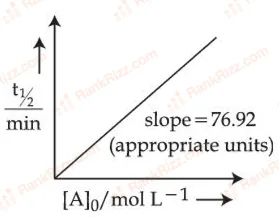
For the reaction A→A \rightarrow products.

Figure for JEE Main 2025 Chemistry question on Integrated rate laws and half-life (zero and first order)

The concentration of A at 10 minutes is _______ ×10−3\times 10^{-3} mol L−1^{-1}. (nearest integer).

The reaction was started with 2.5 mol L−1^{-1} of A.

NEXT IN THIS PAPER →Maths, Q51 onwards