RankRizz
JEE MAIN 2025 · 02 APR S1+4 / −1MEDIUMTRANSCRIBED

JEE Main 2025 Chemistry question — Reactive intermediates and rearrangements

Consider the following compound (X):
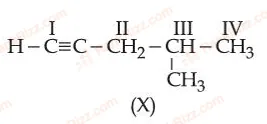
Figure for JEE Main 2025 Chemistry question on Reactive intermediates and rearrangements


The most stable and least stable carbon radicals, respectively, produced by homolytic cleavage of corresponding C-H bond are:

SOLUTION
  • Position I (spsp hybridized carbon): Homolytic cleavage at this position forms an acetylenic radical (−C≡C˙-\text{C}\equiv\dot{\text{C}}). Because spsp hybridized carbons are highly electronegative, they hold the unshared electron very tightly, making this radical highly unstable (least stable).

  • Position II (Propargylic position): The radical formed here (−C≡C−C˙H−-\text{C}\equiv\text{C}-\dot{\text{C}}\text{H}-) is stabilized by resonance with the adjacent triple bond, similar to an allylic radical. Resonance stabilization is significantly stronger than hyperconjugation, making this radical the most stable.
     
  • Position III (3∘3^\circ carbon): This forms a tertiary free radical. It is stabilized via hyperconjugation by 8 α-hydrogens8\ \alpha\text{-hydrogens}, but it lacks resonance stabilization, making it less stable than the propargylic radical at position II.
     
  • Position IV (1∘1^\circ carbon): This forms a primary free radical stabilized by only 1 α-hydrogen1\ \alpha\text{-hydrogen}, making it less stable than III but more stable than I.
  • The correct option is D (II, I).

    Tagged Reactive intermediates and rearrangements. Machine-assigned, so read it as a strong shortlist rather than a verdict.

    SubjectChemistry
    TopicReactive intermediates and rearrangements
    TypeMultiple choice