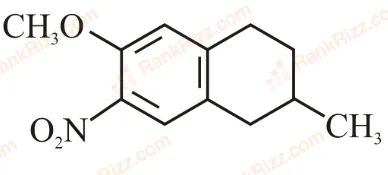
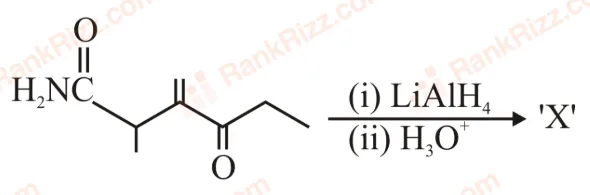
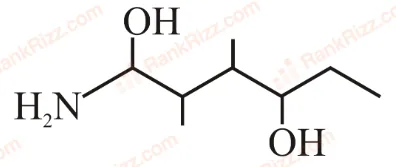
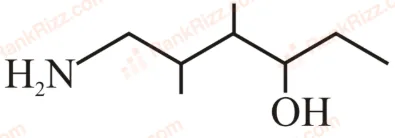
The 30 Chemistry questions of JEE Main 10 Apr 2023, Shift 2, numbered across the whole paper. Pick an answer on any question to check it against the key. Free to read, nothing to download.
Chemistry
Q31Concentration terms and their interconversionTRANSCRIBED
Given below are two statements: one is labelled as Assertion A and the other is labelled as Reason R. Assertion A: 3.1500 g of hydrated oxalic acid dissolved in water to make 250.0 mL solution will result in 0.1 M oxalic acid solution. Reason R: Molar mass of hydrated oxalic acid is 126 g mol−1. In the light of the above statements, choose the correct answer from the options given below:
A
Both A and R are true but R is NOT the correct explanation of A
B
A is true but R is false
C
Both A and R are true and R is the correct explanation of A
Given below are two statements: one is labelled as Assertion A and the other is labelled as Reason R. Assertion A: The energy required to form Mg2+ from Mg is much higher than that required to produce Mg+ Reason R: Mg2+ is small ion and carry more charge than Mg+ In the light of the above statements, choose the correct answer from the options given below.
A
Both A and R are true but R is NOT the correct explanation of A
B
A is true but R is false
C
A is false but R is true
D
Both A and R are true and R is the correct explanation of A
Q36Position, isotopes, preparation and properties of dihydrogenTRANSCRIBED
Given below are two statements: one is labelled as Assertion A and the other is labelled as Reason R. Assertion A: Physical properties of isotopes of hydrogen are different. Reason R: Mass difference between isotopes of hydrogen is very large. In the light of the above statements, choose the correct answer from the options given below:
A
Both A and R are true and R is the correct explanation of A
B
A is false but R is true
C
A is true but R is false
D
Both A and R are true but R is NOT the correct explanation of A
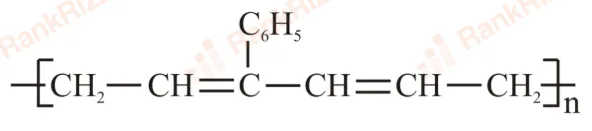
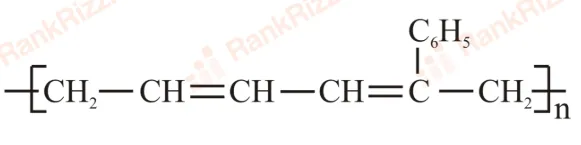
In Carius tube, an organic compound 'X' is treated with sodium peroxide to form a mineral acid 'Y'. The solution of BaCl2 is added to 'Y' to form a precipitate 'Z'. 'Z' is used for the quantitative estimation of an extra element. 'X' could be
Q42Crystal lattices, unit cells and densityTRANSCRIBED
The correct relationships between unit cell edge length 'a' and radius of sphere 'r' for face-centred and body-centred cubic structures respectively are:
Q45Colour and magnetic behaviour of complexes from CFTTRANSCRIBED
The correct order of the number of unpaired electrons in the given complexes is (A) [Fe(CN)6]3− (B) FeF63− (C) CoF63− (D) [Cr(oxalate)3]3− (E) Ni(CO)4 Choose the correct answer from the options given below:
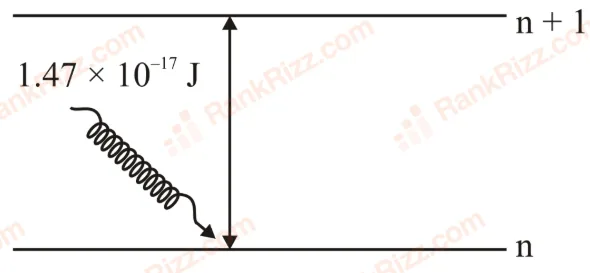
The electron in the nth orbit of Li2+ is excited to (n+1) orbit using the radiation of energy 1.47×10⁻¹⁷ J (as shown in the diagram). The value of n is _______ Given: RH=2.18×10⁻¹⁸ J
Q54Law of mass action and equilibrium constants Kc and KpTRANSCRIBED
A(g)⇌2B(g)+C(g) For the given reaction, if the initial pressure is 450 mmHg and the pressure at time t is 720 mmHg at a constant temperature T and constant volume V. The fraction of A(g) decomposed under these conditions is x×10−1. The value of x is (nearest integer) _______
Q55Enthalpies of reaction and Hess's lawTRANSCRIBED
The number of endothermic process/es from the following is _______. A. I2(g)→2I(g) B. HCl(g)→H(g)+Cl(g) C. H2O(l)→H2O(g) D. C(s)+O2(g)→CO2(g) E. Dissolution of ammonium chloride in water
An aqueous solution of volume 300 cm3 contains 0.63 g of protein. The osmotic pressure of the solution at 300 K is 1.29 mbar. The molar mass of the protein is _______ g mol−1. Given: R = 0.083 L bar K−1 mol−1
Q58Conductance, conductivity and molar conductivityTRANSCRIBED
The specific conductance of 0.0025M acetic acid is 5×10⁻⁵ S cm−1 at a certain temperature. The dissociation constant of acetic acid is _______ ×10−7. (Nearest integer) Consider limiting molar conductivity of CH3COOH as 400 S cm2 mol−1
Q59Integrated rate laws and half-life (zero and first order)TRANSCRIBED
The number of incorrect statement/s from the following is _______ A. The successive half lives of zero order reactions decreases with time. B. A substance appearing as reactant in the chemical equation may not affect the rate of reaction C. Order and molecularity of a chemical reaction can be a fractional number D. The rate constant units of zero and second order reaction are mol L−1 s−1 and mol−1 L s−1 respectively