JEE Main 2023 Chemistry question — Reactive intermediates and rearrangements
The decreasing order of hydride affinity for following carbocations is:
(a)
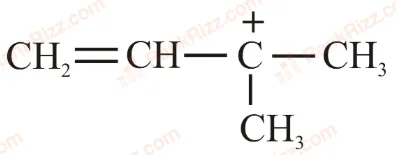
(b)
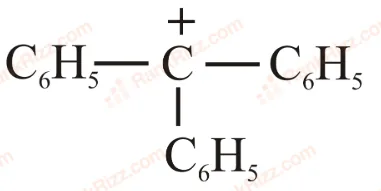
(c)
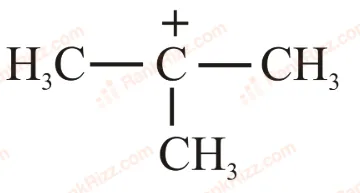
(d)
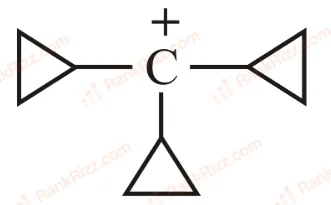
Choose the correct answer from the options given below:
SOLUTION
Hydride affinity is defined for the reaction
.
The larger the energy released (that is, the more negative the reaction enthalpy), the greater is the hydride affinity of the carbocation .
A carbocation that is intrinsically less stable gains a larger amount of stabilisation on accepting a hydride ion, so it shows a higher hydride affinity.
Conversely, a more stable carbocation is already low in energy; it gains relatively little additional stabilisation on accepting and therefore exhibits a lower hydride affinity.
Hence,
.
Case 1 (c):
The methyl cation possesses neither hyperconjugation nor resonance stabilisation. It is the least stabilised of the four; therefore it will have the highest hydride affinity.
Case 2 (a):
The n-propyl (1°) carbocation is stabilised by hyperconjugation with two α-hydrogen atoms. It is more stable than but less stable than a 3° or resonance-stabilised cation. Its hydride affinity is therefore lower than that of (c) but higher than that of (b) and (d).
Case 3 (b):
The tert-butyl (3°) carbocation enjoys extensive hyperconjugation (nine α-hydrogen atoms), making it markedly more stable than a 1° carbocation. Hence its hydride affinity is lower than those of (c) and (a).
Case 4 (d):
The benzyl carbocation is stabilised by resonance with the aromatic ring, distributing the positive charge over several atoms. This resonance stabilisation is stronger than the hyperconjugative stabilisation present in . Therefore it is the most stable of the four and consequently has the lowest hydride affinity.
Combining the four cases, the order from highest to lowest hydride affinity is
This corresponds to Option B: C, A, B, D.
Answer : Option B
Tagged Reactive intermediates and rearrangements. Machine-assigned, so read it as a strong shortlist rather than a verdict.