JEE MAIN 2023 · 10 APR S2+4 / −1MEDIUMTRANSCRIBED
JEE Main 2023 Chemistry question — Electrophilic substitution of aniline
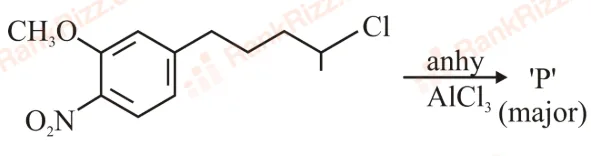
The major product 'P' formed in the given reaction is
SOLUTION
Key idea: Intramolecular Friedel–Crafts alkylation: turns the secondary chloride into a carbocation that attacks the ring ortho to the chain, closing a strain-free six-membered ring. The –OCH group decides which ortho position is used.
- Chain: ; ionisation gives a 2° cation on the carbon bearing .
- Ring closure onto the carbon ortho to the chain gives ring atoms: two aromatic C + 3 + = 6-membered (tetralin).
- The two ortho positions are C2 (between the chain and , crowded) and C6. C6 is para to –OCH (activated); is meta to it, so it is not strongly deactivated there.
- Attack at C6 gives a tetralin in which is attached to the aromatic carbon para to , and the / pair sits on the other side of the ring: P = 6-methoxy-7-nitro-1-methyl-1,2,3,4-tetrahydronaphthalene.
- (C) closes at the crowded C2; (D) moves the to C2 of the ring (no reason); (B) is an intermolecular dimer.
Answer: (A)
Tagged Electrophilic substitution of aniline. Machine-assigned, so read it as a strong shortlist rather than a verdict.