RankRizz

JEE Main 10 Apr 2023, Shift 2: Maths

The 30 Maths questions of JEE Main 10 Apr 2023, Shift 2, numbered across the whole paper. Pick an answer on any question to check it against the key. Free to read, nothing to download.

Maths

Q61Algebra of complex numbers and square rootsTRANSCRIBED

Let S={z=x+iy:2z−3i4z+2i is a real number}S = \{z = x + iy: \frac{2z - 3i}{4z + 2i} \text{ is a real number}\}. Then which of the following is NOT correct?

  1. A

    y+x2+y2≠−14y + x^2 + y^2 \neq -\frac{1}{4}

  2. B

    (x,y)=(0,−12)(x, y) = (0, -\frac{1}{2})

  3. C

    x=0x = 0

  4. D

    y∈(−∞,−12)∪(−12,∞)y \in (-\infty, -\frac{1}{2}) \cup (-\frac{1}{2}, \infty)

Q62Combinations and selections with conditionsTRANSCRIBED

Eight persons are to be transported from city A to city B in three cars of different makes. If each car can accommodate at most three persons, then the number of ways, in which they can be transported, is

  1. A

    1120

  2. B

    3360

  3. C

    1680

  4. D

    560

Q63Sums of natural numbers, squares and cubesTRANSCRIBED

If Sn=4+11+21+34+50+…S_n = 4 + 11 + 21 + 34 + 50 + \ldots to nn terms, then 160(S29−S9)\frac{1}{60}\left(S_{29}-S_9\right) is equal to

  1. A

    223

  2. B

    226

  3. C

    220

  4. D

    227

Q64Divisibility and remainder problemsTRANSCRIBED

Let the number (22)2022+(2022)22(22)^{2022} + (2022)^{22} leave the remainder α\alpha when divided by 3 and β\beta when divided by 7. Then (α2+β2)(\alpha^2 + \beta^2) is equal to

  1. A

    20

  2. B

    13

  3. C

    5

  4. D

    10

Q65General term and specific coefficientsTRANSCRIBED

If the coefficients of xx and x2x^2 in (1+x)p(1−x)q(1 + x)^p(1 - x)^q are 4 and -5 respectively, then 2p+3q2p + 3q is equal to

  1. A

    60

  2. B

    69

  3. C

    66

  4. D

    63

Q66Number of solutions in an intervalTRANSCRIBED

Let S={x∈[−π2,π2]:91−tan⁡2x+9tan⁡2x=10}S = \{x \in [-\frac{\pi}{2}, \frac{\pi}{2}]: 9^{1-\tan^2 x} + 9^{\tan^2 x} = 10\} and β=∑x∈Stan⁡2x3\beta = \sum_{x \in S} \tan^2 \frac{x}{3}, then 16(β−14)2\frac{1}{6}(\beta - 14)^2 is equal to

  1. A

    16

  2. B

    8

  3. C

    64

  4. D

    32

Q67Equation of a circle in various formsTRANSCRIBED

Let AA be the point (1, 2) and BB be any point on the curve x2+y2=16x^2 + y^2 = 16. If the centre of the locus of the point PP, which divides the line segment AB in the ratio 3:2 is the point C(α,β)C(\alpha, \beta), then the length of the line segment ACAC is

  1. A

    355\frac{3\sqrt{5}}{5}

  2. B

    455\frac{4\sqrt{5}}{5}

  3. C

    255\frac{2\sqrt{5}}{5}

  4. D

    655\frac{6\sqrt{5}}{5}

Q68Common tangents involving an ellipseTRANSCRIBED

Let a circle of radius 4 be concentric to the ellipse 15x2+19y2=28515x^2 + 19y^2 = 285. Then the common tangents are inclined to the minor axis of the ellipse at the angle

  1. A

    π3\frac{\pi}{3}

  2. B

    π4\frac{\pi}{4}

  3. C

    π6\frac{\pi}{6}

  4. D

    π12\frac{\pi}{12}

Q69Logical connectives, truth tables and tautologiesTRANSCRIBED

The statement ∼p∨∼p∧q\sim p \vee \sim p \wedge q is equivalent to

  1. A

    ∼p∧q\sim p \wedge q

  2. B

    p∧q∧∼pp \wedge q \wedge \sim p

  3. C

    ∼p∧q∧q\sim p \wedge q \wedge q

  4. D

    ∼p∨q\sim p \vee q

Q70Variance and standard deviationTRANSCRIBED

Let μ\mu be the mean and σ\sigma be the standard deviation of the distribution

XiX_i012345
fif_ik+2k+22k2kk2−1k^2-1k2−1k^2-1k2+1k^2+1k−3k-3


where Σfi=62\Sigma f_i = 62. If [x][x] denotes the greatest integer ≤x\leq x, then [μ2+σ2][\mu^2 + \sigma^2] is equal to

  1. A

    9

  2. B

    8

  3. C

    7

  4. D

    6

Q71Cartesian products and counting relationsTRANSCRIBED

Let A={2,3,4}A = \{2, 3, 4\} and B={8,9,12}B = \{8, 9, 12\}. Then the number of elements in the relation R={(a1,b1,a2,b2)∈A×B,A×B:a1 divides b2 and a2 divides b1}R = \{(a_1, b_1, a_2, b_2) \in A \times B, A \times B: a_1 \text{ divides } b_2 \text{ and } a_2 \text{ divides } b_1\} is

  1. A

    36

  2. B

    24

  3. C

    18

  4. D

    12

Q72Properties of determinantsTRANSCRIBED

If A=15!6!7!∣5!6!7!6!7!8!7!8!9!∣A = \frac{1}{5!6!7!} \begin{vmatrix} 5! & 6! & 7! \\ 6! & 7! & 8! \\ 7! & 8! & 9! \end{vmatrix}, then adj 2A2A is equal to

  1. A

    2202^{20}

  2. B

    282^8

  3. C

    2122^{12}

  4. D

    2162^{16}

Q73Monotonicity and intervals of increase/decreaseTRANSCRIBED

Let g(x)=f(x)+f(1−x)g(x) = f(x) + f(1-x) and f′′(x)>0f''(x) > 0, x∈(0,1)x \in (0, 1). If gg is decreasing in the interval (0,α)(0, \alpha) and increasing in the interval (α,1)(\alpha, 1), then tan⁡−1(2α)+tan⁡−1(1α)+tan⁡−1(α+1α)\tan^{-1}(2\alpha) + \tan^{-1}\left(\frac{1}{\alpha}\right) + \tan^{-1}\left(\frac{\alpha+1}{\alpha}\right) is equal to

  1. A

    π\pi

  2. B

    5π4\frac{5\pi}{4}

  3. C

    3π4\frac{3\pi}{4}

  4. D

    3π2\frac{3\pi}{2}

Q74Integration by substitutionTRANSCRIBED

For α,β,γ,δ∈N\alpha,\beta,\gamma,\delta\in \mathbb{N}, if ∫((xe)2x+(ex)2x)log⁡exdx=1α(xe)βx−1γ(ex)δx+C\int\left(\left(\frac{x}{e}\right)^{2x}+\left(\frac{e}{x}\right)^{2x}\right)\log_exdx=\frac{1}{\alpha}\left(\frac{x}{e}\right)^{\beta x}-\frac{1}{\gamma}\left(\frac{e}{x}\right)^{\delta x}+C, where e=Σ n=0∞1n!e=\Sigma\ _{n=0}^{\infty}\frac{1}{n!} and CC is the constant of integration, then α+2β+3γ−4δ\alpha +2\beta +3\gamma -4\delta is equal to

  1. A

    1

  2. B

    4

  3. C

    -4

  4. D

    -8

Q75Leibniz rule for differentiating integralsTRANSCRIBED

Let f be a continuous function satisfying ∫0t2f(x)+x2dx=43t3\int_0^{t^2} f(x) + x^2 dx = \frac{4}{3}t^3, ∀t>0\forall t > 0. Then f(π24)f\left(\frac{\pi^{2}}{4}\right) is equal to

  1. A

    π2(1−π216)\pi^2(1 - \frac{\pi^2}{16})

  2. B

    −π(1+π316)-\pi(1 + \frac{\pi^3}{16})

  3. C

    π(1−π316)\pi(1 - \frac{\pi^3}{16})

  4. D

    −π2(1+π216)-\pi^2(1 + \frac{\pi^2}{16})

Q76Vector (cross) product and areaTRANSCRIBED

Let a⃗=2i^+7j^−k^\vec{a} = 2\hat{i} + 7\hat{j} - \hat{k}, b⃗=3i^+5k^\vec{b} = 3\hat{i} + 5\hat{k} and c⃗=i^−j^+2k^\vec{c} = \hat{i} - \hat{j} + 2\hat{k}. Let d⃗\vec{d} be a vector which is perpendicular to both a⃗\vec{a} and b⃗\vec{b}, and c⃗⋅d⃗=12\vec{c} \cdot \vec{d} = 12. Then (−i^+j^−k^)⋅(c⃗×d⃗)(-\hat{i} + \hat{j} - \hat{k}) \cdot (\vec{c} \times \vec{d}) is equal to

  1. A

    24

  2. B

    44

  3. C

    42

  4. D

    48

Q77Vector algebra, components and section formulaTRANSCRIBED

If the points PP and QQ are respectively the circumcenter and the orthocentre of a △ABC\triangle ABC, then PA→+PB→+PC→\overrightarrow{PA} + \overrightarrow{PB} + \overrightarrow{PC} is equal to

  1. A

    2QP→2\overrightarrow{QP}

  2. B

    2PQ→2\overrightarrow{PQ}

  3. C

    PQ→\overrightarrow{PQ}

  4. D

    QP→\overrightarrow{QP}

Q78Distance, foot and image with respect to a planeTRANSCRIBED

Let the image of the point P(1, 2, 6) in the plane passing through the points A(1, 2, 0) and B(1, 4, 1) C(0, 5, 1) be Q(α,β,γ)Q(\alpha, \beta, \gamma). Then α2+β2+γ2\alpha^2 + \beta^2 + \gamma^2 equal to

  1. A

    65

  2. B

    62

  3. C

    76

  4. D

    70

Q79Foot of perpendicular, image and distance from a lineTRANSCRIBED

Let the line x1=6−y2=z+85\frac{x}{1} = \frac{6-y}{2} = \frac{z+8}{5} intersect the lines x−54=y−73=z+21\frac{x-5}{4} = \frac{y-7}{3} = \frac{z+2}{1} and x+36=3−y3=z−61\frac{x+3}{6} = \frac{3-y}{3} = \frac{z-6}{1} at the points A and B respectively. Then the distance of the mid-point of the line segment AB from the plane 2x−2y+z=142x - 2y + z = 14 is

  1. A

    3

  2. B

    113\frac{11}{3}

  3. C

    4

  4. D

    103\frac{10}{3}

Q80Binomial distributionTRANSCRIBED

Let a die be rolled n times. Let the probability of getting odd numbers seven times be equal to the probability of getting odd numbers nine times. If the probability of getting even numbers twice is k215\frac{k}{2^{15}}, then k is equal to

  1. A

    60

  2. B

    15

  3. C

    90

  4. D

    30

Q81Formation of numbers and divisibilityTRANSCRIBED

The sum of all the four-digit numbers that can be formed using all the digits 2, 1, 2, 3 is equal to _______.

Q82Arithmetico-geometric progressionTRANSCRIBED

Suppose a1,a2,2,a3,a4a_1, a_2, 2, a_3, a_4 be in an arithmetico-geometric progression. If the common ratio of the corresponding geometric progression is 2 and the sum of all 5 terms of the arithmetico-geometric progression is 492\frac{49}{2}, then a4a_4 is equal to _______.

Q83Distance from a line, foot of perpendicular and imageTRANSCRIBED

Let the equations of two adjacent sides of a parallelogram ABCDABCD be 2x−3y=−232x - 3y = -23 and 5x+4y=235x + 4y = 23. If the equation of its one diagonal ACAC is 3x+7y=233x + 7y = 23 and the distance of AA from the other diagonal is dd, then 50d250d^2 is equal to _______.

Q84Systems of linear equationsTRANSCRIBED

Let SS be the set of values of λ\lambda, for which the system of equations 6λx−3y+3z=4λ26\lambda x - 3y + 3z = 4\lambda^2, 2x+6λy+4z=12x + 6\lambda y + 4z = 1 and 3x+2y+3λz=λ3x + 2y + 3\lambda z = \lambda has no solution. Then 12∑λ∈S∣λ∣12\sum_{\lambda \in S} |\lambda| is equal to _______.

Q85Domain, range and principal valuesTRANSCRIBED

If the domain of the function f(x)=sec⁡−1(2x5x+3)f(x) = \sec^{-1}\left(\frac{2x}{5x+3}\right) is [α,β)∪(γ,δ][\alpha, \beta) \cup (\gamma, \delta], then 3α+10β+γ+21δ3\alpha + 10\beta + \gamma + 21\delta is equal to _______.

Q86Half-angle formulas, area and Napier's analogyTRANSCRIBED

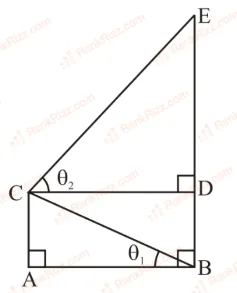
In the figure, θ1+θ2=π2\theta_1 + \theta_2 = \frac{\pi}{2} and 3BE=4AB\sqrt{3}BE = 4AB. If the area of △CAB\triangle CAB is 23−32\sqrt{3} - 3 square units, when θ2θ1\frac{\theta_2}{\theta_1} is the largest, then the perimeter (in unit) of △CED\triangle CED is equal to _______.

Figure for JEE Main 2023 Mathematics question on Half-angle formulas, area and Napier's analogy
Q87Tangents and normals to curvesTRANSCRIBED

Let the quadratic curve passing through the point (-1, 0) and touching the line y=xy = x at (1, 1) be y=f(x)y = f(x). Then the xx-intercept of the normal to the curve at the point (α,α+1)(\alpha, \alpha + 1) in the first quadrant is _______.

Q88Areas of regions defined by inequalitiesTRANSCRIBED

If the area of the region {(x,y):∣x2−2∣≤y≤x}\{(x, y): |x^2 - 2| \leq y \leq x\} is A, then 6A+1626A + 16\sqrt{2} is equal to _______.

Q89Variable separable equationsTRANSCRIBED

Let the tangent at any point P on a curve passing through the points (1, 1) and (110\frac{1}{10}, 100), intersect positive x-axis and y-axis at the points A and B respectively. If PA : PB = 1 : k and y=y(x)y = y(x) is the solution of the differential equation edydx=kx+k2e^{\frac{dy}{dx}} = kx + \frac{k}{2}, y(0)=ky(0) = k, then 4y(1)−5log⁡e34y(1) - 5\log_e 3 is equal to _______.

Q90Line and plane: intersection, coplanarity and projectionTRANSCRIBED

Let the foot of perpendicular from the point A(4, 3, 1) on the plane P: x−y+2z+3=0x - y + 2z + 3 = 0 be N. If B(5,α,β)B(5, \alpha, \beta), α,β∈Z\alpha, \beta \in \mathbb{Z} is a point on plane P such that the area of the triangle ABN is 323\sqrt{2}, then α2+β2+αβ\alpha^2 + \beta^2 + \alpha\beta is equal to _______.