RankRizz

JEE Main 08 Apr 2017, Online: Chemistry

The 30 Chemistry questions of JEE Main 08 Apr 2017, Online, numbered across the whole paper. Pick an answer on any question to check it against the key. Free to read, nothing to download.

Chemistry

Q31Concentration terms and their interconversionTRANSCRIBED

Excess of NaOH (aq) was added to 100 mL of FeCl3_3 (aq) resulting into 2.14 g of Fe(OH)3_3. The molarity of FeCl3_3(aq) is: (Given the molar mass of Fe = 56 g mol−1^{-1} and molar mass of Cl = 35.5 g mol−1^{-1})

  1. A

    0.3 M

  2. B

    0.2 M

  3. C

    0.6 M

  4. D

    1.8 M

Q32Hydrogen spectrum and spectral seriesTRANSCRIBED

If the shortest wavelength in Lyman series of hydrogen atom is AA, then the longest wavelength in Paschen series of He+^+ is:

  1. A

    5A9\frac{5A}{9}

  2. B

    36A7\frac{36A}{7}

  3. C

    36A5\frac{36A}{5}

  4. D

    9A5\frac{9A}{5}

Q33Molecular orbital theory of diatomic speciesTRANSCRIBED

Which of the following is paramagnetic?

  1. A

    CO

  2. B

    NO+^+

  3. C

    O22−O_2^{2-}

  4. D

    B2B_2

Q34VSEPR theory and shapes of molecules and ionsTRANSCRIBED

sp3d2sp^3d^2 hybridization is not displayed by

  1. A

    SF6SF_6

  2. B

    BrF5BrF_5

  3. C

    PF5PF_5

  4. D

    [CrF6]3−[CrF_6]^{3-}

Q35Real gases, compressibility factor and van der Waals equationTRANSCRIBED

Among the following, the incorrect statement is:

  1. A

    at low pressure, real gases show ideal behaviour.

  2. B

    at very low temperature, real gases show ideal behaviour.

  3. C

    at Boyle's temperature, real gases show ideal behaviour.

  4. D

    at very large volume, real gases show ideal behaviour.

Q36Enthalpies of reaction and Hess's lawTRANSCRIBED

The enthalpy change on freezing of 1 mol of water at 5°C to ice at −5-5°C is: (Given ΔfusH=6\Delta_{fus}H = 6 kJ mol−1^{-1} at 0°C, Cp(H2O,l)=75.3C_p(H_2O, l) = 75.3 J mol−1^{-1} K−1^{-1}, Cp(H2O,s)=36.8C_p(H_2O, s) = 36.8 J mol−1^{-1} K−1^{-1})

  1. A

    6.00 kJ mol−1^{-1}

  2. B

    5.81 kJ mol−1^{-1}

  3. C

    5.44 kJ mol−1^{-1}

  4. D

    6.56 kJ mol−1^{-1}

Q37Enthalpies of reaction and Hess's lawTRANSCRIBED

For a reaction, A(g)→A(l)A(g) \to A(l); ΔH=−3RT\Delta H = -3RT. The correct statement for the reaction is:

  1. A

    ΔH=ΔU=0\Delta H = \Delta U = 0

  2. B

    ∣ΔH∣<∣ΔU∣|\Delta H| < |\Delta U|

  3. C

    ∣ΔH∣>∣ΔU∣|\Delta H| > |\Delta U|

  4. D

    ΔH=ΔU≠0\Delta H = \Delta U \neq 0

Q38pH of acids, bases and their mixturesTRANSCRIBED

Addition of sodium hydroxide solution to a weak acid (HA) results in a buffer of pH 6. If ionization constant of HA is 10−510^{-5}, the ratio of salt to acid concentration in the buffer solution will be:

  1. A

    10 : 1

  2. B

    4 : 5

  3. C

    5 : 4

  4. D

    1 : 10

Q39General properties of transition elementsTRANSCRIBED

The pair of compounds having metals in their highest oxidation state is:

  1. A

    Mn2O7Mn_2O_7 and CrO2Cl2CrO_2Cl_2

  2. B

    [Fe(CN)6]3−[Fe(CN)_6]^{3-} and [Cu(CN)4]2−[Cu(CN)_4]^{2-}

  3. C

    [NiCl4]2−[NiCl_4]^{2-} and [CoCl4]2−[CoCl_4]^{2-}

  4. D

    [FeCl4]−[FeCl_4]^{-} and Co2O3Co_2O_3

Q40Hydrogen peroxideTRANSCRIBED

In which of the following reactions, hydrogen peroxide acts as an oxidizing agent?

  1. A

    HOCl+H2O2→H3O++Cl−+O2HOCl + H_2O_2 \to H_3O^+ + Cl^- + O_2

  2. B

    I2+H2O2+2OH−→2I−+2H2O+O2I_2 + H_2O_2 + 2OH^- \to 2I^- + 2H_2O + O_2

  3. C

    PbS+4H2O2→PbSO4+4H2OPbS + 4H_2O_2 \to PbSO_4 + 4H_2O

  4. D

    2MnO4−+3H2O2→2MnO2+3O2+2H2O+2OH−2MnO_4^- + 3H_2O_2 \to 2MnO_2 + 3O_2 + 2H_2O + 2OH^-

Q41Group 15: trends and hydridesTRANSCRIBED

A metal M reacts with nitrogen gas to afford M3NM_3N, M3NM_3N on heating at high temperature gives back M and on reaction with water produces a gas B. Gas B reacts with an aqueous solution of CuSO4_4 to form a deep blue compound. M and B respectively are:

  1. A

    Li and NH3_3

  2. B

    Ba and NH3_3

  3. C

    Na and N2_2

  4. D

    Al and N2_2

Q42Ionisation enthalpyTRANSCRIBED

Consider the following ionization enthalpies of two elements 'A' and 'B'.

Element1st (kJ/mol)2nd (kJ/mol)3rd (kJ/mol)
A899175714847
B73714507731

Which of the following statements is correct?
  1. A

    Both 'A' and 'B' belong to group-1 where 'A' comes below 'B'.

  2. B

    Both 'A' and 'B' belong to group-2 where 'A' comes below 'B'.

  3. C

    Both 'A' and 'B' belong to group-1 where 'B' comes below 'A'.

  4. D

    Both 'A' and 'B' belong to group-2 where 'B' comes below 'A'.

Q43Methods of purification of organic compoundsTRANSCRIBED

Which of the following statements is not true about partition chromatography?

  1. A

    Stationary phase is a finely divided solid adsorbent.

  2. B

    Separation depends upon equilibration of solute between a mobile and a stationary phase.

  3. C

    Mobile phase can be a gas.

  4. D

    Paper chromatography is an example of partition chromatography.

Q44IUPAC nomenclature of organic compoundsTRANSCRIBED

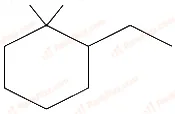
The IUPAC name of the following compound is:
Figure for JEE Main 2017 Chemistry question on IUPAC nomenclature of organic compounds

  1. A

    2-Ethyl-1, 1-dimethyl cyclohexane

  2. B

    1, 1-Dimethyl-2-ethyl cyclohexane

  3. C

    2, 2-Dimethyl-1-1-ethyl cyclohexane

  4. D

    1-Ethyl-2, 2-dimethyl cyclohexane

Q45HaloarenesTRANSCRIBED

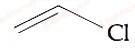
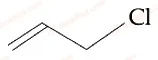
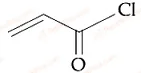
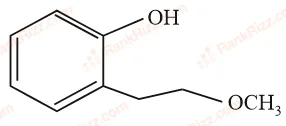
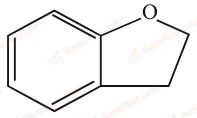
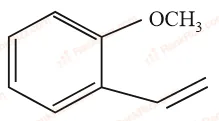
Which of the following compounds will not undergo Friedel Crafts reaction with benzene?

  1. A
    Figure for JEE Main 2017 Chemistry question on Haloarenes
  2. B
    Figure for JEE Main 2017 Chemistry question on Haloarenes
  3. C
    Figure for JEE Main 2017 Chemistry question on Haloarenes
  4. D
    Figure for JEE Main 2017 Chemistry question on Haloarenes
Q46Stratospheric pollution and ozone depletionTRANSCRIBED

Identify the pollutant gases largely responsible for the discoloured and lustreless nature of marble of the Taj Mahal.

  1. A

    SO2SO_2 and O3O_3

  2. B

    O3O_3 and CO2CO_2

  3. C

    SO2SO_2 and NO2NO_2

  4. D

    CO2CO_2 and NO2NO_2

Q47Abnormal molar mass and van't Hoff factorTRANSCRIBED

5 g of Na2_2SO4_4 was dissolved in xx g of H2_2O. The change in freezing point was found to be 3.82°C. If Na2_2SO4_4 is 81.5% ionised, the value of xx is approximately: (KfK_f for water = 1.86°C kg mol−1^{-1}) (molar mass of S = 32 g mol−1^{-1} and that of Na = 23 g mol−1^{-1})

  1. A

    25 g

  2. B

    65 g

  3. C

    15 g

  4. D

    45 g

Q48Electrode potentials, electrochemical series and cell EMFTRANSCRIBED

Consider the following standard electrode potentials (E°E° in volts) in aqueous solution:

ElementM3+/MM^{3+}/MM+/MM^+/M
Al−1.66-1.66+0.55+0.55
Tl+1.26+1.26−0.34-0.34

Based on these data, which of the following statements is correct?
  1. A

    Tl+Tl^+ is more stable than Al3+Al^{3+}

  2. B

    Al+Al^+ is more stable than Al3+Al^{3+}

  3. C

    Tl3+Tl^{3+} is more stable than Al3+Al^{3+}

  4. D

    Tl+Tl^+ is more stable than Al+Al^+

Q49Electrode potentials, electrochemical series and cell EMFTRANSCRIBED

What is the standard reduction potential (E°E°) for Fe3+→FeFe^{3+} \to Fe?
Given that:
Fe2++2e−→FeFe^{2+} + 2e^- \to Fe; E°Fe2+/Fe=−0.47E°_{Fe^{2+}/Fe} = -0.47 V
Fe3++e−→Fe2+Fe^{3+} + e^- \to Fe^{2+}; E°Fe3+/Fe2+=+0.77E°_{Fe^{3+}/Fe^{2+}} = +0.77 V

  1. A

    −0.057-0.057 V

  2. B

    +0.30+0.30 V

  3. C

    −0.30-0.30 V

  4. D

    +0.057+0.057 V

Q50Arrhenius equation and activation energyTRANSCRIBED

The rate of a reaction A doubles on increasing the temperature from 300 to 310 K. By how much, the temperature of reaction B should be increased from 300 K so that rate doubles if activation energy of the reaction B is twice to that of reaction A.

  1. A

    4.92 K

  2. B

    9.84 K

  3. C

    19.67 K

  4. D

    2.45 K

Q51Properties of colloids and coagulationTRANSCRIBED

Among the following, the correct statement is:

  1. A

    sols of metal sulphides are lyophilic.

  2. B

    Brownian movement is more pronounced for smaller particles than for bigger particles.

  3. C

    one would expect charcoal to adsorb chlorine more than hydrogen sulphide.

  4. D

    Hardy Schulze law states that bigger the size of the ions, the greater is its coagulating power.

Q52Group 16: trends, dioxygen, ozone and oxidesTRANSCRIBED

The number of S = O and S - OH bonds present in peroxodisulphuric acid and pyrosulphuric acid respectively are:

  1. A

    (2 and 2) and (2 and 4).

  2. B

    (4 and 2) and (4 and 2).

  3. C

    (4 and 2) and (2 and 4).

  4. D

    (2 and 2) and (2 and 2).

Q53Group analysis and confirmatory tests of cationsTRANSCRIBED

A solution containing a period-IV cation gives a precipitate on passing H2_2S. A solution of this precipitate in dil. HCl produces a white precipitate with NaOH solution and bluish-white precipitate with basic potassium ferrocyanide. The cation is:

  1. A

    Mn2+Mn^{2+}

  2. B

    Zn2+Zn^{2+}

  3. C

    Ni2+Ni^{2+}

  4. D

    Co2+Co^{2+}

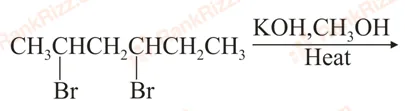
Q54Nucleophilic substitution (SN1 and SN2)TRANSCRIBED

The major product of the following reaction is:

Figure for JEE Main 2017 Chemistry question on Nucleophilic substitution (SN1 and SN2)
  1. A

    CH3CH=CH−CH=CHCH3CH_3CH = CH - CH = CHCH_3

  2. B

    CH2=CHCH=CHCH2CH3CH_2 = CHCH = CHCH_2CH_3

  3. C

    CH3CH=C=CHCH2CH3CH_3CH = C = CHCH_2CH_3

  4. D

    CH2=CHCH2CH=CHCH3CH_2 = CHCH_2CH = CHCH_3

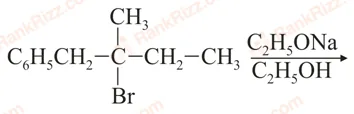
Q55Nucleophilic substitution (SN1 and SN2)TRANSCRIBED

The major product of the following reaction is:

Figure for JEE Main 2017 Chemistry question on Nucleophilic substitution (SN1 and SN2)
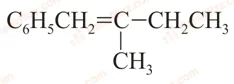
  1. A
    Figure for JEE Main 2017 Chemistry question on Nucleophilic substitution (SN1 and SN2)
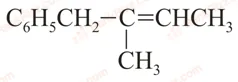
  2. B
    Figure for JEE Main 2017 Chemistry question on Nucleophilic substitution (SN1 and SN2)
  3. C
    Figure for JEE Main 2017 Chemistry question on Nucleophilic substitution (SN1 and SN2)
  4. D
    Figure for JEE Main 2017 Chemistry question on Nucleophilic substitution (SN1 and SN2)
Q56Properties and reactions of alcoholsTRANSCRIBED

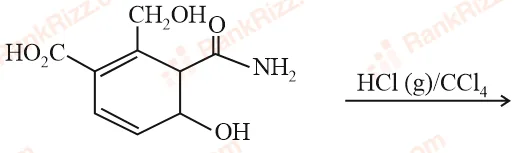
The major product of the following reaction is:

Figure for JEE Main 2017 Chemistry question on Properties and reactions of alcohols
  1. A
    Figure for JEE Main 2017 Chemistry question on Properties and reactions of alcohols
  2. B
    Figure for JEE Main 2017 Chemistry question on Properties and reactions of alcohols
  3. C
    Figure for JEE Main 2017 Chemistry question on Properties and reactions of alcohols
  4. D
    Figure for JEE Main 2017 Chemistry question on Properties and reactions of alcohols
Q57Preparation of aminesTRANSCRIBED

The major product expected from the following reaction is:

Figure for JEE Main 2017 Chemistry question on Preparation of amines
  1. A
    Figure for JEE Main 2017 Chemistry question on Preparation of amines
  2. B
    Figure for JEE Main 2017 Chemistry question on Preparation of amines
  3. C
    Figure for JEE Main 2017 Chemistry question on Preparation of amines
  4. D
    Figure for JEE Main 2017 Chemistry question on Preparation of amines
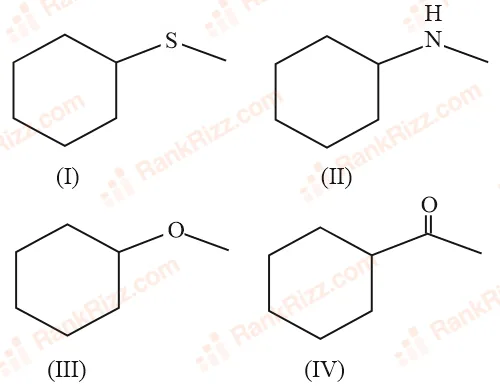
Q58Acidity and basicity of organic compoundsTRANSCRIBED

A mixture containing the following four compounds is extracted with 1 M HCl. The compound that goes to aqueous layer is:

Figure for JEE Main 2017 Chemistry question on Acidity and basicity of organic compounds
  1. A

    IV

  2. B

    II

  3. C

    I

  4. D

    III

Q59Drugs and medicinesTRANSCRIBED

The reason for "drug induced poisoning" is:

  1. A

    binding irreversibly to the active site of the enzyme.

  2. B

    binding at the allosteric sites of the enzyme.

  3. C

    binding reversibly at the active site of the enzyme.

  4. D

    bringing conformational change in the binding site of enzyme.

Q60Proteins and enzymesTRANSCRIBED

Among the following, the essential amino acid is:

  1. A

    Valine

  2. B

    Alanine

  3. C

    Serine

  4. D

    Aspartic acid

NEXT IN THIS PAPER →Maths, Q61 onwards