JEE Main 2017 Chemistry question — Nucleophilic substitution (SN1 and SN2)
The major product of the following reaction is:
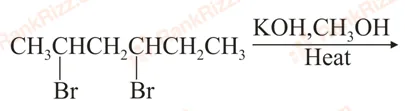
SOLUTION
The reaction involves two consecutive -eliminations (dehydro-halogenations) of a vicinal dihalide with alcoholic . Each elimination removes one molecule of and generates a new bond. After the second elimination three different arrangements of the two bonds are possible:
• conjugated diene : (double bonds separated by one single bond)
• isolated diene : or (double bonds separated by two or more single bonds)
• cumulated diene : (two consecutive double bonds, an allene)
Step 1 - Relative stability of the three possibilities
The heat of hydrogenation (or equivalently, the enthalpy of formation) follows the order
This means conjugated dienes are the most stable because the two bonds can overlap with the intermediate bond, giving an extended delocalised -system with extra resonance stabilisation.
Step 2 - Product distribution under elimination conditions
E2 eliminations are under thermodynamic control when they are carried out with a strong base at high temperature in alcoholic medium. Under such conditions the most stable alkene (or diene) predominates. Consequently the conjugated diene is formed in the greatest amount, while the less-stable isolated and cumulated dienes are minor or negligible.
Step 3 - Matching with the given options
Only Option A, , is the conjugated diene. Options B and D are isolated dienes, and Option C is the cumulated diene (allene). Therefore Option A corresponds to the thermodynamically favoured major product.
Hence the major product is obtained as
Option A which is:
Tagged Nucleophilic substitution (SN1 and SN2). Machine-assigned, so read it as a strong shortlist rather than a verdict.