Q31Mole concept, atomic and molar massTRANSCRIBED
A sample of a hydrate of barium chloride weighing 61 g was heated until all the water of hydration was removed. The dried sample weighed 52 g. The formula of the hydrated salt is: (atomic mass, Ba = 137 amu, Cl = 35.5 amu)
- A
BaCl2⋅H2O
- B
BaCl2⋅3H2O
- C
BaCl2⋅4H2O
- D
BaCl2⋅2H2O
Q32Radial and angular nodes and orbital energiesTRANSCRIBED
If the principal quantum number n = 6, the correct sequence of filling of electrons will be:
- A
ns → (n-1) d → (n-2) f → np
- B
ns → np → (n-1)d → (n-2)f
- C
ns → (n-2)f → np → (n-1)d
- D
ns → (n-2)f → (n-1)d → np
Q33Modern periodic table and classification of elementsTRANSCRIBED
In the long form of the periodic table, the valence shell electronic configuration of 5s25p4 corresponds to the element present in:
- A
- B
- C
- D
Q34VSEPR theory and shapes of molecules and ionsTRANSCRIBED
The shape of XeOF4 by VSEPR theory is:
- A
- B
- C
- D
Q35Molecular orbital theory of diatomic speciesTRANSCRIBED
After understanding the assertion and reason, choose the correct option.
Assertion: In the bonding molecular orbital (MO) of H2, electron density is increased between the nuclei.
Reason: The bonding MO is ψA+ψB, which shows destructive interference of the combining electron waves.
- A
Assertion and Reason are correct, but Reason is not the correct explanation for the Assertion.
- B
Assertion and Reason are correct and Reason is the correct explanation for the Assertion.
- C
Assertion is incorrect, Reason is correct.
- D
Assertion is correct, Reason is incorrect.
Q36Kinetic theory of gases and molecular speedsTRANSCRIBED
Which of the following is not an assumption of the kinetic theory of gases?
- A
Collisions of gas particles are perfectly elastic.
- B
A gas consists of many identical particles which are in continual motion.
- C
At high pressure, gas particles are difficult to compress.
- D
Gas particles have negligible volume.
Q37Bond enthalpy, atomisation, phase-change and solution enthalpiesTRANSCRIBED
The heat of atomization of methane and ethane are 360 kJ mol−1 and 620 kJ mol−1, respectively. The longest wavelength of light capable of breaking the C - C bond is (Avogadro's number = 6.023×10²³, h = 6.62×10⁻³⁴ J s)
- A
2.48×10⁴ nm
- B
1.49×10⁴ nm
- C
2.48×10³ nm
- D
1.49×10³ nm
Q38Law of mass action and equilibrium constants Kc and KpTRANSCRIBED
Gaseous N2O4 dissociates into gaseous NO2 according to the reaction N2O4(g)⇌2NO2(g). At 300 K and 1 atm pressure, the degree of dissociation of N2O4 is 0.2. If one mole of N2O4 gas is contained in a vessel, then the density of the equilibrium mixture is:
- A
- B
- C
- D
Q39Hardness of water and its removalTRANSCRIBED
Permanent hardness in water cannot be cured by:
- A
Treatment with washing soda
- B
- C
- D
Q40Compounds of alkaline earth metalsTRANSCRIBED
The correct order of thermal stability of hydroxides is
- A
Mg(OH)2<Sr(OH)2<Ca(OH)2<Ba(OH)2
- B
Mg(OH)2<Ca(OH)2<Sr(OH)2<Ba(OH)2
- C
Ba(OH)2<Sr(OH)2<Ca(OH)2<Mg(OH)2
- D
Ba(OH)2<Ca(OH)2<Sr(OH)2<Mg(OH)2
Q41Quantitative estimation of elementsTRANSCRIBED
1.4 g of an organic compound was digested according to Kjeldahl's method and the ammonia evolved was absorbed in 60 mL of M/10 H2SO4 solution. The excess sulphuric acid required 20 mL of M/10 NaOH solution for neutralization. The percentage of nitrogen in the compound is:
- A
- B
- C
- D
Q42Structural isomerismTRANSCRIBED
The optically inactive compound from the following is:
- A
- B
- C
- D
Q43Nucleophilic substitution (SN1 and SN2)TRANSCRIBED
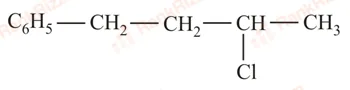
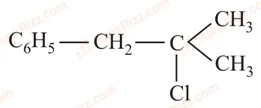
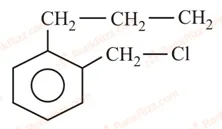
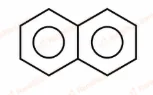
A compound A with molecular formula C10H13Cl, gives a white precipitate on adding silver nitrate solution. A on reacting with alcoholic KOH gives compound B as the main product. B on ozonolysis, gives C and D. C gives Cannizaro reaction, but not aldol condensation. D gives aldol condensation, but not Cannizaro reaction. A is
- A
- B
- C
- D
Q44Stratospheric pollution and ozone depletionTRANSCRIBED
Photochemical smog consists of excessive amount of X, in addition to aldehydes, ketones, peroxy acetyl nitrile (PAN). X is:
- A
- B
- C
- D
Q45Relative lowering of vapour pressureTRANSCRIBED
A solution at 20∘C is composed of 1.5 mol of benzene and 3.5 mol of toluene. If the vapour pressure of pure benzene and pure toluene at this temperature are 74.7 torr and 22.3 torr respectively, then the total vapour pressure of the solution and the benzene mole fraction in equilibrium with it will be, respectively:
- A
- B
- C
- D
Q46Galvanic cells, cell notation and salt bridgeTRANSCRIBED
A variable, the opposite external potential (Eext) is applied to the cell Zn | Zn2+ (1M) || Cu2+ (1M) | Cu, of potential 1.1 V. When Eext<1.1 V and Eext>1.1 V, respectively electrons flow from
- A
anode to cathode in both the cases.
- B
anode to cathode and cathode to anode.
- C
cathode to anode and anode to cathode.
- D
cathode to anode in both cases.
Q47Integrated rate laws and half-life (zero and first order)TRANSCRIBED
The reaction 2N2O5(g)→4NO2(g)+O2(g) follows first order kinetics. The pressure of a vessel containing only N2O5 was found to increase from 50 mm Hg to 87.5 mm Hg in 30 min. The pressure exerted by the gases after 60 min. will be (Assume temperature remains constant):
- A
- B
- C
- D
Q48Adsorption and adsorption isothermsTRANSCRIBED
The following statements relate to the adsorption of gases on a solid surface. Identify the incorrect statement among them:
- A
Entropy of adsorption is negative
- B
Enthalpy of adsorption is negative
- C
On adsorption decrease in surface energy appears as heat
- D
On adsorption, the residual forces on the surface are increased
Q49Thermodynamic principles and Ellingham diagramTRANSCRIBED
In the isolation of metals, calcination process usually results in:
- A
- B
- C
- D
Q50Group 17: halogens and hydrogen halidesTRANSCRIBED
The least number of oxyacids are formed by:
- A
- B
- C
- D
Q51Group analysis and confirmatory tests of cationsTRANSCRIBED
The cation that will not be precipitated by H2S in the presence of dil HCl is:
- A
- B
- C
- D
Q52Group analysis and confirmatory tests of cationsTRANSCRIBED
An aqueous solution of a salt X turns blood red on treatment with SCN− and blue on treatment with K4[Fe(CN)6], X also gives a positive chromyl chloride test. The salt X is:
- A
- B
Fe(NO3)3
- C
- D
Cu(NO3)2
Q53Werner's theory and coordination terminologyTRANSCRIBED
Which molecule/ion among the following cannot act as a ligand in complex compounds?
- A
- B
- C
- D
Q54Structural isomerism in complexesTRANSCRIBED
The correct statement on the isomerism associated with the following complex ions.
(a) [Ni(H2O)5NH3]2+
(b) [Ni(H2O)4(NH3)2]2+ and
(c) [Ni(H2O)3(NH3)3]2+ is:
- A
(a) and (b) show only geometrical isomerism
- B
(a) and (b) show geometrical and optical isomerism
- C
(b) and (c) show geometrical and optical isomerism
- D
(b) and (c) show only geometrical isomerism
Q55Reactions of carboxylic acidsTRANSCRIBED
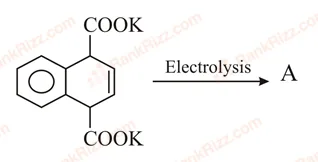
A is:
- A
- B
- C
- D
Q56Reactions of carboxylic acidsTRANSCRIBED
In the presence of a small amount of phosphorous, aliphatic carboxylic acid reacts with chlorine or bromine to yield a reaction in which, α-hydrogen is been replaced by halogen. This reaction is known as
- A
- B
- C
- D
Hell-volhard-zelinsky reaction
Q57Electrophilic substitution of anilineTRANSCRIBED
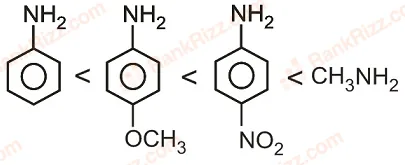
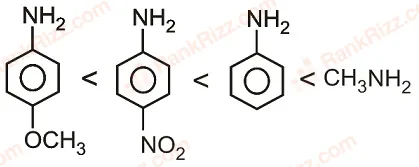
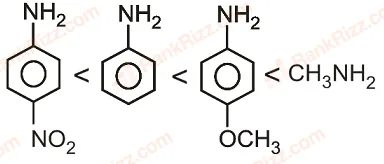
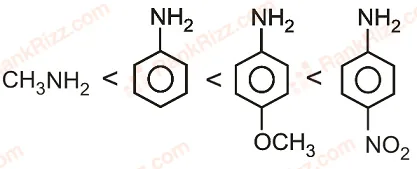
The correct order of basicity is
- A
- B
- C
- D
Q58Important polymers and their monomersTRANSCRIBED
Match the polymers in column-A with their main uses in column-B and choose the correct answer:
Column - A Column - B
A. Polystyrene i. Paints and lacquers
B. Glyptal ii. Rain coats
C. Polyvinyl chloride iii. Manufacture of toys
D. Bakelite iv. Computer discs
- A
A - iii, B - i, C - ii, D - iv
- B
A - ii, B - i, C - iii, D - iv
- C
A - ii, B - iv, C - iii, D - i
- D
A - iii, B - iv, C - ii, D - i
Q59Drugs and medicinesTRANSCRIBED
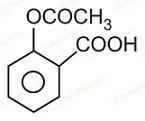
is used as:
- A
- B
- C
- D
Q60Carbohydrates: classification and monosaccharidesTRANSCRIBED
Complete hydrolysis of starch gives:
- A
Galactose and fructose in equimolar amounts
- B
Glucose and galactose in equimolar amounts
- C
Glucose and fructose in equimolar amounts
- D