RankRizz

Doppler effect in sound — JEE Main Previous Year Questions

Every JEE Main question on Doppler effect in sound, one of the ideas inside Waves: 37 questions from 2005–2023, 24 of them in the last five years. Newest first, answer key on every one. Free to read.

Questions

37

Years asked

14

Since

2005

Of the chapter

22%

Every Doppler effect in sound question

21–37 OF 37 · NEWEST FIRST

JEE MAIN 2019 · 09 JAN S2Doppler effect in soundTRANSCRIBED

A musician using an open flute of length 50 cm produces second harmonic sound waves. A person runs towards the musician from another end of a hall at a speed of 10 km h−1^{-1}. If the wave speed is 330 m s−1^{-1}, the frequency heard by the running person shall be close to:

  1. A

    333 Hz

  2. B

    500 Hz

  3. C

    666 Hz

  4. D

    753 Hz

JEE MAIN 2019 · 09 APR S2Doppler effect in soundTRANSCRIBED

Two cars A and B are moving away from each other in opposite directions. Both the cars are moving with speed of 20 m s−1^{-1} with respect to the ground. If an observer in car A detects a frequency 2000 Hz of the sound coming from car B, what is the natural frequency of the sound source in car B? (speed of sound in air = 340 m s−1^{-1})

  1. A

    2150 Hz

  2. B

    2300 Hz

  3. C

    2250 Hz

  4. D

    2060 Hz

JEE MAIN 2019 · 12 APR S2Doppler effect in soundTRANSCRIBED

Two sources of sound S1_1 and S2_2 produce sound waves of same frequency 660 Hz. A listener is moving from source S1_1 towards S2_2 with a constant speed u0_0 m/s and he hears 10 beats/s. The velocity of sound is 330 m/s. Then, u0_0 equals:

  1. A

    10.0 m/s

  2. B

    2.5 m/s

  3. C

    5.5 m/s

  4. D

    15.0 m/s

JEE MAIN 2019 · 10 APR S2Doppler effect in soundTRANSCRIBED

A source of sound S is moving with a velocity of 50 m s−1^{-1} towards a stationary observer. The observer measures the frequency of the source as 1000 Hz. What will be the apparent frequency of the source when it is moving away from the observer after crossing him? (Take velocity of sound in air is 350 m s−1^{-1})

  1. A

    750 Hz

  2. B

    857 Hz

  3. C

    1143 Hz

  4. D

    807 Hz

JEE MAIN 2017 · 02 APR OFFLINEDoppler effect in soundTRANSCRIBED

An observer is moving with half the speed of light towards a stationary microwave source emitting waves at frequency 10 GHz. What is the frequency of the microwave measured by the observer? (speed of light = 3×1083 \times 10^{8} m s−1^{-1})

  1. A

    15.3 GHz

  2. B

    10.1 GHz

  3. C

    12.1 GHz

  4. D

    17.3 GHz

JEE MAIN 2016 · 09 APR ONLINEDoppler effect in soundTRANSCRIBED

Two engines pass each other moving in opposite directions with uniform speed of 30 m/s. One of them is blowing a whistle of frequency 540 Hz. Calculate the frequency heard by driver of second engine before they pass each other. Speed of sound is 330 m/sec:

  1. A

    450 Hz

  2. B

    540 Hz

  3. C

    270 Hz

  4. D

    648 Hz

JEE MAIN 2016 · 10 APR ONLINEDoppler effect in soundTRANSCRIBED

A toy-car, blowing its horn, is moving with a steady speed of 5 m s−1^{-1}, away from a wall. An observer, towards whom the toy car is moving, is able to hear 5 beats per second. If the velocity of sound in air is 340 m s−1^{-1}, the frequency of the horn of the toy car is close to

  1. A

    680 Hz

  2. B

    510 Hz

  3. C

    340 Hz

  4. D

    170 Hz

JEE MAIN 2015 · 04 APR OFFLINEDoppler effect in soundTRANSCRIBED

A train is moving on a straight track with speed 20 m s−1^{-1}. It is blowing its whistle at the frequency of 1000 Hz. The percentage change in the frequency heard by a person standing near the track as the train passes him is (speed of sound = 320 m s−1^{-1}) close to:

  1. A

    24%

  2. B

    6%

  3. C

    12%

  4. D

    18%

JEE MAIN 2015 · 10 APR ONLINEDoppler effect in soundTRANSCRIBED

A bat moving at 10 m s−1^{-1} towards a wall sends a sound signal of 8000 Hz towards it. On reflection, it hears a sound of frequency ff. The value of ff in Hz is close to (speed of sound = 320 m s−1^{-1})

  1. A

    8258

  2. B

    8424

  3. C

    8000

  4. D

    8516

JEE MAIN 2015 · 11 APR ONLINEDoppler effect in soundTRANSCRIBED

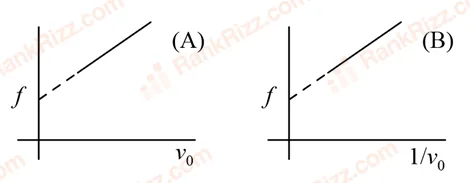
A source of sound emits sound waves at frequency f0f_0. It is moving towards an observer with fixed speed vsv_s (vs<v)(v_s < v), where vv is the speed of sound in air. If the observer were to move towards the source with speed v0v_0, one of the following two graphs (A and B) will give the correct variation of the frequency ff heard by the observer as v0v_0 is changed.

Figure for JEE Main 2015 Physics question on Doppler effect in sound

The variation of ff with v0v_0 is given correctly by:

  1. A

    Graph A with slope = f0(v−vs)\frac{f_0}{(v-v_s)}

  2. B

    Graph A with slope = f0(v+vs)\frac{f_0}{(v+v_s)}

  3. C

    Graph B with slope = f0(v−vs)\frac{f_0}{(v-v_s)}

  4. D

    Graph B with slope = f0(v+vs)\frac{f_0}{(v+v_s)}

JEE MAIN 2014 · 11 APR ONLINEDoppler effect in soundTRANSCRIBED

Two factories are sounding their sirens at 800 Hz. A man goes from one factory to other at a speed of 2 m/s. The velocity of sound is 320 m/s. The number of beats heard by the person in one second will be:

  1. A

    2

  2. B

    4

  3. C

    8

  4. D

    10

JEE MAIN 2014 · 12 APR ONLINEDoppler effect in soundTRANSCRIBED

A source of sound A emitting waves of frequency 1800 Hz is falling towards ground with a terminal speed v. The observer B on the ground directly beneath the source receives waves of frequency 2150 Hz. The source A receives waves, reflected from ground of frequency nearly: (Speed of sound = 343 m/s)

  1. A

    2150 Hz

  2. B

    2500 Hz

  3. C

    1800 Hz

  4. D

    2400 Hz

JEE MAIN 2013 · 22 APR ONLINEDoppler effect in soundTRANSCRIBED

A and B are two sources generating sound waves. A listener is situated at C. The frequency of the source at A is 500 Hz. A, now, moves towards C with a speed 4 m/s. The number of beats heard at C is 6. When A moves away from C with speed 4 m/s, the number of beats heard at C is 18. The speed of sound is 340 m/s. The frequency of the source at B is :

Figure for JEE Main 2013 Physics question on Doppler effect in sound
  1. A

    500 Hz

  2. B

    506 Hz

  3. C

    512 Hz

  4. D

    494 Hz

JEE MAIN 2012Doppler effect in soundTRANSCRIBED

This question has Statement 1 and Statement 2. Of the four choices given after the Statements, choose the one that best describes the two Statements. Statement 1: Bats emitting ultrasonic waves can detect the location of a prey by hearing the waves reflected from it. Statement 2: When the source and the detector are moving, the frequency of reflected waves is changed.

  1. A

    Statement 1 is false, Statement 2 is true.

  2. B

    Statement 1 is true, Statement 2 is false.

  3. C

    Statement 1 is true, Statement 2 is true, Statement 2 is not the correct explanation of Statement 1.

  4. D

    Statement 1 is true, Statement 2 is true, Statement 2 is the correct explanation of Statement 1.

JEE MAIN 2009Doppler effect in soundTRANSCRIBED

A motor cycle starts from rest and accelerates along a straight path at 22 m/s2^2. At the starting point of the motor cycle there is a stationary electric siren. How far has the motor cycle gone when the driver hears the frequency of the siren at 94%94\% of its value when the motor cycle was at rest? (speed of sound =330= 330 ms−1^{-1})

  1. A

    4949 m

  2. B

    9898 m

  3. C

    147147 m

  4. D

    196196 m

JEE MAIN 2006Doppler effect in soundTRANSCRIBED

A whistle producing sound waves of frequencies 9500 Hz9500\,Hz and above is approaching a stationary person with speed v ms−1v\,ms^{-1}. The velocity of sound in air is 300 ms−1300\,ms^{-1}. If the person can hear frequencies upto a maximum of 10,000 Hz10{,}000\,Hz, the maximum value of vv upto which he can hear the whistle is

  1. A

    30 ms−130\,ms^{-1}

  2. B

    152 ms−115\sqrt{2}\,ms^{-1}

  3. C

    15/2 ms−115/\sqrt{2}\,ms^{-1}

  4. D

    15 ms−115\,ms^{-1}

JEE MAIN 2005Doppler effect in soundTRANSCRIBED

An observer moves towards a stationary source of sound, with a velocity one fifth of the velocity of sound. What is the percentage increase in the apparent frequency?

  1. A

    zero

  2. B

    0.5%0.5\%

  3. C

    5%5\%

  4. D

    20%20\%