In an open organ pipe and are and harmonic frequencies, respectively. If = 2200 Hz then length of the pipe is ____ mm .
(Take velocity of sound in air is 330 m/s.)
- A
275
- B
250
- C
200
- D
225
Every JEE Main question on Organ pipes and resonance columns, one of the ideas inside Waves: 17 questions from 2008–2026, 7 of them in the last five years. Newest first, answer key on every one. Free to read.
Questions
17
Years asked
8
Since
2008
Of the chapter
10%
Questions on Organ pipes and resonance columns in each year it was asked.
1–17 OF 17 · NEWEST FIRST
In an open organ pipe and are and harmonic frequencies, respectively. If = 2200 Hz then length of the pipe is ____ mm .
(Take velocity of sound in air is 330 m/s.)
275
250
200
225
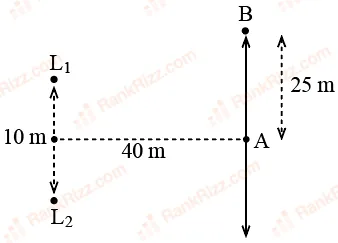
Two loudspeakers are placed with a separation of 10 m , as shown in figure. Both speakers are fed with an audio input signal of same frequency with constant volume. A voice recorder, initially at point , at equidistance to both loud speakers, is moved by 25 m along the line while monitoring the audio signal. The measured signal was found to undergo 10 cycles of minima and maxima during the movement. The frequency of the input signal is ________Hz
(Speed of sound in air is 324 m/s and )

A closed and an open organ pipe have same lengths. If the ratio of frequencies of their seventh overtones is then the value of is ________.
The velocity of sound in a gas, in which two wavelengths m and m produce beats in s, will be
m s
m s
m s
m s
The equations of two waves are given by :
cm
cm
These waves are simultaneously passing through a string. The amplitude of the resulting wave is :
2 cm
4 cm
5.8 cm
8 cm
Two waves executing simple harmonic motion travelling in the same direction with same amplitude and frequency are superimposed. The resultant amplitude is equal to the times of amplitude of individual motions. The phase difference between the two motions is ______ (degree).
A set of tuning forks is arranged in a series of increasing frequencies. If each fork gives beats with respect to the preceding fork and the frequency of the last fork is twice the frequency of the first, then the frequency of last fork is ______ Hz.
A tuning fork is vibrating at 250 Hz. The length of the shortest closed organ pipe that will resonate with the tuning fork will be _________ cm. (Take speed of sound in air as 340 m s)
Two travelling waves produces a standing wave represented by equation.
. The node closest to the origin in the region will be at = _________ (in cm).
Three harmonic waves having equal frequency and same intensity , have phase angles , and respectively. When they are superimposed the intensity of the resultant wave is close to:
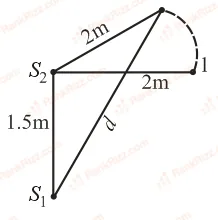
Two coherent sources of sound, and , produce sound waves of the same wavelength are in phase. and are placed apart (see fig). A listener, located at L, directly in front of , finds that the intensity is at a minimum when he is away from . The listener moves away from , keeping the distance from fixed. The adjacent maximum of intensity is observed when the listener is at a distance from . Then is:

12 m
5 m
2 m
3 m
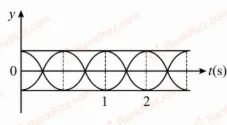
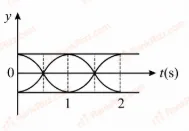
The correct figure that shows, schematically, the wave pattern produced by the superposition of two waves of frequencies 9 Hz and 11 Hz, is


A cylindrical tube, open at both ends, has a fundamental frequency, , in air. The tube is dipped vertically in water so that half of it is in water. The fundamental frequency of the air-column is now
This question has Statement 1 and Statement 2. Of the four choices given after the Statements, choose the one that best describes the two Statements. Statement 1: In the resonance tube experiment, if the tuning fork is replaced by another identical turning fork but with its arm having been filled, the length of the air column should be increased to obtain resonance again. Statement 2: On filling the arms, the frequency of a tuning fork increases.
Statement 1 is true, Statement 2 is true, Statement 2 is a correct explanation of Statement 1.
Statement 1 is true, Statement 2 is false.
Statement 1 is false, Statement 2 is true.
Statement 1 is true, Statement 2 is true, Statement 2 is not a correct explanation of Statement 1.
An air column in a pipe, which is closed at one end, will be in resonance with a vibrating tuning fork of frequency 264 Hz if the length of the column in cm is (velocity of sound = 330 m/s)
125.00
93.75
62.50
187.50
A uniform tube of length cm is held vertically with its lower end dipped in water. A sound source of frequency Hz sends sound waves into the tube. When the length of tube above water is cm and again when it is cm, the tube resonates with the source of sound. Two lowest frequencies (in Hz), to which tube will resonate when it is taken out of water, are (approximately).
While measuring the speed of sound by performing a resonance column experiment, a student gets the first resonance condition at a column length of 18 cm during winter. Repeating the same experiment during summer, she measures the column length to be cm for the second resonance. Then