JEE Main 2015 Physics question — Doppler effect in sound
A source of sound emits sound waves at frequency . It is moving towards an observer with fixed speed , where is the speed of sound in air. If the observer were to move towards the source with speed , one of the following two graphs (A and B) will give the correct variation of the frequency heard by the observer as is changed.
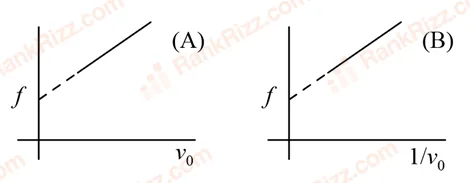
The variation of with is given correctly by:
SOLUTION
For a source and observer moving toward each other, the observed frequency is given by:
To find the correct graph, we rewrite this expression in the linear form , where and :
Because is a linear function of , the graph must be a straight line with a positive intercept. This corresponds to Graph A.
Tagged Doppler effect in sound. Machine-assigned, so read it as a strong shortlist rather than a verdict.