JEE MAIN 2018 · 15 APR S1Single slit diffractionTRANSCRIBED
Light of wavelength 550 nm falls normally on a slit of width cm. The angular position of the second minima from the central maximum will be (in radians):
- A
- B
- C
- D
Every JEE Main question on Single slit diffraction, one of the ideas inside Wave Optics: 29 questions from 2005–2026, 14 of them in the last five years. Newest first, answer key on every one. Free to read.
Questions
29
Years asked
15
Since
2005
Of the chapter
15%
21–29 OF 29 · NEWEST FIRST
Light of wavelength 550 nm falls normally on a slit of width cm. The angular position of the second minima from the central maximum will be (in radians):
A single slit of width is illuminated by a coherent monochromatic light of wavelength . If the second and fourth minima in the diffraction pattern at a distance 1 cm from the slit are at 3 cm and 6 cm respectively from the central maximum, what is the width of the central maximum? (i.e. distance between first minimum on either side of the central maximum)
4.5 cm
1.5 cm
6.0 cm
3.0 cm
A single slit of width 0.1 mm is illuminated by a parallel beam of light of wavelength 6000 Å and diffraction bands are observed on a screen 0.5 m from the slit. The distance of the third dark band from the central bright band is:
9 mm
3 mm
4.5 mm
1.5 mm
The box of a pin hole camera, of length L, has a hole of radius a. It is assumed that when the hole is illuminated by a parallel beam of light of wavelength the spread of the spot (obtained on the opposite wall of the camera) is the sum of its geometrical spread and the spread due to diffraction. The spot would then have its minimum size (say ) when:
and
and
and
and
In Young's double-slit experiment, the distance between the two identical slits is 6.1 times larger than the slit width. Then the number of intensity maxima observed within the central maximum of the single-slit diffraction pattern is:
3
6
24
12
In an experiment of single slit diffraction pattern, first minimum for red light coincides with first maximum of some other wavelength. If wavelength of red light is 6600 , then wavelength of first maximum will be:
3300
4400
5500
6600
The first diffraction minimum due to the single slit diffraction is seen at for a light of wavelength falling perpendicularly on the slit. The width of the slit is
cm
cm
cm
cm
Paragraph: Wave property of electrons implies that they will show diffraction effects. Davisson and Germer demonstrated this by diffracting electrons from crystals. The law governing the diffraction from a crystal is obtained by requiring that electron waves reflected from the planes of atoms in a crystal interfere constructively (see in figure).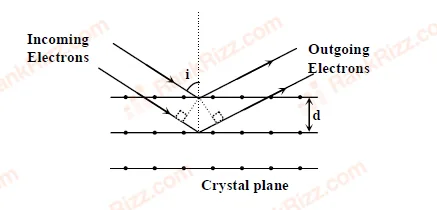
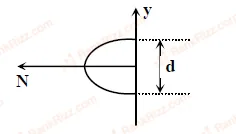
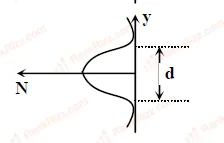
Question: In an experiment, electrons are made to pass through a narrow slit of width '' comparable to their de Broglie wavelength. They are detected on a screen at a distance '' from the slit (see figure).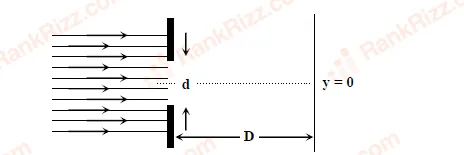
Which of the following graph can be expected to represent the number of electrons '' detected as a function of the detector position '' ( corresponds to the middle of the slit)?
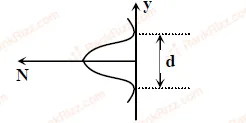
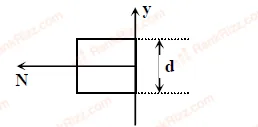
If is the intensity of the principal maximum in the single slit diffraction pattern, then what will be its intensity when the slit width is doubled?