JEE Main 2008 Physics question — Single slit diffraction
Paragraph: Wave property of electrons implies that they will show diffraction effects. Davisson and Germer demonstrated this by diffracting electrons from crystals. The law governing the diffraction from a crystal is obtained by requiring that electron waves reflected from the planes of atoms in a crystal interfere constructively (see in figure).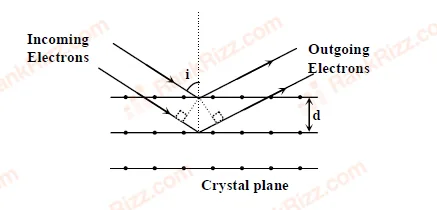
Question: In an experiment, electrons are made to pass through a narrow slit of width '' comparable to their de Broglie wavelength. They are detected on a screen at a distance '' from the slit (see figure).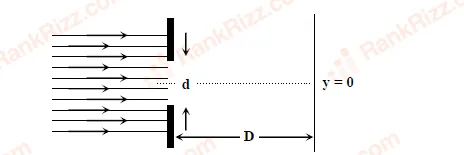
Which of the following graph can be expected to represent the number of electrons '' detected as a function of the detector position '' ( corresponds to the middle of the slit)?
SOLUTION
Key idea: Single-slit diffraction of electrons: the central maximum has angular half-width , with weaker secondary maxima beyond it.
- Since is comparable to , the spreading angle is large.
- On a screen at distance , the first minima are at . For this is much wider than the slit width .
- So is a broad central peak at . Its first zeros lie well outside , with small side maxima beyond them.
- (B) and (C) show no diffraction. (A) has the central peak confined within the slit width. (D) shows the central maximum spreading beyond with secondary maxima.
Answer: (D)
Tagged Single slit diffraction. Machine-assigned, so read it as a strong shortlist rather than a verdict.