RankRizz

Polarisation: Malus's law and Brewster's law — JEE Main Previous Year Questions

Every JEE Main question on Polarisation: Malus's law and Brewster's law, one of the ideas inside Wave Optics: 38 questions from 2004–2026, 20 of them in the last five years. Newest first, answer key on every one. Free to read.

Questions

38

Years asked

15

Since

2004

Of the chapter

19%

Every Polarisation: Malus's law and Brewster's law question

21–38 OF 38 · NEWEST FIRST

JEE MAIN 2021 · 24 FEB S1Polarisation: Malus's law and Brewster's lawTRANSCRIBED

An unpolarized light beam is incident on the polarizer of a polarization experiment and the intensity of light beam emerging from the analyzer is measured as 100 Lumens. Now, if the analyzer is rotated around the horizontal axis (direction of light) by 30° in clockwise direction, the intensity of emerging light will be ______ Lumens.
JEE MAIN 2021 · 26 AUG S2Polarisation: Malus's law and Brewster's lawTRANSCRIBED

A source of light is placed in front of a screen. The intensity of light on the screen is II. Two Polaroids P1P_1 and P2P_2 are so placed in between the source of light and screen that the intensity of light on the screen is I2\frac{I}{2}. Then the P2P_2, should be rotated by an angle of _________ (degrees) so that the intensity of light on the screen becomes 3I8\frac{3I}{8}.

JEE MAIN 2020 · 07 JAN S1Polarisation: Malus's law and Brewster's lawTRANSCRIBED

A polarizer - analyser set is adjusted such that the intensity of light coming out of the analyser is just 36% of the original intensity. Assuming that the polarizer - analyser set does not absorb any light, the angle by which the analyser needs to be rotated further, to reduce the output intensity to zero, is (sin⁡−1(35)=37∘\sin^{-1}\left(\frac{3}{5}\right) = 37^\circ)

  1. A

    53∘^\circ

  2. B

    37∘^\circ

  3. C

    90∘^\circ

  4. D

    45∘^\circ

JEE MAIN 2020 · 04 SEP S1Polarisation: Malus's law and Brewster's lawTRANSCRIBED

A beam of plane polarized light of large cross-sectional area and uniform intensity of 3.3 W m−2^{-2} falls normally on a polarizer (cross-sectional area 3×10−43 \times 10^{-4} m2^2), which rotates about its axis with an angular speed of 31.4 rad s−1^{-1}. The energy of light passing through the polarizer per revolution, is close to:

  1. A

    1.0×10−51.0 \times 10^{-5} J

  2. B

    1.0×10−41.0 \times 10^{-4} J

  3. C

    1.5×10−41.5 \times 10^{-4} J

  4. D

    5.0×10−45.0 \times 10^{-4} J

JEE MAIN 2019 · 12 APR S2Polarisation: Malus's law and Brewster's lawTRANSCRIBED

A system of three polarizers P1_1, P2_2, P3_3 is set up such that the pass axis of P3_3 is crossed with respect to that of P1_1. The pass axis of P2_2 is inclined at 60° to the pass axis of P3_3. When a beam of unpolarized light of intensity I0_0 is incident on P1_1, the intensity of light transmitted by the three polarizers is I. The ratio (I0_0/I) equals (nearly):

  1. A

    5.33

  2. B

    16.00

  3. C

    1.80

  4. D

    10.67

JEE MAIN 2019 · 09 JAN S1Polarisation: Malus's law and Brewster's lawTRANSCRIBED

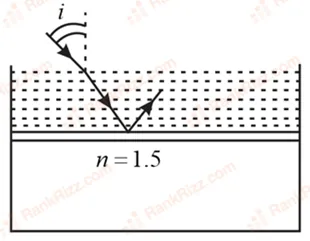
Consider a tank made of glass (refractive index 1.5) with a thick bottom. It is filled with a liquid of refractive index μ\mu. A student finds that, irrespective of what the incident angle ii (see figure) is for a beam of light entering the liquid, the light reflected from the liquid glass interface is never completely polarized. For this to happen, the minimum value of μ\mu is:

Figure for JEE Main 2019 Physics question on Polarisation: Malus's law and Brewster's law
  1. A

    35\frac{3}{\sqrt{5}}

  2. B

    43\frac{4}{3}

  3. C

    53\frac{5}{\sqrt{3}}

  4. D

    53\sqrt{\frac{5}{3}}

JEE MAIN 2018 · 08 APR OFFLINEPolarisation: Malus's law and Brewster's lawTRANSCRIBED

Unpolarized light of intensity I passes through an ideal polariser A. Another identical polariser B is placed behind A. The intensity of light beyond B is found to be I2\frac{I}{2}. Now another identical polariser C is placed between A and B. The intensity beyond B is now found to be I8\frac{I}{8}. The angle between polariser A and C is:

  1. A

    60∘^\circ

  2. B

    0∘^\circ

  3. C

    30∘^\circ

  4. D

    45∘^\circ

JEE MAIN 2018 · 15 APR S2Polarisation: Malus's law and Brewster's lawTRANSCRIBED

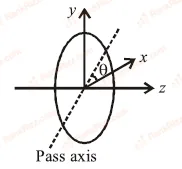
A plane polarized light is incident on a polariser with its pass axis making angle θ\theta with x-axis, as shown in the figure. At four different values of θ\theta, θ\theta = 8∘^\circ, 38∘^\circ, 188∘^\circ and 218∘^\circ, the observed intensities are same. What is the angle between the direction of polarization and x-axis?

Figure for JEE Main 2018 Physics question on Polarisation: Malus's law and Brewster's law
  1. A

    203∘^\circ

  2. B

    45∘^\circ

  3. C

    98∘^\circ

  4. D

    128∘^\circ

JEE MAIN 2018 · 16 APR ONLINEPolarisation: Malus's law and Brewster's lawTRANSCRIBED

Unpolarized light of intensity I is incident on a system of two polarizers, A followed by B. The intensity of emergent light is I2\frac{I}{2}. If a third polarizer C is placed between A and B, the intensity of emergent light is reduced to I3\frac{I}{3}. The angle between the polarizers A and C is θ\theta, then:

  1. A

    cos⁡θ=(23)14\cos\theta = \left(\frac{2}{3}\right)^{\frac{1}{4}}

  2. B

    cos⁡θ=(13)14\cos\theta = \left(\frac{1}{3}\right)^{\frac{1}{4}}

  3. C

    cos⁡θ=(13)12\cos\theta = \left(\frac{1}{3}\right)^{\frac{1}{2}}

  4. D

    cos⁡θ=(23)12\cos\theta = \left(\frac{2}{3}\right)^{\frac{1}{2}}

JEE MAIN 2018 · 08 APR OFFLINEPolarisation: Malus's law and Brewster's lawTRANSCRIBED

The angular width of the central maximum in a single slit diffraction pattern is 60∘^\circ. The width of the slit is 1 μ\mum. The slit is illuminated by monochromatic plane waves. If another slit of the same width is made near it, Young's fringes can be observed on a screen placed at a distance 50 cm from the slits. If the observed fringe width is 1 cm, what is slit separation distance? (i.e., the distance between the centres of each slit.)

  1. A

    100 μ\mum

  2. B

    25 μ\mum

  3. C

    50 μ\mum

  4. D

    75 μ\mum

JEE MAIN 2015 · 11 APR ONLINEPolarisation: Malus's law and Brewster's lawTRANSCRIBED

Unpolarized light of intensity I0I_0 is incident on surface of a block of glass at Brewster's angle. In that case, which one of the following statements is true?

  1. A

    transmitted light is partially polarized with intensity I02\frac{I_0}{2}

  2. B

    transmitted light is completely polarized with intensity less than I02\frac{I_0}{2}

  3. C

    reflected light is partially polarized with intensity I02\frac{I_0}{2}

  4. D

    reflected light is completely polarized with intensity less than I02\frac{I_0}{2}

JEE MAIN 2014 · 19 APR ONLINEPolarisation: Malus's law and Brewster's lawTRANSCRIBED

A ray of light is incident from a denser to a rarer medium. The critical angle for total internal reflection is θiC\theta_{iC} and Brewster's angle of incidence is θiB\theta_{iB}, such that sin⁡θiCsin⁡θiB=η=1.28\frac{\sin\theta_{iC}}{\sin\theta_{iB}} = \eta = 1.28. The relative refractive index of the two media is:

  1. A

    0.4

  2. B

    0.2

  3. C

    0.9

  4. D

    0.8

JEE MAIN 2014 · 06 APR OFFLINEPolarisation: Malus's law and Brewster's lawTRANSCRIBED

Two beams, A and B of plane polarized light with mutually perpendicular planes of polarization are seen through a polaroid. From the position when the beam A has maximum intensity (and beam B has zero intensity), a rotation of polaroid through 30° makes the two beams appear equally bright. If the initial intensities of the two beams are IAI_A and IBI_B respectively, then IAIB\frac{I_A}{I_B} equals:

  1. A

    3

  2. B

    32\frac{3}{2}

  3. C

    1

  4. D

    13\frac{1}{3}

JEE MAIN 2013 · 07 APR ONLINEPolarisation: Malus's law and Brewster's lawTRANSCRIBED

A beam of unpolarised light of intensity I0I_0 is passed through a polaroid A and then through another polaroid B which is oriented so that its principle plane makes an angle of 45° relative to that of A. The intensity of the emergent light is:

  1. A

    I04\frac{I_0}{4}

  2. B

    I08\frac{I_0}{8}

  3. C

    I0I_0

  4. D

    I02\frac{I_0}{2}

JEE MAIN 2013 · 09 APR ONLINEPolarisation: Malus's law and Brewster's lawTRANSCRIBED

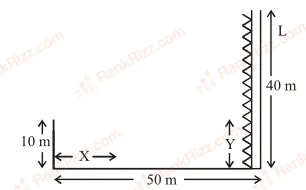
A person lives in a high-rise building on the bank of a river 50 m wide. Across the river is a well lit tower of height 40 m. When the person, who is at a height of 10 m, looks through a polarizer at an appropriate angle at light of the tower reflecting from the river surface, he notes that intensity of light coming from distance X from his building is the least and this corresponds to the light coming from light bulbs at height 'Y' on the tower. The values of X and Y are respectively close to (refractive index of water ∼43\sim \frac{4}{3})

Figure for JEE Main 2013 Physics question on Polarisation: Malus's law and Brewster's law
  1. A

    25 m, 10 m

  2. B

    13 m, 27 m

  3. C

    22 m, 13 m

  4. D

    17 m, 20 m

JEE MAIN 2012Polarisation: Malus's law and Brewster's lawTRANSCRIBED

Two polaroids have their polarizing directions parallel so that the intensity of a transmitted light is maximum. The angle through which either polaroid must be turned if the intensity is to drop by one-half is

  1. A

    135∘135^\circ

  2. B

    90∘90^\circ

  3. C

    120∘120^\circ

  4. D

    180∘180^\circ

JEE MAIN 2005Polarisation: Malus's law and Brewster's lawTRANSCRIBED

When an unpolarized light of intensity I0I_0 is incident on a polarizing sheet, the intensity of the light which does not get transmitted is

  1. A

    12I0\frac{1}{2} I_0

  2. B

    14I0\frac{1}{4} I_0

  3. C

    zero

  4. D

    I0I_0

JEE MAIN 2004Polarisation: Malus's law and Brewster's lawTRANSCRIBED

The angle of incidence at which reflected light totally polarized for reflection from air to glass (refractive index nn), is

  1. A

    sin⁡−1(n)\sin^{-1}(n)

  2. B

    sin⁡−1(1/n)\sin^{-1}(1/n)

  3. C

    tan⁡−1(1/n)\tan^{-1}(1/n)

  4. D

    tan⁡−1(n)\tan^{-1}(n)