JEE Main 2013 Physics question — Polarisation: Malus's law and Brewster's law
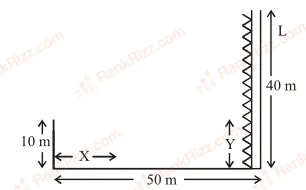
A person lives in a high-rise building on the bank of a river 50 m wide. Across the river is a well lit tower of height 40 m. When the person, who is at a height of 10 m, looks through a polarizer at an appropriate angle at light of the tower reflecting from the river surface, he notes that intensity of light coming from distance X from his building is the least and this corresponds to the light coming from light bulbs at height 'Y' on the tower. The values of X and Y are respectively close to (refractive index of water )
SOLUTION
The light intensity is least when it reflects from the water surface at the Brewster angle (), as the reflected light becomes completely polarized.
From Brewster's Law, the angle of incidence for which reflected light is perfectly polarized is
This implies that for the right-angled triangle formed by the light ray, the ratio of the opposite side (horizontal distance) to the adjacent side (vertical height) is .
The person is at a height . The light ray reflected from distance enters the person's eye at the angle with the normal.
The distance from the point of reflection to the tower is . For the ray coming from height on the tower to reflect at the same point with the same Brewster angle:
Tagged Polarisation: Malus's law and Brewster's law. Machine-assigned, so read it as a strong shortlist rather than a verdict.