RankRizz
JEE MAIN 2025 · 24 JAN S2+4 / −1MEDIUMTRANSCRIBED

JEE Main 2025 Physics question — Polarisation: Malus's law and Brewster's law

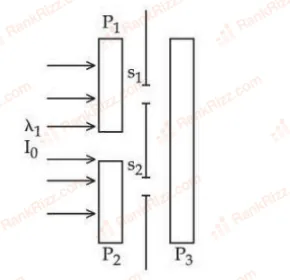
In a Young's double slit experiment, three polarizers are kept as shown in the figure. The transmission axes of  P1P_1  and  P2P_2 are orthogonal to each other. The polarizer  P3P_3  covers both the slits with its transmission axis at  45∘45^\circ  to those of  P1P_1  and  P2P_2. An unpolarized light of wavelength  λ\lambda and intensity  I0I_0  is incident on  P1P_1  and  P2P_2.The intensity at a point after  P3P_3  where the path difference between the light waves from s1s_1  and  s2s_2  is  λ3 is:\frac{\lambda}{3}\text{ is:}

page8_img1
SOLUTION

Intensity after passing orthogonal polarizers P1P_1 and P2P_2:

I1=I2=I02I_1 = I_2 = \frac{I_0}{2}

Beams from s1s_1 and s2s_2 passing through P3P_3 at 45∘45^\circ (using Malus's Law):

Is1=I1cos⁡2(45∘)  ⟹  Is1=I02×12=I04I_{s1} = I_1 \cos^2(45^\circ) \implies I_{s1} = \frac{I_0}{2} \times \frac{1}{2} = \frac{I_0}{4}

Is2=I2cos⁡2(45∘)  ⟹  Is2=I02×12=I04I_{s2} = I_2 \cos^2(45^\circ) \implies I_{s2} = \frac{I_0}{2} \times \frac{1}{2} = \frac{I_0}{4}

Since both beams pass through P3P_3, they have parallel transmission axes and can interfere.

Δx=λ3  ⟹  ϕ=2πλΔx=2π3\Delta x = \frac{\lambda}{3} \implies \phi = \frac{2\pi}{\lambda} \Delta x = \frac{2\pi}{3}

Resultant intensity:

Inet=Is1+Is2+2Is1Is2cos⁡ϕI_{\text{net}} = I_{s1} + I_{s2} + 2\sqrt{I_{s1}I_{s2}}\cos\phi

Inet=I04+I04+2(I04)cos⁡(2π3)  ⟹  Inet=I02+I02(−12)=I04I_{\text{net}} = \frac{I_0}{4} + \frac{I_0}{4} + 2\left(\frac{I_0}{4}\right)\cos\left(\frac{2\pi}{3}\right) \implies I_{\text{net}} = \frac{I_0}{2} + \frac{I_0}{2}\left(-\frac{1}{2}\right) = \frac{I_0}{4}

Tagged Polarisation: Malus's law and Brewster's law. Machine-assigned, so read it as a strong shortlist rather than a verdict.

SubjectPhysics
TopicPolarisation: Malus's law and Brewster's law
TypeMultiple choice