RankRizz
JEE MAIN 2021 · 27 JUL S1+4 / −1MEDIUMTRANSCRIBED

JEE Main 2021 Physics question — Vectors: addition, subtraction, resolution and unit vectors

Assertion AA : If A,B,C,DA, B, C, D are four points on a semi-circular arc with a centre at OO such that ∣AB→∣=∣BC→∣=∣CD→∣\left|\overrightarrow{AB}\right| = \left|\overrightarrow{BC}\right| = \left|\overrightarrow{CD}\right|. Then, AB→+AC→+AD→=4AO→+OB→+OC→\overrightarrow{AB} + \overrightarrow{AC} + \overrightarrow{AD} = 4\overrightarrow{AO} + \overrightarrow{OB} + \overrightarrow{OC}
Reason RR : Polygon law of vector addition yields AB→+BC→+CD→=AD→=2AO→\overrightarrow{AB} + \overrightarrow{BC} + \overrightarrow{CD} = \overrightarrow{AD} = 2\overrightarrow{AO}
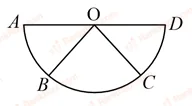
Figure for JEE Main 2021 Physics question on Vectors: addition, subtraction, resolution and unit vectors


In the light of the above statements, choose the most appropriate answer from the options given below.

SOLUTION

Analysis of the Assertion:

The assertion states that for four points A, B, C, DA,\ B, \ C, \ D on a semi-circular arc with center OO such that ∣AB⃗∣=∣BC⃗∣=∣CD⃗∣|\vec{AB}|=|\vec{BC}|=|\vec{CD}|:

AB⃗+AC⃗+AD⃗=4AO⃗+ OB⃗ + OC⃗\vec{AB}+\vec{AC}+\vec{AD} = 4\vec{AO} + \vec{OB} + \vec{OC}

We can rewrite the vectors on the left side in terms of the origin (center) OO:

  1. AB⃗= OB⃗− OA⃗\vec{AB} = \vec{OB} - \vec{OA}
  2. AC⃗= OC⃗− OA⃗\vec{AC} = \vec{OC} - \vec{OA}
  3. AD⃗= OD⃗− OA⃗\vec{AD} = \vec{OD} - \vec{OA}

Summing these gives,

AB⃗+AC⃗+AD⃗= (OB⃗+OC⃗+OD⃗)−3OA⃗\vec{AB}+\vec{AC}+\vec{AD} = (\vec{OB}+\vec{OC}+\vec{OD}) - 3\vec{OA}

We find that, since OA⃗\vec{OA} and OD⃗\vec{OD} are opposite radii originating from OO, OD⃗=−OA⃗=AO⃗\vec{OD} = -\vec{OA} = \vec{AO}, since OA⃗=−AO⃗\vec{OA} = -\vec{AO} (same length but opposite direction), we therefore get,

AB⃗+AC⃗+AD⃗=(OB⃗+OC⃗+AO⃗)+3AO⃗\vec{AB}+\vec{AC}+\vec{AD} = (\vec{OB}+\vec{OC}+\vec{AO}) + 3\vec{AO}

or,

AB⃗+AC⃗+AD⃗=4AO⃗+OB⃗+OC⃗\vec{AB}+\vec{AC}+\vec{AD} = 4\vec{AO} + \vec{OB} + \vec{OC}

Assertion A is true.

Analysis of the Reason:

By the polygon law of vector addition, AB⃗+BC⃗+CD⃗=AD⃗\vec{AB}+\vec{BC}+\vec{CD} = \vec{AD}, and we also see that AD⃗=2AO⃗\vec{AD} = 2\vec{AO}, since AD⃗\vec{AD} is the diameter, and AO⃗\vec{AO} is the radius.

Thus, the reason R is correct.

But the polygon law of vector addition has not been useful in examining the assertion A while we derived equality in assertion A. Thus, although both the assertion A and the reason R are correct, R is not the correct explanation of A.

Tagged Vectors: addition, subtraction, resolution and unit vectors. Machine-assigned, so read it as a strong shortlist rather than a verdict.

SubjectPhysics
TopicVectors: addition, subtraction, resolution and unit vectors
TypeMultiple choice