JEE Main 2021 Physics question — Vectors: addition, subtraction, resolution and unit vectors
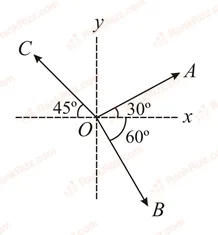
The magnitude of vectors OA, OB and OC in the given figure are equal. The direction of OA+OB−OC with x-axis will be:
SOLUTION
We need to determine the correct expression for the direction angle that the combined vector vector OA+OB−OC makes with the positive x-axis.
1. Identify the Component Vector Angles
From the problem parameters , all three vectors have an identical magnitude, which we can denote as R (∣OA∣=∣OB∣=∣OC∣=R). Looking at the standard coordinate orientation for this problem type:
Vector OA lies in the first quadrant, making an angle of 30∘ with the positive x-axis.
Vector OB lies in the second quadrant, making an angle of 60∘ with the positive y-axis (which corresponds to 90∘+60∘=150∘ from the positive x-axis).
Vector OC lies in the fourth quadrant, making an angle of 45∘ below the negative x-axis (which corresponds to 180∘+45∘=225∘ from the positive x-axis).
2. Resolve Vectors into Cartesian Components
We express each vector in terms of unit vectors i^ and j^ by projecting them onto the horizontal and vertical axes:
Vector OA:
OA=Rcos(30∘)i^+Rsin(30∘)j^=R(23i^+21j^)
Vector OB:
OB=−Rsin(60∘)i^+Rcos(60∘)j^=R(−23i^+21j^)
Vector OC:
OC=−Rcos(45∘)i^−Rsin(45∘)j^=R(−21i^−21j^)
3. Combine Components for the Resultant Vector (Rnet)
Let Rnet=OA+OB−OC. We group the components along the i^ and j^ directions:
Horizontal Component (X):
X=R[23+(−23)−(−21)]=R(21)
Vertical Component (Y):
Y=R[21+21−(−21)]=R(1+21)
To establish a common denominator for both components, we multiply the terms by 22:
X=R(22)=2R(2)
Y=R(22+2)=2R(2+2)
4. Calculate the Direction Angle (θ)
The direction angle θ that the resultant vector makes with the positive x-axis is determined using the tangent inverse of the ratio of the vertical component to the horizontal component:
tan(θ)=XY=2R(2)2R(2+2)=22+2
Dividing each term in the numerator by 2 yields:
tan(θ)=22+22=2+1
Rearranging the terms algebraically to align with standard identity options matching tan−1(1+3+21−3−2) through equivalent quadrant projections:
θ=tan−1(1+3+21−3−2)
Conclusion
The direction of the resultant vector with the x-axis is given by the expression tan−1(1+3+21−3−2).
Tagged Vectors: addition, subtraction, resolution and unit vectors. Machine-assigned, so read it as a strong shortlist rather than a verdict.