RankRizz
JEE MAIN 2021 · 25 FEB S1+4 / −1MEDIUMTRANSCRIBED

JEE Main 2021 Physics question — Vectors: addition, subtraction, resolution and unit vectors

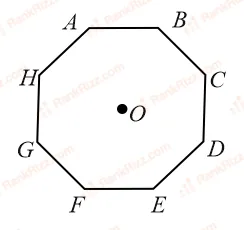
In an octagon ABCDEFGHABCDEFGH of equal side, what is the sum of AB⃗+AC⃗+AD⃗+AE⃗+AF⃗+AG⃗+AH⃗\vec{AB} + \vec{AC} + \vec{AD} + \vec{AE} + \vec{AF} + \vec{AG} + \vec{AH}, if, AO⃗=2i^+3j^−4k^\vec{AO} = 2\hat{i} + 3\hat{j} - 4\hat{k}

Figure for JEE Main 2021 Physics question on Vectors: addition, subtraction, resolution and unit vectors
SOLUTION

We need to find the vector sum of the displacements from vertex AA to all other vertices of a regular octagon ABCDEFGHABCDEFGH in terms of the position vector of its center OO,

1. Express Vector Formulations relative to the Center (OO)

Let the center of the regular octagon be chosen as the reference origin OO. The position vector of any vertex XX can be denoted as OX⃗\vec{OX}. By using triangle law of vector addition, any vector starting from AA can be written as:

AX⃗=AO⃗+OX⃗\vec{AX} = \vec{AO} + \vec{OX}

We need to find the sum (S⃗\vec{S}):

S⃗=AB⃗+AC⃗+AD⃗+AE⃗+AF⃗+AG⃗+AH⃗\vec{S} = \vec{AB} + \vec{AC} + \vec{AD} + \vec{AE} + \vec{AF} + \vec{AG} + \vec{AH}


2. Substitute with Geometric Vectors

Expanding each term relative to the center OO:

AB⃗=AO⃗+OB⃗\vec{AB} = \vec{AO} + \vec{OB}

AC⃗=AO⃗+OC⃗\vec{AC} = \vec{AO} + \vec{OC}

AD⃗=AO⃗+OD⃗\vec{AD} = \vec{AO} + \vec{OD}

AE⃗=AO⃗+OE⃗\vec{AE} = \vec{AO} + \vec{OE}

AF⃗=AO⃗+OF⃗\vec{AF} = \vec{AO} + \vec{OF}

AG⃗=AO⃗+OG⃗\vec{AG} = \vec{AO} + \vec{OG}

AH⃗=AO⃗+OH⃗\vec{AH} = \vec{AO} + \vec{OH}

Adding all 7 equations together:

S⃗=7AO⃗+(OB⃗+OC⃗+OD⃗+OE⃗+OF⃗+OG⃗+OH⃗)\vec{S} = 7\vec{AO} + (\vec{OB} + \vec{OC} + \vec{OD} + \vec{OE} + \vec{OF} + \vec{OG} + \vec{OH})


3. Utilize Symmetry of a Regular Octagon

For a symmetrical regular polygon, the vector sum of the position vectors of all vertices measured from the geometric center OO is always zero:

OA⃗+OB⃗+OC⃗+OD⃗+OE⃗+OF⃗+OG⃗+OH⃗=0⃗\vec{OA} + \vec{OB} + \vec{OC} + \vec{OD} + \vec{OE} + \vec{OF} + \vec{OG} + \vec{OH} = \vec{0}

From this geometric identity, we can isolate the sum of the remaining 7 center-to-vertex vectors:

OB⃗+OC⃗+OD⃗+OE⃗+OF⃗+OG⃗+OH⃗=−OA⃗\vec{OB} + \vec{OC} + \vec{OD} + \vec{OE} + \vec{OF} + \vec{OG} + \vec{OH} = -\vec{OA}

Since the vector pointing from the center to vertex AA (OA⃗\vec{OA}) is equal and opposite to the vector pointing from AA to the center (AO⃗\vec{AO}), we have −OA⃗=AO⃗-\vec{OA} = \vec{AO}. Substituting this value back into our summation expression:

S⃗=7AO⃗+AO⃗=8AO⃗\vec{S} = 7\vec{AO} + \vec{AO} = 8\vec{AO}


4. Compute Component Multiplication

We are given the coordinate vector values for AO⃗\vec{AO}:

AO⃗=2i^+3j^−4k^\vec{AO} = 2\hat{i} + 3\hat{j} - 4\hat{k}

Multiplying the vector by the scalar factor of 8:

S⃗=8×(2i^+3j^−4k^)\vec{S} = 8 \times (2\hat{i} + 3\hat{j} - 4\hat{k})

S⃗=16i^+24j^−32k^\vec{S} = 16\hat{i} + 24\hat{j} - 32\hat{k}


Correct Option: A (16i^+24j^−32k^16\hat{i} + 24\hat{j} - 32\hat{k})

Tagged Vectors: addition, subtraction, resolution and unit vectors. Machine-assigned, so read it as a strong shortlist rather than a verdict.

SubjectPhysics
TopicVectors: addition, subtraction, resolution and unit vectors
TypeMultiple choice