An object, moving with a speed of , is decelerated at a rate given by: $\frac{dv}{dt} = -2.5\sqrt{v}$ is the instantaneous speed. The time taken by the object, to come to rest, would be:
- A
- B
- C
- D
Every Motion in a Straight Line question JEE Main has set, grouped by the idea it tests rather than the order of the syllabus. 134 questions across 6 distinct ideas. Free to read, answer key on every one.
Questions
134
Distinct ideas
6
Share of marks
1.8%
Difficulty
EASY
A chapter is not one subject — it is a handful of procedures the examiner reuses. These are the ones Motion in a Straight Line questions actually test.
121–134 OF 134 · NEWEST FIRST
An object, moving with a speed of , is decelerated at a rate given by: $\frac{dv}{dt} = -2.5\sqrt{v}$ is the instantaneous speed. The time taken by the object, to come to rest, would be:
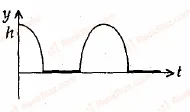
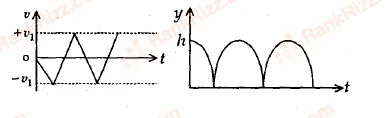
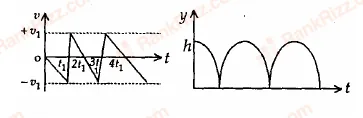
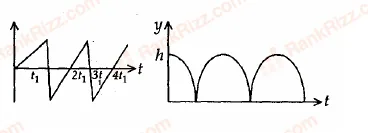
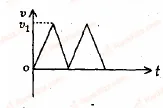
Consider a rubber ball freely falling from a height m onto a horizontal elastic plate. Assume that the duration of collision is negligible and the collision with the plate is totally elastic. Then the velocity as a function of time the height as function of time will be


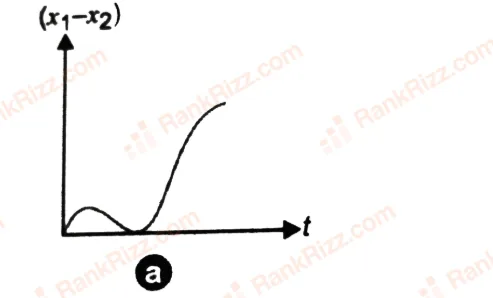
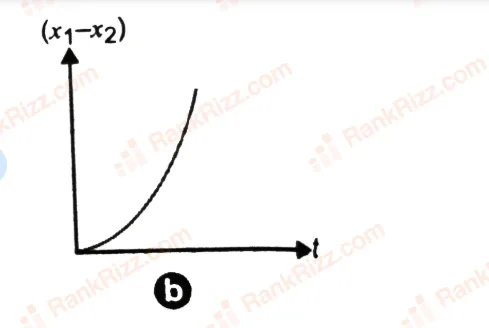
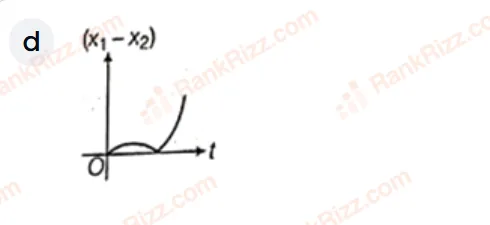
A body is at rest at . At , it starts moving in the positive -direction with a constant acceleration. At the same instant another body passes through moving in the positive direction with a constant speed. The position of the first body is given by after time '' and that of the second body by after the same time interval. Which of the following graphs correctly describes as a function of time ''?


The velocity of a particle is . If its position is at , then its displacement after unit time () is
A particle located at at time , starts moving along the positive -direction with a velocity '' that varies as . The displacement of the particle varies with time as
A body falling from rest under gravity passes a certain point . It was at a distance of from , prior to passing through . If , then the height above the point from where the body began to fall is
720 m
900 m
320 m
680 m
The relation between time and distance is where and are constants. The acceleration is
A car starting from rest accelerates at the rate through a distance , then continues at constant speed for time and then decelerates at the rate to come to rest. If the total distance traversed is , then
None of these
A parachutist after bailing out falls m without friction. When parachute opens, it decelerates at m/s. He reaches the ground with a speed of m/s. At what height, did he bail out?
m
m
m
m
Two points and move from rest along a straight line with constant acceleration and respectively. If takes sec. more than and describes '' units more than in acquiring the same speed then
A lizard, at an initial distance of cm behind an insect, moves from rest with an acceleration of cm/s and pursues the insect which is crawling uniformly along a straight line at a speed of cm/s. Then the lizard will catch the insect after
s
s
s
s
A ball is released from the top of a tower of height metres. It takes seconds to reach the ground. What is the position of the ball in seconds?
metres from the ground
An automobile travelling with speed of km/h, can brake to stop within a distance of m. If the car is going twice as fast, i.e km/h, the stopping distance will be
m
m
m
m
A particle moves towards east from a point to a point at the rate of km/h and then towards north from to at the rate of km/h. If km and km, then its average speed for its journey from to and resultant average velocity direct from to are respectively
km/h and km/h
km/h and km/h
km/h and km/h
km/h and km/h
OTHER PHYSICS CHAPTERS