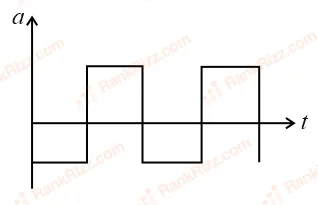
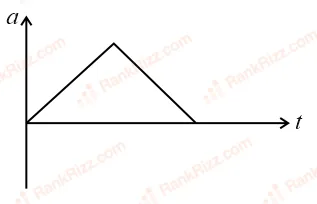
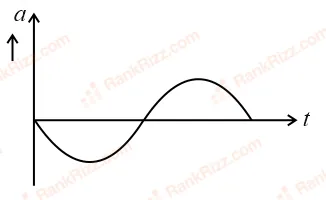
A juggler throws balls vertically upwards with same initial velocity in air. When the first ball reaches its highest position, he throws the next ball. Assuming the juggler throws balls per second, the maximum height the balls can reach is
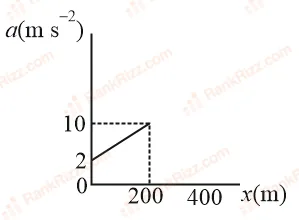
- A
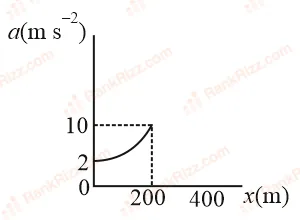
- B
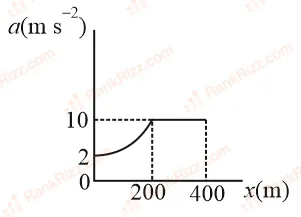
- C
- D
Every Motion in a Straight Line question JEE Main has set, grouped by the idea it tests rather than the order of the syllabus. 134 questions across 6 distinct ideas. Free to read, answer key on every one.
Questions
134
Distinct ideas
6
Share of marks
1.8%
Difficulty
EASY
A chapter is not one subject — it is a handful of procedures the examiner reuses. These are the ones Motion in a Straight Line questions actually test.
61–80 OF 134 · NEWEST FIRST
A juggler throws balls vertically upwards with same initial velocity in air. When the first ball reaches its highest position, he throws the next ball. Assuming the juggler throws balls per second, the maximum height the balls can reach is
Two balls and are placed at the top of 180 m tall tower. Ball is released from the top at s. Ball is thrown vertically down with an initial velocity at s. After a certain time, both balls meet 100 m above the ground. Find the value of in m s. [use m s]
10
15
20
30
If , then is:
4
Zero
8
16
A ball is released from a height . If and be the time required to complete first half and second half of the distance respectively. Then, choose the correct relation between and .
When a ball is dropped into a lake from a height m above the water level, it hits the water with a velocity and then sinks to the bottom with the constant velocity . It reaches the bottom of the lake s after it is dropped. The approximate depth of the lake is
m
m
m
m
From the top of a tower, a ball is thrown vertically upward which reaches the ground in s. A second ball thrown vertically downward from the same position with the same speed reaches the ground in s. A third ball released, from the rest from the same location, will reach the ground in ______ s.
A ball of mass kg is dropped from the height of m. The height, at which the magnitude of velocity becomes equal to the magnitude of acceleration due to gravity, is ______ m. [Use m s]
A ball is projected vertically upward with an initial velocity of m s at s. At s, another ball is projected vertically upward with same velocity. At ______ s, second ball will meet the first ball.
m s
A car covers distance with first one-third at velocity m s, second one-third at m s and last one-third at m s. If , and m s, then the average velocity of the car is ______ m s.

A car is moving with speed of and after applying the brake it will move before it stops. If the same car is moving with a speed of one third the reported speed then it will stop after travelling ______ m distance.
A particle is moving in a straight line such that its velocity is increasing at per meter. The acceleration of the particle is ______ at a point where its velocity is .
A ball is thrown vertically upwards with a velocity of 19.6 m s from the top of a tower. The ball strikes the ground after 6 s. The height from the ground up to which the ball can rise will be m. The value of is _____ (use )
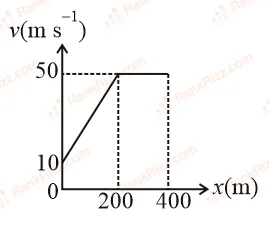
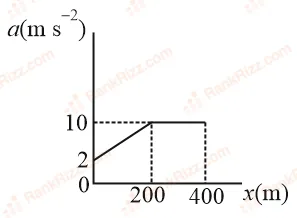
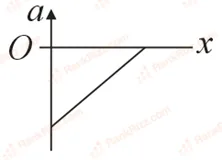
The velocity-displacement graph describing the motion of a bicycle is shown in the figure.
The acceleration-displacement graph of the bicycle's motion is best described by:


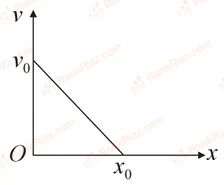
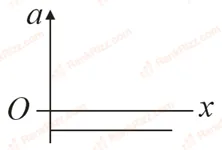
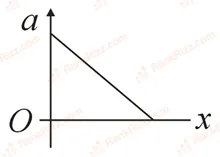
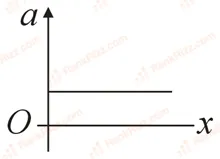
The velocity-displacement graph of a particle is shown in the figure.
The acceleration-displacement graph of the same particle is represented by :


A car accelerates from rest at a constant rate for some time after which it decelerates at a constant rate to come to rest. If the total time elapsed is seconds, the total distance travelled is:
The velocity of a particle is m s. Its position is at ; then its displacement after time ( s) is:
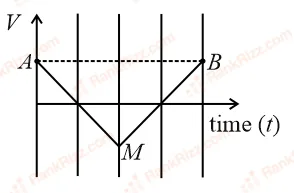
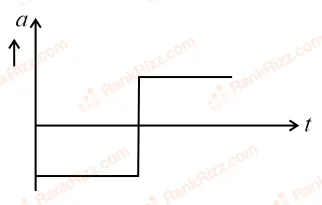
If the velocity-time graph has the shape AMB, what would be the shape of the corresponding acceleration-time graph?


A ball is thrown up with a certain velocity so that it reaches a height . Find the ratio of the two different times of the ball reaching in both the directions.
A stone is dropped from the top of a building. When it crosses a point 5 m below the top, another stone starts to fall from a point 25 m below the top. Both stones reach the bottom of building simultaneously. The height of the building is:
25 m
45 m
35 m
50 m
Water droplets are coming from an open tap at a particular rate. The spacing between a droplet observed at 4 second after its fall to the next droplet is 34.3 m. At what rate the droplets are coming from the tap? (Take m s)
3 drops/2 seconds
2 drops/second
1 drop/second
1 drop/7 seconds
OTHER PHYSICS CHAPTERS