JEE MAIN 2021 · 25 JUL S2Non-uniform acceleration using calculusTRANSCRIBED
The relation between time and distance for a moving body is given as , where and are constants. The retardation of the motion is: (When stands for velocity)
- A
- B
- C
- D
Every Motion in a Straight Line question JEE Main has set, grouped by the idea it tests rather than the order of the syllabus. 134 questions across 6 distinct ideas. Free to read, answer key on every one.
Questions
134
Distinct ideas
6
Share of marks
1.8%
Difficulty
EASY
A chapter is not one subject — it is a handful of procedures the examiner reuses. These are the ones Motion in a Straight Line questions actually test.
81–100 OF 134 · NEWEST FIRST
The relation between time and distance for a moving body is given as , where and are constants. The retardation of the motion is: (When stands for velocity)
Water drops are falling from a nozzle of a shower onto the floor from a height of 9.8 m. The drops fall at a regular interval of time. When the first drop strikes the floor, at that instant, the third drop begins to fall. Locate the position of second drop from the floor when the first drop strikes the floor.
2.94 m
4.18 m
2.45 m
7.35 m
An engine of a train, moving with uniform acceleration, passes the signal-post with velocity and the last compartment with velocity . The velocity with which middle point of the train passes the signal post is:
A rubber ball is released from a height of 5 m above the floor. It bounces back repeatedly, always rising to of the height through which it falls. Find the average speed of the ball. (Take m s)
3.0 m s
3.5 m s
2.0 m s
2.50 m s
A scooter accelerates from rest for time at constant rate and then retards at constant rate for time and comes to rest. The correct value of will be:
A balloon was moving upwards with a uniform velocity of 10 m s. An object of finite mass is dropped from the balloon when it was at a height of 75 m from the ground level. The height of the balloon from the ground when object strikes the ground was around: (takes the value of g as 10 m s)
300 m
200 m
125 m
250 m
A boy reaches the airport and finds that the escalator is not working. He walks up the stationary escalator in time . If he remains stationary on a moving escalator then the escalator takes him up in time . The time taken by him to walk up on the moving escalator will be:
The instantaneous velocity of a particle moving in a straight line is given as , where and are constants. The distance travelled by the particle between 1 s and 2 s is:
If the velocity of a body related to displacement is given by m s, then the acceleration of the body is _________ m s.
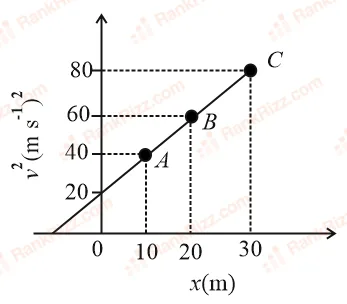
A particle is moving with constant acceleration . Following graph shows versus (displacement) plot. The acceleration of the particle is _________ m s.
Two spherical balls having equal masses with radius of 5 cm each are thrown upwards along the same vertical direction at an interval of 3 s with the same initial velocity of 35 m s, then these balls collide at a height of _________ m.
(take g = 10 m s)
The velocity and time graph of a body in a straight line motion is shown in the figure. The point is at seconds. The total distance covered by the body in s is:
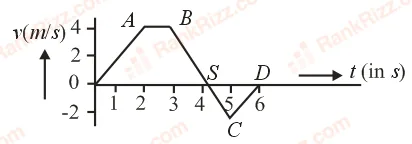
m
12 m
11 m
m
Train A and train B are running on parallel tracks in the opposite directions with speed of 36 km hour and 72 km hour, respectively. A person is walking in train A in the direction opposite to its motion with a speed of 1.8 km hour. Speed (in m s) of this person as observed from train B will be close to: (take the distance between the tracks as negligible)
29.5 m s
28.5 m s
31.5 m s
30.5 m s
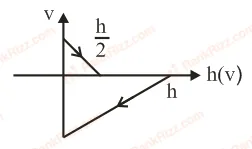
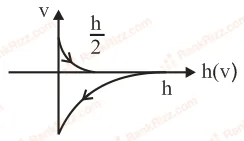
A tennis ball is released from a height h and after freely falling on a wooden floor it rebounds and reaches height h/2. The velocity versus height of the ball during its motion may be represented graphically by: (graphs are drawn schematically and on not to scale)
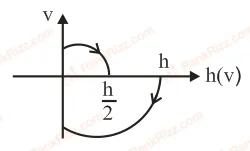
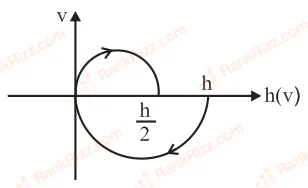
A helicopter rises from rest on the ground vertically upwards with a constant acceleration . A food packet is dropped from the helicopter when it is at a height . The time taken by the packet to reach the ground is close to [ is the acceleration due to gravity]:
The distance covered by a particle in one dimensional motion varies with time as . If the acceleration of the particle depends on as , where is an integer, the value of is ___________.
The speed versus time graph for a particle is shown in the figure. The distance travelled (in m) by the particle during the time interval t = 0 to t = 5 s will be __________
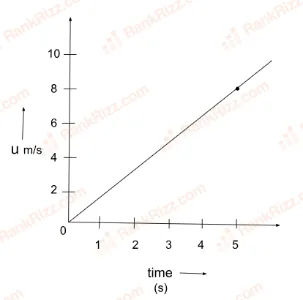
A ball is dropped from the top of a 100 m high tower on a planet. In the last s before hitting the ground, it covers a distance of 19 m. Acceleration due to gravity (in m s) near the surface on that planet is
A particle moves from the point m, at , with an initial velocity ms. It is acted upon by a constant force which produces a constant acceleration ms. What is the distance of the particle from the origin at time 2 s?
15 m
m
5 m
m
A particle is moving with speed along positive x-axis. Calculate the speed of the particle at time (assume that the particle is at origin at t = 0)
OTHER PHYSICS CHAPTERS