RankRizzStart free

Motion in a Straight Line — JEE Main Previous Year Questions

Every Motion in a Straight Line question JEE Main has set, grouped by the idea it tests rather than the order of the syllabus. 134 questions across 6 distinct ideas. Free to read, answer key on every one.

Questions

134

Distinct ideas

6

Share of marks

1.8%

Difficulty

EASY

The ideas inside Motion in a Straight Line

A chapter is not one subject — it is a handful of procedures the examiner reuses. These are the ones Motion in a Straight Line questions actually test.

01Distance, displacement, speed, velocity and acceleration (average vs instantaneous)set 19×
02Equations of motion for uniform accelerationset 25×
03Vertical motion under gravityset 30×
04Non-uniform acceleration using calculusset 17×
05Motion graphs: x-t, v-t and a-tset 30×
06Relative motion in one dimensionset 13×

Every Motion in a Straight Line question

101–120 OF 134 · NEWEST FIRST

JEE MAIN 2019 · 12 JAN S1Relative motion in one dimensionTRANSCRIBED

A passenger train of length 60 m travels at a speed of 80 km/hr. Another freight train of length 120 m travels at a speed of 30 km/hr. The ratio of times taken by the passenger train to completely cross the freight train when: (i) they are moving in the same direction, and (ii) in the opposite directions is:

  1. A

  2. B

  3. C

  4. D

JEE MAIN 2019 · 09 APR S2Non-uniform acceleration using calculusTRANSCRIBED

The position of a particle as a function of time t, is given by where a, b and c are constants. When the particles zero acceleration, then its velocity will be:

  1. A

  2. B

  3. C

  4. D

JEE MAIN 2019 · 09 JAN S2Equations of motion for uniform accelerationTRANSCRIBED

In a car race on straight road, car A takes a time less than car at the finish and passes finishing point with a speed more than that of car . Both the cars start from rest and travel with constant acceleration and respectively. Then is equal to:

  1. A

  2. B

  3. C

  4. D

JEE MAIN 2019 · 09 APR S2Distance, displacement, speed, velocity and acceleration (average vs instantaneous)TRANSCRIBED

The position vector of a particle changes with time according to the relation . What is the magnitude of the acceleration at ?

  1. A

    40

  2. B

    25

  3. C

    100

  4. D

    50

JEE MAIN 2019 · 08 APR S2Motion graphs: x-t, v-t and a-tTRANSCRIBED

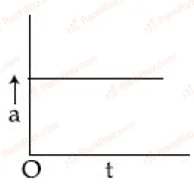
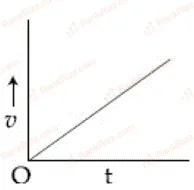
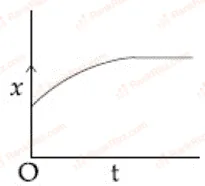
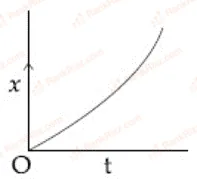
A particle starts from origin O from rest and moves with a uniform acceleration along the positive -axis. Identify all figures that correctly represent the motion qualitatively. (a = acceleration, v = velocity, x = displacement, t = time)

  1. A

    A, B, D

  2. B

    A, B, C

  3. C

    B, C

  4. D

    A

JEE MAIN 2019 · 10 JAN S2Motion graphs: x-t, v-t and a-tTRANSCRIBED

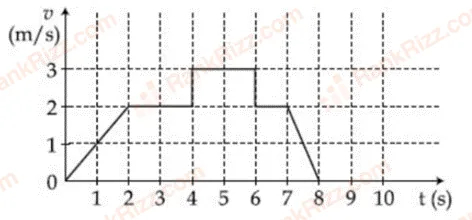
A particle starts from the origin at time and moves along the positive -axis. The graph of velocity with respect to time is shown in figure. What is the position of the particle at time ?

  1. A

    10 m

  2. B

    9 m

  3. C

    6 m

  4. D

    3 m

JEE MAIN 2018 · 08 APR OFFLINEEquations of motion for uniform accelerationTRANSCRIBED

All the graphs below are intended to represent the same motion. One of them does it incorrectly. Pick it up.

  1. A
  2. B
  3. C
  4. D
JEE MAIN 2018 · 15 APR S1Equations of motion for uniform accelerationTRANSCRIBED

An automobile, travelling at 40 km/h, can be stopped at a distance of 40 m by applying brakes. If the same automobile is travelling at 80 km/h, the minimum stopping distance, in metres, is (assume no skidding):

  1. A

    75 m

  2. B

    160 m

  3. C

    100 m

  4. D

    150 m

JEE MAIN 2018 · 15 APR S1Motion graphs: x-t, v-t and a-tTRANSCRIBED

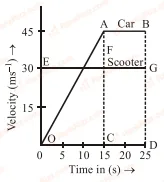
The velocity-time graphs of a car and a scooter are shown in the figure. (i) the difference between the distance travelled by the car and the scooter in 15 s and (ii) the time at which the car will catch up with the scooter are, respectively.

  1. A

    337.5 m and 25 s

  2. B

    225.5 m and 10 s

  3. C

    112.5 m and 22.5 s

  4. D

    112.5 m and 15 s

JEE MAIN 2017 · 02 APR OFFLINEMotion graphs: x-t, v-t and a-tTRANSCRIBED

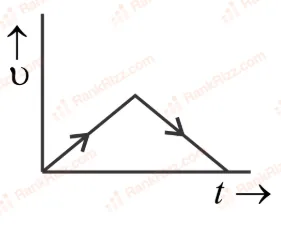
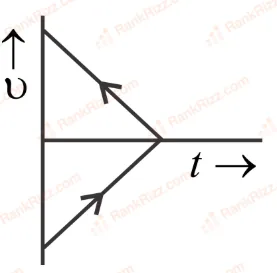
A body is thrown vertically upwards. Which one of the following graphs correctly represents the velocity vs time ?

  1. A
    image
  2. B
    image
  3. C
    image
  4. D
    image
JEE MAIN 2017 · 08 APR ONLINEMotion graphs: x-t, v-t and a-tTRANSCRIBED

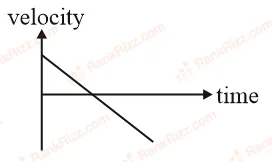
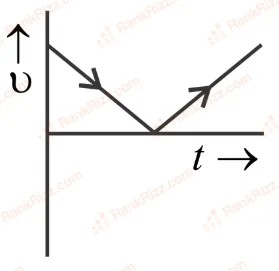
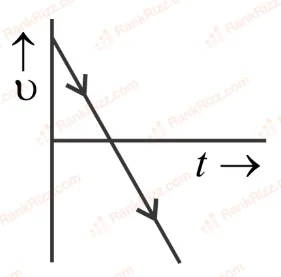
Which graph corresponds to an object moving with a constant negative acceleration and a positive velocity?

  1. A
    image
  2. B
    image
  3. C
    image
  4. D
    image
JEE MAIN 2017 · 09 APR ONLINERelative motion in one dimensionTRANSCRIBED

A car is standing 200 m behind a bus, which is also at rest. The two start moving at the same instant but with different forward accelerations. The bus has acceleration 2 m s and the car has acceleration 4 m s. The car will catch up with the bus after time:

  1. A

    s

  2. B

    15 s

  3. C

    s

  4. D

    s

JEE MAIN 2015 · 04 APR OFFLINERelative motion in one dimensionTRANSCRIBED

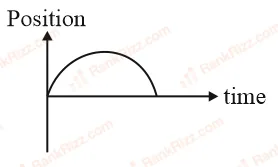
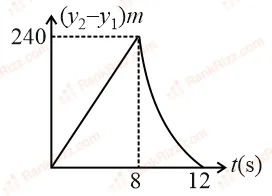
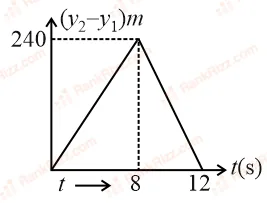
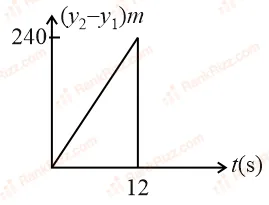
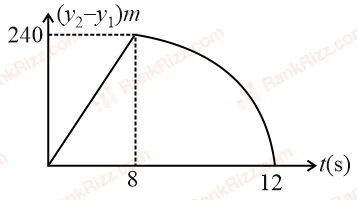
Two stones are thrown up simultaneously from the edge of a cliff 240 m high with an initial speed of 10 m s and 40 m s respectively. Which of the following graph best represents the time variation of the relative position of the second stone with respect to the first? (Assume stones do not rebound after hitting the ground and neglect air resistance, take ms)(the figures are schematic and not drawn to scale)

  1. A
  2. B
  3. C
  4. D
JEE MAIN 2015 · 11 APR ONLINEEquations of motion for uniform accelerationTRANSCRIBED

From the top of a 64 metres high tower, a stone is thrown upwards vertically with the velocity of 48 m/s. The greatest height (in metres) attained by the stone, assuming the value of the gravitational acceleration m/s, is:

  1. A

    112

  2. B

    88

  3. C

    128

  4. D

    100

JEE MAIN 2014 · 06 APR OFFLINEVertical motion under gravityTRANSCRIBED

From a tower of height H, a particle is thrown vertically upwards with a speed u. The time taken by the particle, to hit the ground, is n times that taken by it to reach the highest point of its path. The relation between H, u and n is:

  1. A

  2. B

  3. C

  4. D

JEE MAIN 2014 · 12 APR ONLINERelative motion in one dimensionTRANSCRIBED

A person climbs up a stalled escalator in 60 s. If standing on the same but escalator running with constant velocity he takes 40 s. How much time is taken by the person to walk up the moving escalator?

  1. A

    37 s

  2. B

    27 s

  3. C

    24 s

  4. D

    45 s

JEE MAIN 2012Motion graphs: x-t, v-t and a-tTRANSCRIBED

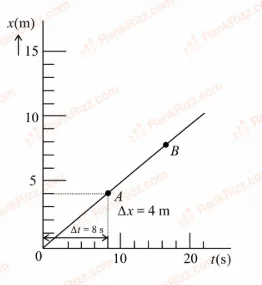
The graph of an object's motion (along the -axis) is shown in the figure. The instantaneous velocity of the object at points and are and respectively. Then

image
  1. A

  2. B

    v_A = 0.5\ \text{m/s} < v_B

  3. C

    v_A = 0.5\ \text{m/s} > v_B

  4. D

JEE MAIN 2012Motion graphs: x-t, v-t and a-tTRANSCRIBED

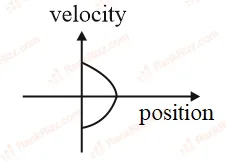
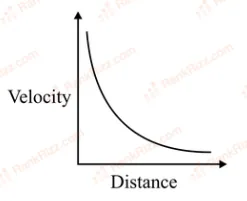
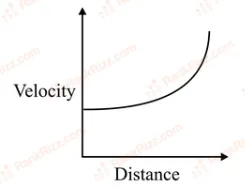
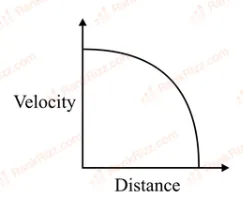
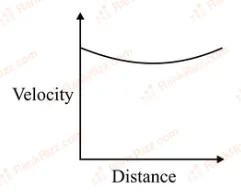
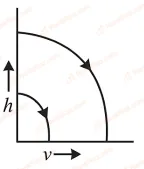
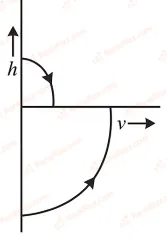
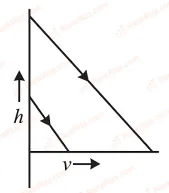
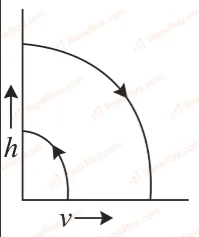
A ball is dropped vertically downwards from a height above the ground. It hits the ground inelastically and bounces up vertically. Neglecting subsequent motion and air resistance, which of the following graph represents variation between speed () and height () correctly?

  1. A
    image
  2. B
    image
  3. C
    image
  4. D
    image
JEE MAIN 2012Equations of motion for uniform accelerationTRANSCRIBED

A goods train accelerating uniformly on a straight railway track, approaches an electric pole standing on the side of track. Its engine passes the pole with velocity and the guard's room passes with velocity . The middle wagon of the train passes the pole with a velocity.

  1. A

  2. B

  3. C

  4. D

JEE MAIN 2012Motion graphs: x-t, v-t and a-tTRANSCRIBED

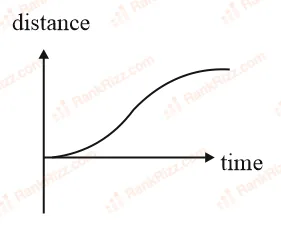
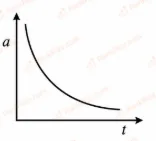
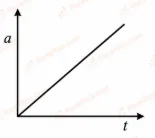
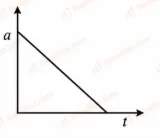
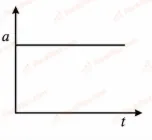
The distance travelled by a body moving along a line in time is proportional to . The acceleration-time graph for the motion of the body will be

  1. A
    image
  2. B
    image
  3. C
    image
  4. D
    image