RankRizz
JEE MAIN 2019 · 08 APR S2+4 / −1MEDIUMTRANSCRIBED

JEE Main 2019 Physics question — Rolling with friction, slipping and impulsive forces

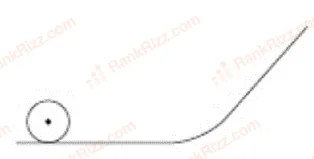
A solid sphere and solid cylinder of identical radii approach an incline with the same linear velocity (see figure). Both roll without slipping all throughout. The two climb maximum heights hsphh_{sph} and hcylh_{cyl} on the incline. The ratio hsphhcyl\frac{h_{sph}}{h_{cyl}} is given by:

Figure for JEE Main 2019 Physics question on Rolling with friction, slipping and impulsive forces
SOLUTION

We begin by recalling a basic energy principle: when a body rolls without slipping, its total mechanical energy is the sum of its translational kinetic energy, its rotational kinetic energy, and its gravitational potential energy. On the horizontal surface (before climbing the incline) the potential energy is taken to be zero, so the total energy consists only of the two kinetic terms. As the body climbs the incline, it slows down, and at the highest point its speed becomes zero. At that instant the whole initial kinetic energy has converted into gravitational potential energy mghmgh.

Let the common mass of the bodies be mm, the common radius be rr and the common initial linear speed be vv. The acceleration due to gravity is denoted by gg. We now treat the two bodies separately.

For the solid sphere, we first state the moment of inertia formula for a solid sphere of radius rr about its centre:

Isph=25mr2.I_{sph}=\frac{2}{5}mr^{2}.

Because the sphere rolls without slipping, the condition v=ωrv=\omega r holds, where ω\omega is the angular speed. Therefore ω=vr\omega=\dfrac{v}{r}.

The total kinetic energy of the sphere just before climbing is:

Ksph=translational KE+rotational KE=12mv2+12Isphω2.\begin{aligned} K_{sph} &= \text{translational KE} + \text{rotational KE} \\ &= \frac{1}{2}mv^{2} + \frac{1}{2}I_{sph}\omega^{2}. \end{aligned}

Substituting Isph=25mr2I_{sph}=\dfrac{2}{5}mr^{2} and ω=vr\omega=\dfrac{v}{r}, we obtain

Ksph=12mv2+12(25mr2)(vr)2=12mv2+12(25m)v2=12mv2+15mv2=(510+210)mv2=710mv2.\begin{aligned} K_{sph} &= \frac{1}{2}mv^{2} + \frac{1}{2}\left(\frac{2}{5}mr^{2}\right)\left(\frac{v}{r}\right)^{2} \\ &= \frac{1}{2}mv^{2} + \frac{1}{2}\left(\frac{2}{5}m\right)v^{2} \\ &= \frac{1}{2}mv^{2} + \frac{1}{5}mv^{2} \\ &= \left(\frac{5}{10} + \frac{2}{10}\right)mv^{2} \\ &= \frac{7}{10}mv^{2}. \end{aligned}

At the maximum height hsphh_{sph} the velocity is zero, hence energy conservation gives

mghsph=710mv2    ⟹    hsph=710v2g.mgh_{sph} = \frac{7}{10}mv^{2} \;\;\Longrightarrow\;\; h_{sph} = \frac{7}{10}\frac{v^{2}}{g}.

For the solid cylinder, we now state its moment of inertia formula about its central axis:

Icyl=12mr2.I_{cyl}=\frac{1}{2}mr^{2}.

Using the same rolling condition ω=vr\omega=\dfrac{v}{r}, the cylinder’s kinetic energy is

Kcyl=12mv2+12Icylω2=12mv2+12(12mr2)(vr)2=12mv2+12(12m)v2=12mv2+14mv2=(24+14)mv2=34mv2.\begin{aligned} K_{cyl} &= \frac{1}{2}mv^{2} + \frac{1}{2}I_{cyl}\omega^{2} \\ &= \frac{1}{2}mv^{2} + \frac{1}{2}\left(\frac{1}{2}mr^{2}\right)\left(\frac{v}{r}\right)^{2} \\ &= \frac{1}{2}mv^{2} + \frac{1}{2}\left(\frac{1}{2}m\right)v^{2} \\ &= \frac{1}{2}mv^{2} + \frac{1}{4}mv^{2} \\ &= \left(\frac{2}{4} + \frac{1}{4}\right)mv^{2} \\ &= \frac{3}{4}mv^{2}. \end{aligned}

Converting this kinetic energy into gravitational potential energy at the maximum height hcylh_{cyl} gives

mghcyl=34mv2    ⟹    hcyl=34v2g.mgh_{cyl} = \frac{3}{4}mv^{2} \;\;\Longrightarrow\;\; h_{cyl} = \frac{3}{4}\frac{v^{2}}{g}.

We are asked for the ratio hsphhcyl\dfrac{h_{sph}}{h_{cyl}}. Substituting the two heights we derived, we have

hsphhcyl=710v2g34v2g=710×43=2830=1415.\begin{aligned} \frac{h_{sph}}{h_{cyl}} &= \frac{\dfrac{7}{10}\dfrac{v^{2}}{g}}{\dfrac{3}{4}\dfrac{v^{2}}{g}} \\ &= \frac{7}{10}\times\frac{4}{3} \\ &= \frac{28}{30} \\ &= \frac{14}{15}. \end{aligned}

The numerical value 1415\dfrac{14}{15} matches Option C.

Hence, the correct answer is Option C.

Tagged Rolling with friction, slipping and impulsive forces. Machine-assigned, so read it as a strong shortlist rather than a verdict.

SubjectPhysics
TopicRolling with friction, slipping and impulsive forces
TypeMultiple choice