A uniform thin bar of mass 6 kg and length 2.4 meter is bent to make an equilateral hexagon. The moment of inertia about an axis passing through the centre of mass and perpendicular to the plane of hexagon is ______ kg m.
Every JEE Main question on Moment of inertia of standard bodies and composite systems, one of the ideas inside Rotational Motion: 73 questions from 2004–2026, 31 of them in the last five years. Newest first, answer key on every one. Free to read.
Questions
73
Years asked
15
Since
2004
Of the chapter
26%
41–60 OF 73 · NEWEST FIRST
A uniform thin bar of mass 6 kg and length 2.4 meter is bent to make an equilateral hexagon. The moment of inertia about an axis passing through the centre of mass and perpendicular to the plane of hexagon is ______ kg m.
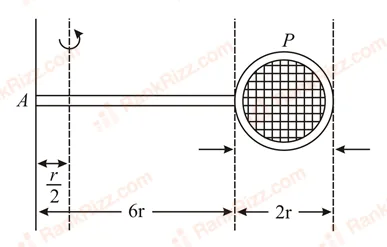
Consider a badminton racket with length scales as shown in the figure.
If the mass of the linear and circular portions of the badminton racket are same (M) and the mass of the threads are negligible, the moment of inertia of the racket about an axis perpendicular to the handle and in the plane of the ring at, distance from the end A of the handle will be _________ .
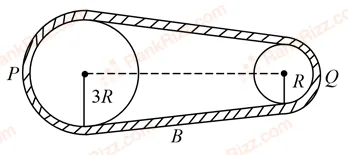
In the given figure, two wheels and are connected by a belt . The radius of is three times that of . In the case of the same rotational kinetic energy, the ratio of rotational inertias will be . The value of will be _________.

Moment of inertia of a cylinder of mass , length and radius about an axis passing through its centre and perpendicular to the axis of the cylinder is . If such a cylinder is to be made for a given mass of a material, the ratio for it to have minimum possible is:
The radius of gyration of a uniform rod of length , about an axis passing through a point away from the centre of the rod, and perpendicular to it, is:
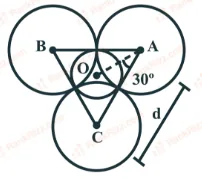
Three solid spheres each of mass and diameter are stuck together such that the lines connecting the centres form an equilateral triangle of side of length . The ratio of moment of inertia of the system about an axis passing the centroid and about center of any of the spheres and perpendicular to the plane of the triangle is:

Mass per unit area of a circular disc of radius a depends on the distance r from its centre as . The moment of inertia of the disc about the axis, perpendicular to the plane and passing through its centre is:
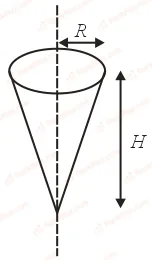
Shown in the figure is a hollow ice-cream cone (it is open at top). If its mass is M, radius of its top is R and height, H, then its moment of inertia about its axis is:

The linear mass density of a thin rod AB of length L varies from A to B as , where is the distance from A. If M is the mass of the rod then its moment of inertia about an axis passing through A and perpendicular to the rod is:
Consider two uniform discs of the same thickness and different radii and made of the same material. If the ratio of their moments of inertia and , respectively, about their axes is then the value of is:
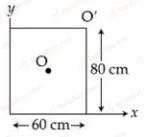
For a uniform rectangular sheet shown in the figure, the ratio of moments of inertia about the axes perpendicular to the sheet and passing through O (the centre of mass) and O' (corner point) is:

2/3
1/4
1/8
1/2
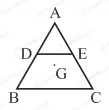
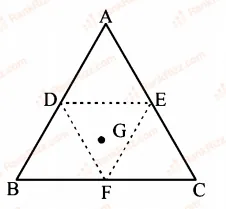
ABC is a plane lamina of the shape of an equilateral triangle. D, E are mid-points of AB, AC and G is the centroid of the lamina. Moment of inertia of the lamina about an axis passing through G and perpendicular to the plane ABC is . If part ADE is removed, the moment of inertia of the remaining part about the same axis is where N is an integer. Value of N is:

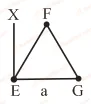
An massless equilateral triangle EFG of side 'a' (As shown in figure) has three particles of mass m situated at its vertices. The moment of inertia of the system about the line EX perpendicular to EG in the plane of EFG is where N is an integer. The value of N is __________.

A thin disc of mass M and radius R has mass per unit area where r is the distance from its centre. Its moment of inertia about an axis going through its centre of mass and perpendicular to its plane is:
A solid sphere of mass M and radius R is divided into two unequal parts. The first part has a mass of and is converted into uniform disc of radius 2R. The second part is converted into a uniform solid sphere. Let I be the moment of inertia of the disc about its axis and I be the moment of inertia of the new sphere about its axis. The ratio I/I is given by:
140
185
65
285
Let the moment of inertia of a hollow cylinder of length 30 cm (inner radius 10 cm and outer radius 20 cm), about its axis be I. The radius of a thin cylinder of the same mass such that its moment of inertia about its axis is also I, is:
16 cm
14 cm
12 cm
18 cm
A thin circular plate of mass and radius has its density varying as with as constant and is the distance from its centre. The moment of Inertia of the circular plate about an axis perpendicular to the plate and passing through its edge is . The value of the coefficient is:
An equilateral triangle ABC is cut from a thin solid sheet of wood. (See figure) D, E and F are the mid-points of its sides as shown and G is the centre of the triangle. The moment of inertia of the triangle about an axis passing through G and perpendicular to the plane of the triangle is . If the smaller triangle DEF is removed from ABC, the moment of inertia of the remaining figure about the same axis is . Then

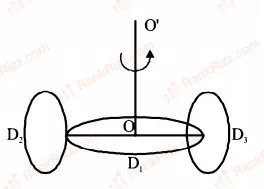
A circular disc of mass M and radius R has two identical discs and of the same mass M and radius R attached rigidly at its opposite ends (see figure). The moment of inertia of the system about the axis OO', passing through the centre of , as shown in the figure, will be

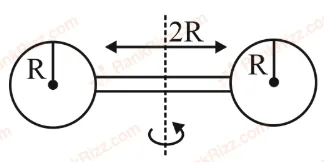
Two identical spherical balls of mass and radius each are stuck on two ends of a rod of length and mass (see figure). The moment of inertia of the system about the axis passing perpendicularly through the centre of the rod is:

RELATED ROTATIONAL MOTION TOPICS