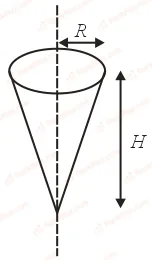
By geometry of the cone:
r R = H − y H ⟹ r = R H ( H − y ) \frac{r}{R} = \frac{H-y}{H} \implies r = \frac{R}{H}(H-y) R r = H H − y ⟹ r = H R ( H − y )
d l = d y 2 + d r 2 = d y 1 + ( d r d y ) 2 = d y 1 + R 2 H 2 = L H d y (where L = R 2 + H 2 ) dl = \sqrt{dy^2 + dr^2} = dy\sqrt{1 + \left(\frac{dr}{dy}\right)^2} = dy\sqrt{1 + \frac{R^2}{H^2}} = \frac{L}{H}dy \quad \text{(where } L = \sqrt{R^2+H^2}\text{)} d l = d y 2 + d r 2 = d y 1 + ( d y d r ) 2 = d y 1 + H 2 R 2 = H L d y (where L = R 2 + H 2 )
Mass element d m dm d m
d m = M π R L ⋅ ( 2 π r ⋅ d l ) = 2 M R L ⋅ r ⋅ ( L H d y ) = 2 M R H r d y dm = \frac{M}{\pi R L} \cdot (2\pi r \cdot dl) = \frac{2M}{RL} \cdot r \cdot \left(\frac{L}{H}dy\right) = \frac{2M}{RH} r dy d m = π R L M ⋅ ( 2 π r ⋅ d l ) = R L 2 M ⋅ r ⋅ ( H L d y ) = R H 2 M r d y
Using d y = − H R d r dy = -\frac{H}{R}dr d y = − R H d r y = H − H R r y = H - \frac{H}{R}r y = H − R H r
d m = 2 M R H r ( − H R d r ) = − 2 M R 2 r d r dm = \frac{2M}{RH} r \left(-\frac{H}{R}dr\right) = -\frac{2M}{R^2} r dr d m = R H 2 M r ( − R H d r ) = − R 2 2 M r d r
Integrating from the base vertex (r = 0 r=0 r = 0 r = R r=R r = R
I = ∫ r 2 d m ⟹ I = ∫ 0 R r 2 ( 2 M R 2 r d r ) I = \int r^2 dm \implies I = \int_{0}^{R} r^2 \left(\frac{2M}{R^2} r dr\right) I = ∫ r 2 d m ⟹ I = ∫ 0 R r 2 ( R 2 2 M r d r )
I = 2 M R 2 ∫ 0 R r 3 d r = 2 M R 2 [ r 4 4 ] 0 R = 2 M R 2 ⋅ R 4 4 = M R 2 2 I = \frac{2M}{R^2} \int_{0}^{R} r^3 dr = \frac{2M}{R^2} \left[ \frac{r^4}{4} \right]_{0}^{R} = \frac{2M}{R^2} \cdot \frac{R^4}{4} = \frac{MR^2}{2} I = R 2 2 M ∫ 0 R r 3 d r = R 2 2 M [ 4 r 4 ] 0 R = R 2 2 M ⋅ 4 R 4 = 2 M R 2