JEE Main 2019 Physics question — Moment of inertia of standard bodies and composite systems
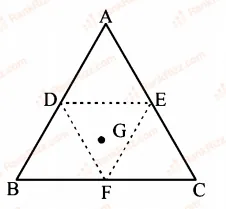
An equilateral triangle ABC is cut from a thin solid sheet of wood. (See figure) D, E and F are the mid-points of its sides as shown and G is the centre of the triangle. The moment of inertia of the triangle about an axis passing through G and perpendicular to the plane of the triangle is . If the smaller triangle DEF is removed from ABC, the moment of inertia of the remaining figure about the same axis is . Then
SOLUTION
Let the side length of the original equilateral triangle be denoted by and let its mass (proportional to its area, because the sheet has uniform density and uniform thickness) be .
For any planar body the moment of inertia about an axis perpendicular to the plane and passing through its centre of mass can always be written in the form
where is a numerical constant which depends only on the shape. For an equilateral triangle this “characteristic length’’ is its side , so we may write
for the complete triangle (given in the problem as ).
Now join the mid-points of the three sides; these mid-points are labelled in the figure. Because each of is the midpoint of a side, the triangle is similar to and its linear dimensions are exactly one-half of those of . Hence
The triangle is cut from the same sheet, so its mass is proportional to its area. For similar figures
Area therefore
Because is similar to , it has the same constant in the formula for the moment of inertia. Using (2) and (3) in the general form , we get
But from (1) we have , so (4) immediately gives
The centroid (centre of mass) of coincides with the centroid of (for any triangle, the centroid of the medial triangle is the same point), so the required axis passes through the centres of both triangles. Therefore the moment of inertia of the residual lamina (shaded region) is simply the difference
Substituting the value from (5), we obtain
Hence, the correct answer is Option A.
Tagged Moment of inertia of standard bodies and composite systems. Machine-assigned, so read it as a strong shortlist rather than a verdict.